
focus | good practice
AI at the service of pastoral life
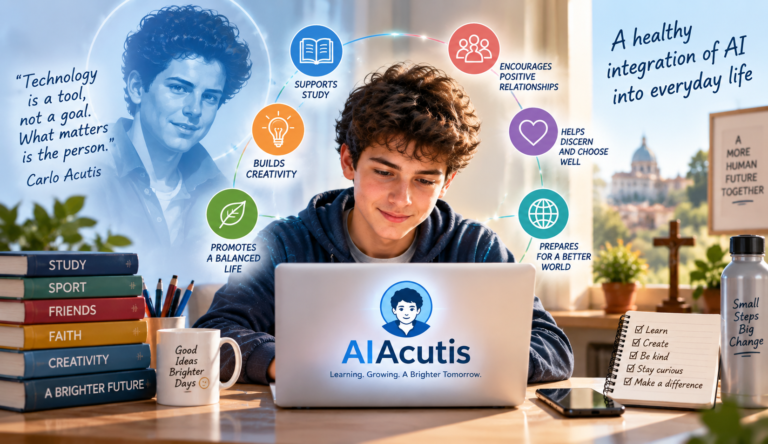
Fr. Davide Imeneo, a journalist and parish priest, is regarded as one of the leading Church experts in the educational and pastoral use of AI. He is the founder of AcutisAI, an educational Artificial Intelligence platform that helps young people integrate the world of AI in a healthy way with their studies and everyday life.
Alongside his various communications projects, he has guided his parish in becoming one of the first Church institutions in Italy to achieve net-zero energy impact. It is an example of how the Catholic Church, including through clergy support funds and the 8×1000 tax allocation system, can provide practical support to civil society.
In this interview, he tells us about some of his projects and initiatives.
Fr. Davide, you began your academic journey with a degree in Communication Sciences and a thesis entitled How Artificial Intelligence Supports Journalistic Work from an SEO Perspective.¹ Where did your interest in Artificial Intelligence come from?
It came from my work as a journalist. Running a newspaper today means inhabiting a complex communications ecosystem: print, web, social media, newsletters, podcasts, and messaging channels. In this context, I realized that AI is a tool that can greatly assist editorial work, provided that it remains at the service of the human person and does not replace them. My first concern was to understand how Artificial Intelligence could help online journalism become more readable, more accessible, and easier for readers to find through search engines. SEO, when used well, is in fact a way of helping a news story connect more effectively with the person searching for it. Naturally, the journalist remains central. AI can suggest subheadings, keywords, summaries, and structures, but it cannot replace the discernment involved in determining an editorial position, the responsibility of choosing which stories to cover, source verification, or the human sensitivity required to tell a story. For me, the point is this: we must not simply submit to technology. We must understand it, govern it, and direct it toward the common good.
We were intrigued that your second degree was in Italian Language and Literature, with a thesis entitled How Generative Artificial Intelligence Is Changing Our Language. Could you briefly explain the thinking behind this thesis?
I chose this topic because generative Artificial Intelligence is, above all, a technology of language: it writes, responds, translates, summarizes, imitates styles, and organizes thoughts. This means that it enters a deeply human space, because language is where we construct relationships, culture, memory, and identity. The central question of my thesis was this: if more and more texts are being written, corrected, or mediated by AI, what happens to our way of speaking, thinking, and reasoning? There is enormous potential, because these tools can help many people communicate better, reach more people, overcome barriers or difficulties, and organize ideas. But there is also a risk: language may become more standardized, less personal, and less imbued with the authorship of the person who writes. As a priest and a journalist, this concerns me deeply because words can heal or wound, illuminate or confuse. For this reason, I believe the challenge posed by AI is cultural and educational. We must learn to use it without losing our own voice, our own style, our critical faculties, and above all our responsibility toward the truth.
You created a platform that places AI at the service of education and evangelization: AcutisAI. How did the project begin, and what does it involve? Could you also tell us something about other projects that are particularly important to you?
AcutisAI grew out of a simple insight: we cannot limit ourselves to telling young people that Artificial Intelligence exists. Nor can we stop at simple digital literacy—we have already seen with social media that this is not enough. We need to accompany young people so that they understand AI, use it well, and direct it toward something good. The project has its roots in the “Aula G” school workshop of Avvenire di Calabria, where we work with middle-school students on journalism, social media, communications, and the digital world. From there came the idea of putting the steering wheel of these Artificial Intelligence tools into the hands of young people themselves. AcutisAI is an educational platform that promotes a virtuous use of Artificial Intelligence. Together with young people, we design and develop GPT applications that are then made freely available to the digital community. Some are designed for journalistic work, others for social communication, while others can be useful for schools, parishes, and associations. The basic idea is to help people understand that technology can become a form of service. The reference to Carlo Acutis comes from the conviction that St. Carlo showed us that the digital world can be inhabited with faith, youthful enthusiasm, intelligence, and creativity. For me, AcutisAI is a laboratory of “digital virtues,” where technical competence, ethics, community, collaboration, and the Gospel come together. All of this comes from one conviction: communication today is a pastoral environment. We need to create relationships, listen, accompany people, and build trust.
How do you think AI can become an effective tool for pastoral ministry, including for people who do not have the same level of expertise that you do?
I believe Artificial Intelligence can be useful in pastoral ministry if we free ourselves from two opposite misunderstandings: absolute fear on the one hand, and naive enthusiasm on the other. AI is neither an enemy to be demonized nor a magical solution. It is a tool, and like every tool, much depends on the intention, competence, and discernment with which it is used. For a parish, a diocesan pastoral office, an association, or a diocese, AI can be useful in many ways. It can prepare draft press releases, organize calendars, simplify texts, translate content, organize ideas, create handouts for meetings, assist with social media communication, and make complex material more accessible. Obviously, it does not replace pastoral relationships, but it can simplify certain processes and allow people to devote more time to listening and personal encounter.
For those who are not familiar with AI, the first step is not to become a computer expert, but to learn how to ask good questions. AI works well when the person using it is clear about the objective, the intended audience, the tone, and the context. In this sense, it can be accessible to everyone, including those who are starting from scratch. Naturally, formation is necessary. It is not enough simply to say, “Use AI,” nor is subscribing to ChatGPT sufficient. People need to be taught to verify its answers, not to give it sensitive data, not to confuse automated generation with authoritative judgment, and always to retain human responsibility. The Church has a great opportunity: to help communities experience the digital world as a space to be inhabited with Gospel wisdom.
And now a more personal question: how did you experience the call to become a priest?
For me, vocation was a journey that began within my family, in prayer, in encounters with the Christian community—especially the parish community—in listening to the Word, and also through people who witnessed to a faith expressed in sincere actions, a joyful faith capable of giving itself for others without expecting anything in return. At a certain point, I felt that the Lord was asking me not to keep my life for myself. As I experienced it, the priestly vocation was the discovery that personal happiness can be found through self-giving. It is not always a linear path. There are questions, fears, and resistance, but above all there is a deep peace that helps you recognize the road you are meant to follow.
Today I also live my priesthood through ministry in diocesan communications. For me, proclaiming the Gospel means meeting people where they are: in parishes, schools, and streets, but also in the digital world, in newspapers, on social media, and through contemporary forms of communication—in the place they spend most time looking at: the screen of their smartphone.
The vocation remains the same: to serve God and his people. The tools change, but the heart remains the same.
Interview conducted by Maria do Sameiro Freitas
________________________________________
¹ SEO, or Search Engine Optimization, is the set of practices that enables a website to appear among the top results in search engines.

PDF version
Humans in a digital revolution
April to June 2026
No 31 – 2026/2