

focus | synodal path
Recommendations of the Final Report of Study Group 3
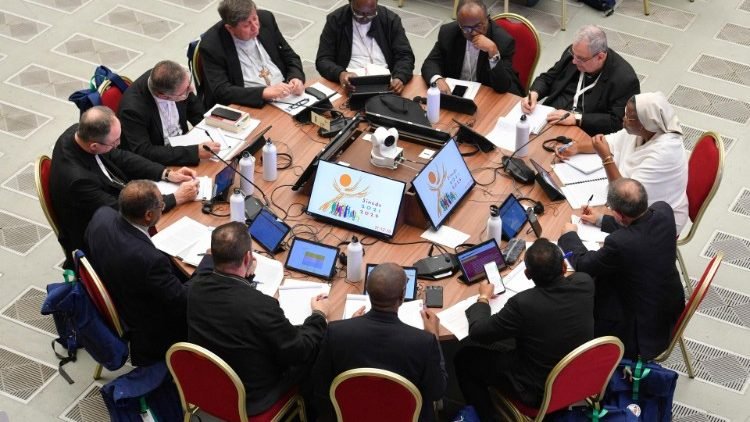
Inhabiting the digital culture for a synodal and missionary Church means walking with people where they live today: listening, announcing, creating relationships and communities. In the final report on the mission in the digital environment, prepared by Study Group 3 of the synodal process and published last March, some indications for the next steps between the opportunities and risks linked to a real change of era.
The Church in the face of a new missionary frontier
“Digital culture constitutes a crucial dimension of the Church’s witness in contemporary culture, as well as an emerging missionary field,” says the Final Document of the Synod on Synodality, a fundamental moment of recognition for the Church of the challenge represented by digital technology (n. 149).
At the end of the first Synodal Assembly of Bishops in the Vatican, Study Group 3 was entrusted with the task of identifying the ways in which “the digital mission of the Church can be faithfully carried out”, sharing its research with communities and people from all over the world.
For many of those who made contributions, the central point is that the digital mission is not simply a strategy but means walking with people where they live today. “The digital kingdom is the place in which the next generation is already immersed; it is their natural living environment,” they write. Others note that the digital environment is clearly already a space for spiritual encounter: these online platforms are not simple tools for sharing information, but spaces in which liturgies are transmitted, prayers are shared and faith-based communities are formed. It is therefore not an opportunity that awaits us, but a reality that is already present. And the whole community is challenged by this new chapter of the Church’s missionary history because, as we read in the Group’s Final Report, “all of us, as baptized persons, are called to bring the Good News to the people we meet in this environment”.
The five themes to reflect on
There are five points of reflection that frame the “recommendations” contained in the text, which urge an awareness of the opportunities but also of the risks linked to the digital environment. They are addressed to the Holy See itself, to the Episcopal Conferences, to the dioceses.
The first point emphasizes that “the digital environment is not simply a set of tools to be mastered; it is a culture. Understanding it implies understanding how we relate to one another, how we form communities and, ultimately, how we share the Gospel in a world increasingly mediated by the digital.”
The second points out that digital engagement can “be a way of living the social mission of the Church and a new dimension of the preferential option for the poor”, because “it makes it possible to listen, accompany and give voice to those whose voice is not heard”. While not replacing face-to-face meetings, “digital spaces can thus become places of authentic human connection, not just of exchange of information.”
The third point draws attention to the fact that the missionary spirit, wherever it is exercised, must be the same and that just as throughout history missionaries have learned the language and customs of the peoples to whom they were sent, “maintaining the integrity of the Gospel”, so “all the baptized are called to understand this new culture while remaining rooted in the truth of our Catholic faith”.
The fourth highlights the link between digital engagement, exercised in its best form, and elements of synodality such as listening, participation and co-responsibility. It makes it possible to reach people “different in origin, geographical area and perspective, in particular those often marginalized in traditional ecclesial contexts”, becoming an expression of “that unity in diversity which is the distinctive sign of the Body of Christ”.
However, the digital environment also presents great risks that must be recognized and addressed. The fifth point points out the power of algorithms that favor isolation by limiting the comparison with different points of view; the economic models that exploit our presence on the platforms; the dynamics that favor polarization and violence. “For this reason,” the Report reads, “in the digital age we are called to promote face-to-face and digital interactions that respect human dignity.” Particular attention should be paid to young people, helping them to “root themselves in real relationships or in the life of the Church”, as Pope Leo XIV emphasized when speaking to the members of the International Consultative Organization for Youth.
A path in the making
The digital mission also requires spiritual and pastoral formation for the prevention of abuse, digital safety and well-being, which together with media literacy, “should become an integral part of Catholic education” and the formation of priests. In the Church, at various levels, there is also a need for continuous reflection on the formation and commitment of digital missionaries. Among the proposals for the next steps is that of “promoting national and international networks of those involved in the digital mission to strengthen coordination, ecclesial communion and the exchange of good practices”. And that of: “Encourage digital platforms as spaces for synodal dialogue, consultation and ecumenical and interreligious collaboration around shared values.”
Finally, the text recognizes that “the common mission in the digital environment is a path in the making” and that “the Church is learning along the way the challenges, opportunities and languages that this emerging culture presents”. It concludes with a clear statement: “the mission in the digital environment is part of the process of pastoral, missionary and synodal conversion to which the Holy Spirit calls the Church today”.

PDF version
Humans in a digital revolution
April to June 2026
No 31 – 2026/2