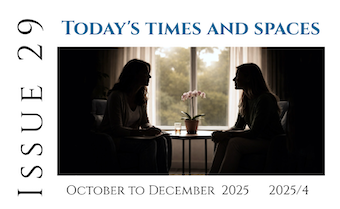
Today’s Times and Spaces

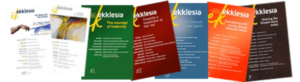
Ekklesia
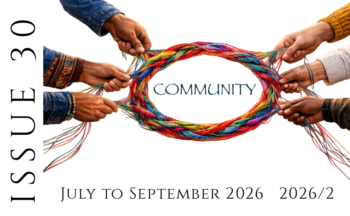
October to December 2025

Issue 29 – 4/2025

In this issue of Ekklesía we examine some of the ways in which the Church is responding to the social, religious and spiritual challenges which were recognised by the recent Synod.

In a world where the notion of space and time have changed and society is becoming increasingly secularized, Church communities are called to create a sense of “home”, be it in a particular physical location or in the digital sphere, and to meet the needs of a diverse and mobile population.

Creating family

Editorial: Creating family

The Vatican Synod calls the Church to a “relational conversion,” becoming a home of welcome, inclusion, and living encounters. 

Hubertus Blaumeiser

Klaus Hemmerle reflects on the Church as a network of living cells, where Christ is present in unity, communion, and shared human experience.

A network of living cells

A vision of the Church of tomorrow as a network of living communities, centred on Christ among believers, where communion, shared burdens, and the experience of God shape a renewed ecclesial life.

Mgr Klaus Hemmerle

The Final Document of the Synod on Synodality calls the Church to renew parish life, embrace mobility and digital culture, and become a welcoming home of communion and mission.

Rooted and Pilgrims

The Synod reflects on a changing world where mobility and digital culture reshape belonging, calling the Church to become a welcoming home of relationships, renewing parish life and fostering communion through creative and mission-oriented pastoral care.

from the Final Document

Christian Hennecke calls the Church to become a living “well” where people encounter Christ, rediscover faith, and grow in communion and mission.

Drinking from the well

The Church in today’s world. The author reflects on a Church in a mobile world, called to move beyond structures and become living “wells” where people encounter Christ, rediscover faith, and grow in communion through mission, accompaniment, and the Spirit’s work.

Christian Hennecke

Where do you live? Jean-Pierre Rosa reflects on Jesus’ dwelling as both movement and communion, revealing a non-territorial Church rooted in encounter, where God’s presence is found in relationships, love, and shared life within humanity.

“Where do you live?”

Jean-Pierre Rosa reflects on Jesus’ dwelling as both movement and communion, revealing a non-territorial Church rooted in encounter, where God’s presence is found in relationships, love, and shared life within humanity.

Jean-Pierre Rosa

Today’s places of mission

The author explores how the Synod envisions the Church as a home of inclusion, where mission unfolds in every human space—from peripheries to digital worlds—calling all the faithful to shared responsibility in bringing the Gospel to today’s world.

Andrew Giménez Recepción

The Church in Belgium is undergoing profound transformation, reshaping parish life through collaboration, lay participation, and missionary renewal, seeking to accompany people more closely in their lives and witness to faith within a changing, secularised society.

Parish networks and the role of the laity

The Catholic Church in Belgium is undergoing profound transformation, reshaping parish life through collaboration, lay participation, and missionary renewal, seeking to accompany people more closely in their lives and witness to faith within a changing, secularised society.

Maria Chiara Biagoni

Jens-Martin Kruse explores how urban churches can renew mission, welcome seekers, and offer living encounters with the Gospel in secular society.

Casting the nets again

The author reflects on the Church in secularised cities, calling for renewed missionary creativity, hospitality, and a “restlessness for the Gospel” so that urban churches become places of encounter, welcome, and living faith.

Jens-Martin Kruse

Pathways to
communion
and dialogue

Ekklesía is a print and digital initiative available in various languages. It conveys and promotes the complementarity of the Church’s charismatic and ministerial dimensions in the light of the teachings of the Second Vatican Ecumenical Council.

Guided by the principle of universal brotherhood, readers are invited to journey and work together along paths of communion and dialogue. In this way, Ekklesía hopes to contribute to building a synodal reality in which all members of God’s people are valued in the common search for new ways to proclaim the Gospel of Jesus to men and women of our time. 

Ekklesía’s articles focus on Church and societal renewal; relationships among different Churches and religions; encounters between diverse peoples and cultures; and dialogue with persons of differing convictions or of no particular religious belief.

Each quarterly issue focuses on a particular and relevant theme.

RELEASE DATE
First published in December 2018, Ekklesía reflects the merger of two former publications, “Charisms in Unity” (1990) and “Gen’s” magazine of ecclesial life (1971).

READERSHIP
People working in all types of pastoral ministry; members of religious congregations and ecclesial communities; persons involved in parish and diocesan activities; leaders and members of movements or associations; those serving on the peripheries or in dialogue initiatives; anyone interested in the journey of the Church in today’s multi-religious, multicultural society.

EDITORIAL BOARD
Hubertus Blaumeiser (editor), Carlos García Andrade, Renzo Beghini, Patrizia Bertoncello, Enrique Cambón, Maria do Sameiro Freitas, Oreste Paliotti.
Secretary: Michele Gatta.

ENGLISH LANGUAGE VERSION
Editors: Susan Kopp and Vincent Lockhart
www.ekklesiaonline.org
Contact: admin@ekklesiaonline.org