

witness | Cardinal Van Thuan
The evangelizing resilience of Venerable Văn Thuân
THE FRANÇOIS-XAVIER NGUYỄN VĂN THUẬN CONFERENCE
The Lateran Apostolic Palace | 25 March 2026
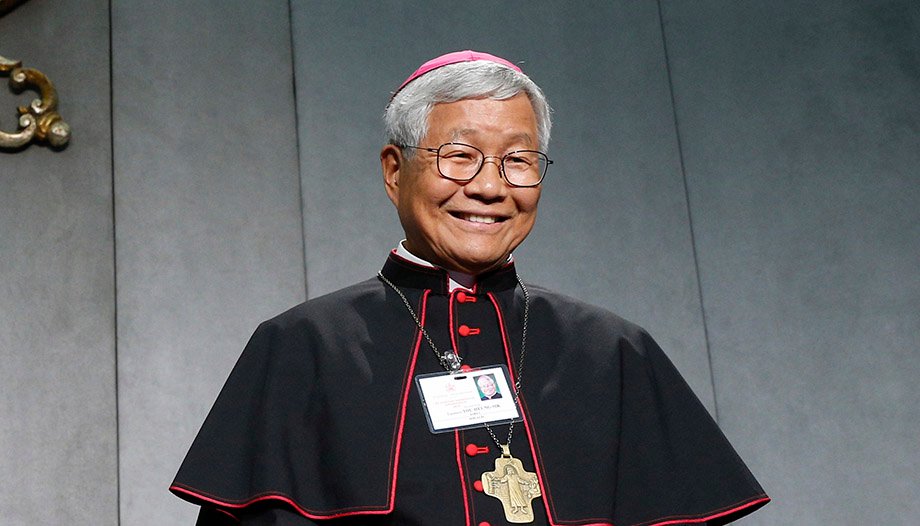
Cardinal You, Prefect of the Dicastery for the Clergy, offers a reflection rich in insights that help us understand more deeply the spirit that animated the Vietnamese cardinal. Central to this is his long and harsh imprisonment, which became an opportunity to choose—and choose again—God, and to test himself radically in the school of the Gospel. The testimonies of those who knew him reveal the hidden and fruitful gestures through which he brought the Kingdom of God into the personal and shared drama of imprisonment, seeking to imitate Jesus Christ, the perfect model of every priest.
When the Church remembers Cardinal François-Xavier Nguyên Văn Thuân, it does not simply remember a great witness of recent history; it contemplates a true model of Christian and priestly life.
His life was marked by extremely severe trials, but it was precisely in those trials that the greatness of his faith was revealed. When he lost everything, he made a new and profound choice of the Lord: God, and not the works of God. This is a fundamental choice for every priest.
He overcame every difficulty because he clung to the Word of God and kept his gaze fixed on Jesus crucified and forsaken. Each day he drew strength from Jesus in the Eucharist when, in prison, he secretly celebrated Mass with three drops of wine and one drop of water in the palm of his hand.
I had the grace of knowing him personally. I remember a man of great gentleness, serenity, and inner freedom. He loved priests deeply. He had the heart of both a father and a brother toward them. For him, priesthood was not simply a ministry, but a vocation to be lived in communion and fraternity.
I remember his eagerness to make the Gospel known to as many people as possible. He knew how to evangelize in every circumstance, with seriousness and depth, but also with skill, a touch of humor, and a love of paradox that won people’s hearts and created a free and informal relationship with them.
For example, this is how he introduced himself at a CELAM meeting when he was President of the Pontifical Council for Justice and Peace, whose offices were in the Trastevere district of Rome:
“I am a non-practicing Christian from the Parish of Santa Maria in Trastevere […]. And I am a foreigner and a former prisoner who spent 13 years in prison […]. Years in which I experienced divine mercy in my human frailty. Years in which I was severely punished, above all psychologically, for my fidelity to my episcopal ministry and to the Apostolic See.”
To the guards who were curious about his life and faith, he spoke of the “defects” of Jesus: his limitless and uncalculating love and mercy. Moved by his humanity and authenticity, they became his friends. Their relationship developed to the point that, with their help, he was able to make the pectoral cross of wood and electrical wire that he wore until the end of his life. One of the guards, who years later was baptized, recalled: “Meeting Bishop Thuân was the most important encounter of my life. He set me on the path to becoming a citizen of the Kingdom of Heaven, a citizen of justice and peace.”
Today I would especially like to share the testimony of one of his Buddhist fellow prisoners, the Venerable Nguyên Thanh Giau, who now lives in California and leads the Hoa Hao Buddhist organization.
He recounts:
“I met Bishop Thuân in 1976, when we were chained together on the ship taking us north to the reeducation camps. As we boarded the ship, we had to pass through many checkpoints, and each time the guards took something from our personal belongings. Everyone was crying in anger and despair, but Bishop Thuân told us: ‘We will be stripped of almost everything, but there is one thing no one can take away from us: our faith in God, in the goodness of our Creator.’”
When we were packed into the ship’s hold and almost all of us were suffering badly from seasickness, Bishop Thuân shared with us all the medicine his family had given him, keeping nothing back for himself. […]
In the [reeducation] camp, we were subjected to forced labor.
We asked him to take care of the kitchen and the cleaning because we could see that he was very ill. Among other things, the portable toilet containers had to be emptied every day. We did not want him to do this dirty work, but he insisted:
“It is an honor for me to share in the life of all of us.”
It was winter, two degrees below zero, and we did not have enough blankets. So Bishop Thuân would go out several times a day to gather branches and pieces of wood to heat the camp at night.
One day, the basket he was carrying on his head was so heavy that he fell backward. Fortunately, someone was there to help him, and he returned to the camp exhausted and out of breath.
Every day he encouraged everyone and held out the prospect of a better future.
Professor Giau concluded:
“I was with him for only a few months, but I can testify that he was what we Buddhists call a ‘Bo tac,’ that is, a very holy man. If I had been with him longer, I could have learned many other things from him. […] I hope to see the day when Bishop Thuân is declared a saint, so that people of every religion may venerate him.”
And I conclude.
I am deeply moved by the way Cardinal Văn Thuân knew how to evangelize in every circumstance.
Let us ask the Lord, through his intercession, to give us priests who, like him, are shaped by the Word of God, in love with the Eucharist, faithful in trial, and witnesses of hope.

PDF version
Humans in a digital revolution
April to June 2026
No 31 – 2026/2