

witness | Cardinal Van Thuan
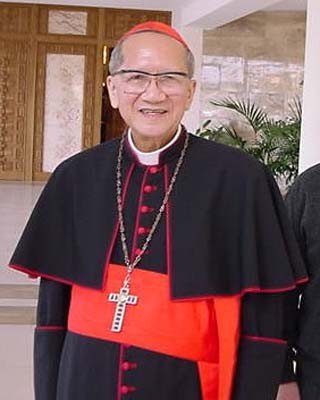
Biographical profile of Cardinal Văn Thuân
In this article, the postulator of the Cause of Beatification of Cardinal François-Xavier Nguyên Văn Thuân retraces the essential stages of the life of the Venerable Vietnamese cardinal, highlighting his remarkable virtues, chief among them hope. It is above all through this virtue that he remains a living witness to the Gospel today. In addition to Cardinal Văn Thuân’s Cause, the author also serves as postulator for other international Causes, including those of Chiara Lubich, Julius Nyerere, and Dorothy Day.
To understand Cardinal Văn Thuân’s extraordinary witness to hope, we need to return to the roots of his life.
Imagine a prison cell. A man deprived of his freedom, his diocese, his mission. And yet, there, with a few drops of wine and a fragment of bread, he celebrates the Eucharist. That man is Cardinal Văn Thuân.
When we think of him, our thoughts immediately turn to his long years of imprisonment and to the radiant witness of hope he offered to the Church and the world. But that hope was not born in prison; it had deep roots.
François-Xavier was born on April 17, 1928, in Huế, central Vietnam, the second of nine children, into a deeply Catholic family. His family preserved a vivid memory of the persecutions that marked the history of the Church in Vietnam, particularly in the nineteenth century. Among his ancestors were martyrs for the faith, and this memory profoundly shaped his spiritual formation.
His mother played a decisive role. A woman of deep faith, she taught her children to trust in God and remain faithful to the Gospel even in times of difficulty. Văn Thuân would often recall that it was from her that he learned to live his Christian journey as a living relationship with God and as a source of hope.
After studying in local seminaries, he was ordained a priest in 1953. He was later sent to Rome to study at the Pontifical Urbaniana University, where he earned a doctorate in canon law.
Returning to Vietnam, he held a number of pastoral and academic positions, distinguishing himself through his apostolic energy and his attention to the formation of young people.
In 1967, Pope Paul VI appointed him Bishop of Nha Trang. During his episcopate, he devoted great energy to the pastoral life of the diocese, promoting the formation of the clergy, catechesis, and lay participation.
This pastoral activity was rooted in a spiritual journey that had matured since his youth. Văn Thuân was attracted by the great traditions of the Church, especially Benedictine, Carmelite, and Jesuit spirituality. These were joined by more recent experiences such as Scouting, the Cursillo movement, and the Focolare Movement, all of which helped shape both his inner life and his concrete approach to pastoral ministry.
In 1975, he was appointed Coadjutor Archbishop of Saigon. A few months later, he was arrested. Thus began a long ordeal: 13 years of imprisonment, nine of them in solitary confinement. Deprived of everything, he discovered that nothing could separate him from Christ. He himself described it in these words:
“During the 13 long years of imprisonment and isolation, I learned to choose God and not the works of God. I became aware that God wanted me here and nowhere else. And in a reeducation camp, with 250 prisoners, almost all of them non-Catholic, I prayed: Lord, you send me here to be your love among my brothers, in hunger, in cold, in hard labor, in humiliation, in injustice.”
This was the turning point: no longer simply doing something for God but becoming a presence of God. He wrote short spiritual messages that were smuggled out of prison, circulated among the faithful, and were later collected in the book The Road of Hope. In his relationship with his guards, he chose the path of friendship and dialogue. He did not respond with fear or resentment, but with charity. And this changed hearts.
In 1988, he was released, but he was not allowed to return to his diocese. He settled in Rome, where John Paul II called him to collaborate with the Holy See. In 1994, he was appointed Vice President of the Pontifical Council for Justice and Peace; in 1998, he became its President; and in 2001, he was created a cardinal.
During these years, he also made a major spiritual contribution. In 2000, he was invited to preach the Spiritual Exercises to the Roman Curia, which later became the book Testimony of Hope, translated into many languages.
He died in Rome on September 16, 2002, leaving the Church an extraordinary witness of faith and hope.
His life appears particularly relevant today.
Pope Francis reminds us that the Gospel is transmitted above all through the witness of a life transformed by an encounter with Christ. Văn Thuân was exactly that: a witness who proclaimed the Gospel even when he no longer had a church, a diocese, or external freedom.
Pope Leo reminds us that holiness is not rigidity, but joy, the work of grace. In this Vietnamese bishop and cardinal, we see a faith capable of smiling even in the midst of trial. A lesser known but very revealing feature of his personality was his sense of humor. Even in the most difficult situations, he retained a remarkable inner freedom.
Cardinal Văn Thuân did not simply leave us words about hope. He left us a life that makes hope credible. And for this reason, his witness continues to tell us, today more than ever, that no prison, no trial, and no night of history can extinguish the light of hope.

PDF version
Humans in a digital revolution
April to June 2026
No 31 – 2026/2