

focus | witness
Piero Facci
The author is a missionary of the Pontifical Institute for Foreign Missions (PIME) tells us here about the life experience of Bishop Mario Pasqualotto, himself a PIME missionary who has spent nearly sixty years in the Brazilian Amazon.
What emerges clearly is that the choice of God—experienced as Love—remains, for every priest, the central foundation of his vocation. This choice is then lived out as koinonia: a life of communion and synodality, together with the People of God, with a special preference for those on the margins of society.
For this very reason, Bishop Mario, now retired, dedicates his entire life to the young people of the Fazenda da Esperança (Farm of Hope) in Manaus, which he himself founded as a concrete fruit of the Lenten season of 2001.
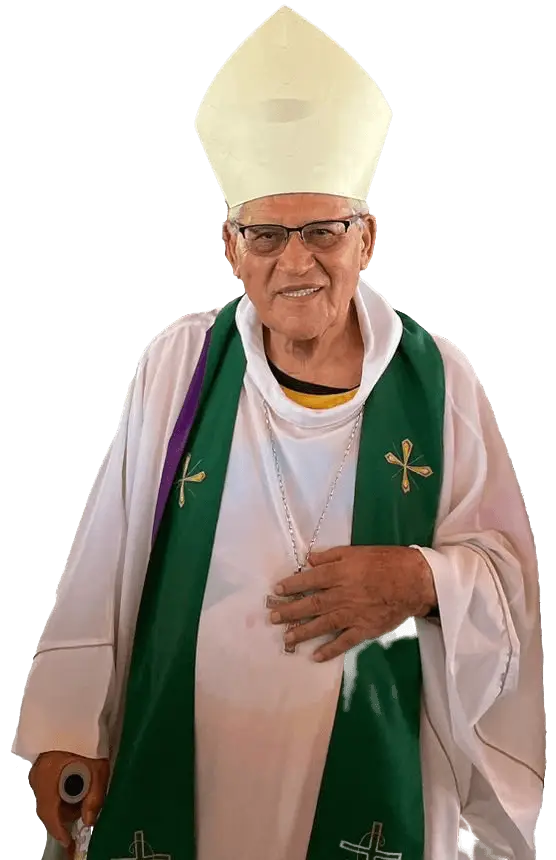
Monsignor, Your Excellency, Most Reverend—these are not titles that suit him. Simply Dom, as bishops are called in Brazil. And it is not unusual to find him in the kitchen washing dishes, or to see him getting up several times during lunch to welcome whoever happens to ring the doorbell at the most unexpected hour. They are poor people, exploited women, young people trying to break free from drug addiction or who have relapsed, and also ordinary people asking for help. But what literally transforms him is when he celebrates with the young people in one of the 160 Fazendas da Esperança (Farms of Hope)[1] spread around the world. There, despite being well into his eighties, he becomes young among the young, joy written all over his face, unafraid to clap his hands or raise his arms in praise, only to immediately afterward listen to their confessions in the sacristy or under a tree. This is Dom Mario Pasqualotto, bishop emeritus in Brazil. He has spent his life in the Amazon, first in the Diocese of Parintins, a fifteen-hour boat journey from the state capital, and today in Manaus, the capital itself, after fourteen years of service as auxiliary bishop.
A New Light Shines in the Night
Originally from the Veneto region of Italy, during the Second World War he travelled back and forth between home and Piedmont, working as a child alongside his poor family in brick production. He often says that this experience taught him to welcome everyone naturally. He recalls how, as a boy, his grandmother would take him with her during the winter to gather firewood to deliver to families in need, and how people were welcomed into his home to share lunch. These experiences helped him develop a concern for the poor. It was in this environment that his vocation was born. While still a young boy, he entered the seminary of the Pontifical Institute for Foreign Missions in Treviso and later continued his high school studies in Monza.
At the age of eighteen, God was waiting for him around the corner through a trial that would make him understand that only God must come first—not other things, however good they may be. Exhausted by his studies and suffering from burnout, his superiors sent him home: “You can no longer continue your studies. Go home, and if one day you feel better, you can return; otherwise, you will have to take a different path.” It was the collapse of his missionary ideal. On the journey home, the bus he was traveling on broke down. It was night, and Mario found himself sitting at the edge of the road. Darkness outside, darkness within. “Why, Lord, do You no longer want me? You know that I love You and want to help others. So why this darkness?”
But God was waiting for him in a new way. Is it not true that one can see farther at night? You can see the stars, the heavens, the moon… The next day he did not even have the courage or strength to go to Mass. Yet in the afternoon he felt the desire to enter the church, to visit Jesus in the Eucharist and entrust himself to Our Lady. At a certain point, a young man named Romeo arrived, full of excitement, and told him about a discovery: a group of young people, a Movement, where everyone loved one another. It was like a bolt of lightning. As he listened to the young man, Mario suddenly felt a joy in his heart that he could not explain. He returned home singing, ate a quick dinner, and then washed the dishes—something he had never done before. His mother said to him, “What happened to you? You left with your head hanging low and now you come back singing?” “Mom, I don’t know what happened. I only know that I’m happy.” A few days later he met a missionary and opened his heart to him. The missionary said: “Your ideal must be God and nothing else. God alone!”
Later, Dom Mario would say: “This was the secret of my life. I chose God. How many times I have had to remember that choice. I have changed parishes many times, and each time it was a loss, a kind of death. But I chose God, not that parish or that superior.” From that encounter, Mario discovered the Spirituality of Unity by participating in a retreat in Fiera di Primiero called a Mariapolis. There, at the end of the 1950s, he heard for the first time about the reality of Jesus present in the midst of his people: “Where two or three are gathered, there am I in the midst of them…” (Mt 18:20). He experienced it as a light that illuminated both his inner and outer life, bringing a new peace and serenity that he had never known before. In this way he also regained his health, returned to the seminary, and in 1965 was ordained a priest.
A Light to the Ends of the Earth
Two years later, he left for the Brazilian Amazon, where he carried out his ministry, first in Barreirinha, then in Parintins, the seat of the diocese, and later in Maués, the land of guaraná, the “sacred” drink of the Sateré indigenous people who inhabit that region. His commitment to becoming one with the indigenous peoples brought him into contact with a culture deeply permeated by the divine. He discovered, for example, that it is always women who grate the guaraná—the drink of life—because women are the ones who give life. They speak about God only at night, under the full moon, when there is silence so that they can listen more attentively, and when there is no wind to carry everything away, even words themselves. And when someone dies, one should not be sad, because the person is buried in the earth, and the earth thereby becomes more noble.
Wherever he went, he sought to sow that Spirituality of Unity that had transformed his own life and was capable of forming “new” men and women. One evening, a group of young people asked him to explain this spirituality more deeply, since it was already bearing fruit in communion and attracting people. Mario apologized, saying that he was tired after celebrating three Masses, baptisms, and numerous meetings. In the end, he gave in to their request and spoke about the charism of unity. But afterward, he had the impression that he had ruined everything because of his confusion and exhaustion. The next day, one of those young people returned full of joy and said to him, “Father Mario, today has been the most beautiful day of my life,” and went on to explain how he had managed to love his coworkers throughout the entire day. It was a new evangelization advancing in the heart of the Amazon.
A light shared with the least among us
Unexpectedly, in 1999, he was appointed auxiliary bishop of the Archdiocese of Manaus. As his episcopal motto, he chose Ut unum sint (“That they may all be one”). He decided to live together with the archbishop; shortly afterward, the other auxiliary bishop joined them as well. One day, having arrived early at a parish for confirmations, he quietly sat at the back of the church without the pastor noticing him and listened to what he was saying to the community: “We too should live like our bishops, who do things together and love one another.”
In 2001, the National Conference of Bishops of Brazil launched its Lenten Fraternity Campaign with the theme: Yes to Life, No to Drugs. It was then that a Fazenda da Esperança (Farm of Hope) was established in Manaus, which today welcomes more than 150 young people. The three pillars of the Fazenda are the Word of God, work, and community life. Living out a phrase from the Gospel of the day is the method used to overcome addictions and become new men and women. Around that time, a young man had joined the community who did not go to church because he owned only one worn-out pair of pants and a threadbare shirt. One of the residents, Raffaele, wanted to share what he had in his closet. He had just received a new shirt and a new pair of pants from his mother. His first instinct was to give away his old clothes, but then he remembered that it was Jesus himself who was in need in that young man, and that it would not be right to give Jesus used clothing. So, he secretly placed the new clothes under the young man’s pillow, because the Gospel passage for that day said: “Your right hand must not know what your left hand is doing.” When he later saw him enter the church wearing his new outfit, he experienced such great happiness that he felt God present within himself, and he wept with joy.
Experiences like these are an everyday occurrence at the Fazenda and become a source of encouragement even for the priests and bishops who come close to these young people. During a spiritual retreat for the clergy of Manaus, Dom Mario proposed that the priests spend the final day with the young people, listening to their stories and allowing themselves to be touched by their lives. It became one of the most beautiful and moving retreats they had ever experienced.
Living the Word, sharing life, doing things together, embracing the cross with joy, imitating Mary, seeing Jesus in one’s neighbor—all this and more make up the richness of the life of this bishop, who for everyone simply remains Dom Mario. His life is recounted in the biography Communion: An Experience of God, compiled by former young residents recovering from drug addiction from an interview conducted with Dom Mario while he was recuperating from surgery.
________________________________________
1 The Fazenda da Esperança is a supportive community with more than 40 years of experience in youth drug-addiction recovery and is now present in 28 nations on 4 continents.

PDF version
Reinventing Community?
January to March 2026
No 30 – 2026/1