

Luce Ardente

an 'Ardent Light'

Roberto Catalano

focus | witness

A humble monk, a prophet of dialogue

On November 10, 20026, the Buddhist monk Phramaha Thongratana Tavor, known to many as Luce Ardente (‘Ardent Light’), died near Bangkok in Thailand. Following the 1995 World Youth Day in Manila, he encountered Chiara Lubich and the Focolare Movement. A deep spiritual relationship was born that extended to many other monks of Thai Theravada Buddhism and made this little monk a privileged witness of Buddhist compassion and universal fraternity.

“Today I am here thanks to Chiara Lubich. I was a simple monk, and after getting to know Chiara I remain a simple monk, but twice as happy as before. I am a happy monk not because I come from Thailand, the land of smiles, but because of the joy of having found a way to make the world one single family, according to Chiara’s teachings, through the gift of unity, the legacy she left us.” With these words, Phramaha Thongratana Tavor introduced himself to the audience in Rieti on the occasion of receiving the Forum Civiltà dell’Amore Award, which had been presented to him in October 2008.

Perhaps this Buddhist monk of the Thai Theravada tradition never better summarized his experience of spiritual friendship with Chiara Lubich, whom he regarded as his “mother.” Their relationship began almost by chance in the mid-1990s when, in preparation for World Youth Day to be held in Manila, the organizers asked the Focolare Movement in Thailand to invite, along with the delegation of young people from that country, a Buddhist monk. Through acquaintances in Bangkok, they came across this small monk, unexpectedly lively and talkative for a typical Theravada monk, yet also deeply rooted in his tradition of Vipassana meditation.

It was in the Philippines that Phramaha Thongratana Tavor first saw a photograph of Chiara Lubich. He wanted to know who this woman was and asked to meet her. Thus, during the Gen Fest of 1995 in Rome, Chiara Lubich met a monk from the ancient Theravada tradition for the first time: a moment that would write a new chapter in the history of interreligious dialogue within the Focolare Movement, as well as in the personal lives of this monk and many other Thai monks.

The beginning of a surprising spiritual relationship

From the very beginning, after listening to her address the thousands of young people gathered at the Palaeur in Rome, the Thai monk began calling Lubich “mother”: a word that expressed a spiritual kinship that was, in some ways, mysterious, considering both the founder of the Focolare Movement’s unwavering roots in the Catholic tradition and, on the other hand, the monk’s deep grounding in the Buddhist tradition. This marked the beginning of a profound spiritual relationship between the two, one that would involve many others in a journey that, thirty years later, still continues with developments that would have been unimaginable at the time. For her part, Lubich gave the Buddhist monk the name Luce Ardente (“Ardent Light”), both because of the difficulty of pronouncing his Thai name and because of the spiritual light that emerged from their encounters.
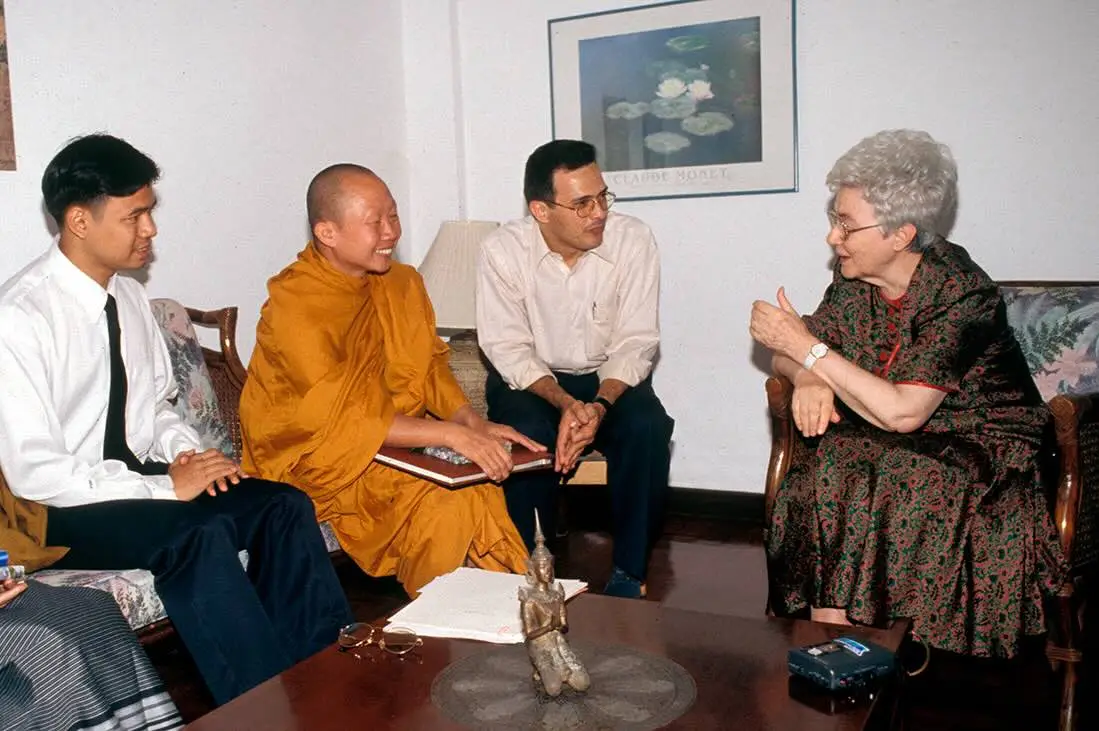
Luce Ardente with Chiara Lubich

Their relationship took an even more decisive turn when Luce Ardente expressed the desire to spend several months in the Movement’s small town of Loppiano. He was therefore invited to live at the Claritas Spirituality Center, where Catholic consecrated men and women from different charisms and geographical backgrounds spend a period of time experiencing communion among their respective charisms in the spirit of the Focolare Movement.

On several occasions, Luce Ardente spent longer or shorter periods with these monks and Catholic consecrated persons in an entirely innovative experience of inter-monastic dialogue. They did not discuss theology or philosophical concepts; rather, they lived Christian love and Buddhist compassion in every moment of the day, setting aside time for spiritual sharing.

Further developments with Buddhist monks, nuns, and laypeople

As an extension of this experience, Luce Ardente suggested that his own spiritual master, Phra Phrom Mongkol—a world-renowned figure in the Theravada tradition and in Vipassana meditation—also take part for a time. Thus, following a brief meeting with Pope John Paul II, the two venerable monks conceived the idea of inviting Chiara Lubich to Thailand.

From December 28, 1996, to January 9, 1997, the Catholic leader was welcomed in Bangkok and Chiang Mai by various temples and universities, where she had the opportunity to meet monks, nuns, and laypeople and share with them her Christian experience, as well as the spiritual friendship that had developed with Luce Ardente and his Master. Once again, the words with which Phra Phrom Mongkol—whom Lubich addressed as “Grand Master”—introduced this Catholic woman to dozens of monks and nuns were both mysterious and, in some ways, prophetic.

“All of you are asking yourselves why Mother, who is a woman, has been invited. I would like you monks and nuns to put that question aside. … When we are in darkness and someone comes to bring us a lamp, we are grateful because it helps us walk along the right path. Anyone who is wise and able to show us the right path for our lives, whether man or woman, deserves our respect.”

An apostle of compassion and fraternity

Luce Ardente continued to be an “apostle” of compassion as a path toward the universal fraternity he had learned from Chiara. He lived this out within his own temple, among his followers, during his many trips abroad and, not infrequently, within the Catholic world itself. He never missed an opportunity to present the figure of this Christian “mother,” whom Buddhist monks and laypeople could also follow in order to become builders of the one human family. From time to time, whenever he passed through Italy, he would take the opportunity to spend time in dialogue with the founder of the Focolare Movement, at least for as long as Chiara’s health allowed it. These were profound conversations, never superficial, during which the monk shared his own understanding of Christian truths, while the founder of the Focolare Movement discovered unexpected aspects of Buddhism that she then appreciated and shared throughout the entire Movement.

Often, during his visits to Loppiano—as on the occasion of Pope Francis’ visit to Loppiano on May 10, 2018—he would accompany other monks so that they too could experience Claritas. On other occasions, he became an “apostle” of the spirit of unity together with members of the Focolare Movement. I remember a journey with him to Sri Lanka to meet monks and laypeople who wanted to understand how to build friendships with Christians. Those were not easy times: Sri Lanka was in the midst of a brutal civil war. A suicide bomb exploded shortly after we had passed through the area. Yet Luce Ardente never uttered a word of criticism, nor did he show any fear or desire to flee. There was only genuine compassion. And so it was throughout three decades.

The final months and a passing of the torch

In recent times, because of illness, he had withdrawn from public life, dividing his days between the hospital and his humble home on the edge of the forest, not far from Bangkok—a true forest monk. Over these past months, many people, including Catholics from the Focolare Movement, regularly took turns staying by his side, both as a sign of gratitude and as a fraternal assurance of complete solidarity during this final stage of his life.

After learning of his death, Margaret Karram, president of the Focolare Movement, wrote a letter to the entire Movement, saying, among other things:

“He fully lived the name that Chiara had given him, becoming everywhere an instrument of light, consolation, and hope. Until the very end, he loved and lived to build fraternity. Throughout his life, he knew how to speak about unity in a unique way, with wisdom and passion, through books, magazines, radio broadcasts, and meetings with Buddhist monks and laypeople, not without facing difficulties.

One day, a monk asked him with some perplexity, ‘Master, do you follow a Christian woman?’ And he replied, ‘I do not follow a woman, but her ideal of universal fraternity. She does not belong only to Christians; she belongs to us as well.’

In his final message to me, he wrote: ‘Margaret, I am suffering, but I endure, endure, endure, because my sufferings are nothing compared to those of Jesus on the Cross. I endure because I am a son of Mother Chiara. Remember this: we will no longer see each other here, but one day we will meet again. Soon I will go to her.’”

One final meaningful coincidence.

Last August, when I had the opportunity to meet him, Luce Ardente had spent the entire morning with Phra Pittaya, a younger monk who had recently returned from several months of experience at Claritas in Loppiano. Phra Pittaya confided to me that they had spent the whole morning talking about their experience of Focolare spirituality. It was a significant and precious passing of the torch for the future.

PDF version

Reinventing Community?
January to March 2026
No 30 – 2026/1