

focus | best practice
Giovanni Soccorsi
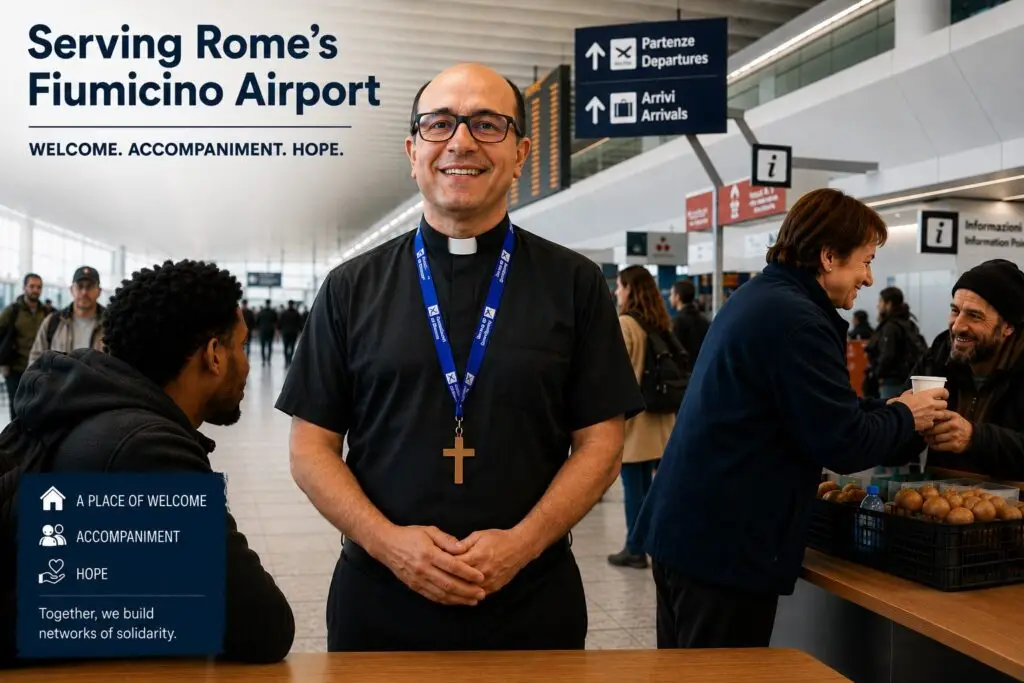
The parish at Leonardo da Vinci Airport in Fiumicino (Rome) was opened in 1960 and consists of a parish, with a chapel located in Terminal 1 Departures. It serves approximately 40,000 workers, 2,000 residents and some 180,000 passengers daily, between arrivals and departures. Although predominantly a lay environment, pastoral activities in recent years are flourishing and are giving rise to an impressive network of services for people in difficulty. Rev. Giovanni Soccorsi serves there as a parish priest.
I began my ministry at Fiumicino Airport in October 2017, but I had also previously served there during the Extraordinary Jubilee of Mercy (2015–2016) in order to help the parish priest at that time, when there was also the opening of the Holy Door in the terminal.
For years, pastoral work centered mainly on Mass, confessions, and a monthly catechesis for airport workers. On my arrival I sought first to understand this whole reality in its dual aspect of airport and parish community, with its own unique population and legal status.
My initial discernment focused on how to proclaim the Gospel in this airport, and how to pray and serve its parishioners. The Extraordinary Jubilee Year of Mercy was also a remarkable sign, with its call to corporal works of mercy. This was confirmed by a practice I noted among many workers — managers, entrepreneurs, employees, interns, air hostesses and stewards — who would leave their packed lunch for the homeless present in the terminal, about 40–50 people a day, who were living there permanently and those who used it only to sleep at night.
Concrete Evangelical Charity
I understood that by committing myself concretely to the poor in the airport, and in solidarity with the workers, it was an opportunity to proclaim the Gospel.
An Aeroporto di Roma (ADR) airport manager asked me to help him find accommodations for a homeless person named “L.”, 60 years old, who had been living in the terminal for several months. He was a quiet person and, though gruff, was an avid reader. He needed to wash, change his clothes, and eat. Thus, L. became the first guest of the Guest House of Santa Maria degli Angeli, at the airport parish.
Another ‘first’ belonged to H., originally from Germany with roots in Brazil. After ten years on the streets of Rome, he had resided at the airport for the past thirteen months. A gentle, silent man, with a non-violent psychiatric disorder, H. slept on cardboard, and owned only one shirt, a pair of trousers, and pajamas. He was very thin because he ate only when, in his own words, ‘a beautiful spiritual lady told him to take from the rubbish bin.’ He had long hair, a beard and was nicknamed Jesus or Moses. Dealing with his situation appeared a monumental undertaking, because he was not always cooperative. I turned to Sister Geralda, a Brazilian Salesian engaged in welcoming her fellow sister religious to Rome. I asked her to speak with him. With her, H. mentioned his native city in Brazil, and from there it was possible to contact the local parish priest. We were then able to contact his mother, who had believed her distant son to be dead. I then contacted the Brazilian embassy to obtain a travel document and purchased a ticket to allow him to willingly return home.
First Experiences
From these experiences we understood that our charitable service needed to focus on two objectives: helping those in need return to their native countries and fostering migrant integration into regions of Italy. This was the beginning of the project Lives in Transit: Between Welcome and Integration. Its focus is on welcoming, listening to, and finding assistance for migrants and the homeless, in collaboration with ADR and the entire parish community at the airport. In the past seven years, more than 600 people have been helped: men, women and minors arriving from across the globe.
From those first interventions was born the Guest House of Santa Maria degli Angeli (Saint Mary of the Angels), located between the parish church and the rectory, with seven beds, a kitchen, two bathrooms, two showers and a large garden. It is focused on assisting adult men, regardless of religion, background, or culture. Its mission includes food provisions, assistance for residence permits, issuing of documents, purchase of travel tickets for those returning to their countries of origin, as well as accompaniment in the search for permanent employment.
Over years, however, the parish realized that the Guest House could not accommodate — for structural, organizational and security reasons – people with addictions or psychiatric illness. This is why I made the further effort to build both public and private collaborative networks in the civil and religious sectors: hospitals, clinics, embassies, lawyers and trade unions.
Fruitfulness of a network
Periods of stay can be from brief overnights (to allow washing and changing before a dignified journey ahead) to medium or long stays (two or five years), in order to complete documentation or professional training paths. With each guest, a life project is built that takes into account intellectual, human and professional abilities. Their commitment is required relative to respect for guest house rules, cleaning, and adherence to Italian legal guidelines, as well as efforts to learn the Italian language, and to later welcome other newcomers.
Candidates are followed by myself and the volunteers, currently six, that include a couple who take care of weekly expenses for food and, if necessary, accommodation. Dialogue with state bodies, law enforcement, airport authorities, embassies, NGOs, diocesan and regional Caritas and voluntary associations has been fundamental and made it possible to raise awareness and improve the Lives in Transit project, overcoming limits, prejudices and fears.
Other important aspects are periodic check-ins with volunteers, airport authorities and the diocesan Caritas, as well as annual reporting of income and expenses.
Stories of Life and Redemption
There are numerous stories. Among them is “K.”, a young African man who fled his village because relatives wanted to kill him due to a physical abnormality that was considered a sign of demonic possession. Today, at 28, he has been living in the parish for six years, undergone one heart operation and two surgeries on his legs. Soon, he will become a father, and he is employed by ADR, with an excellent work record. He has also invested part of his savings to start an agricultural company in his village, with the aim of offering work and training to young people.
Then there is the story of G., a 19-year-old Brazilian teen arrested at the airport with sixty drug capsules in his stomach. Manipulated and forced into drug trafficking, after a four-year legal sentence he now blesses God for that arrest, which allowed him to change his life. He works in the morning as an IT technician, studies at night, and has applied for international protection so as to not fall victim again to violence and drug trafficking.
I find myself returning often to the Gospel parable of the Prodigal Son, or rather of the Merciful Father (Lk 15:11–32). I am fascinated by the dynamics of the characters, their freedom to choose, to wait, to encounter, to hope, to return, to love and to forgive. Assisting another in need does not mean only offering a meal, necessary and right as that is, but there are also relational elements and a welcoming of another’s history and path as a child of God, without violence or presumption. The greatest joy is to receive a request for help and forgiveness, and to learn to respect another’s journey, and in this way overcome one’s own limitations.

PDF version
Reinventing Community?
January to March 2026
No 30 – 2026/1