Ecumenism

Ecumenism lis at the heart of the gospel, the unity of all believers in Christ.

Bishop József-Csaba Pál – synodality in the diocese

focus | the synodal path

Bishop József-Csaba Pàl on putting synodality into practice
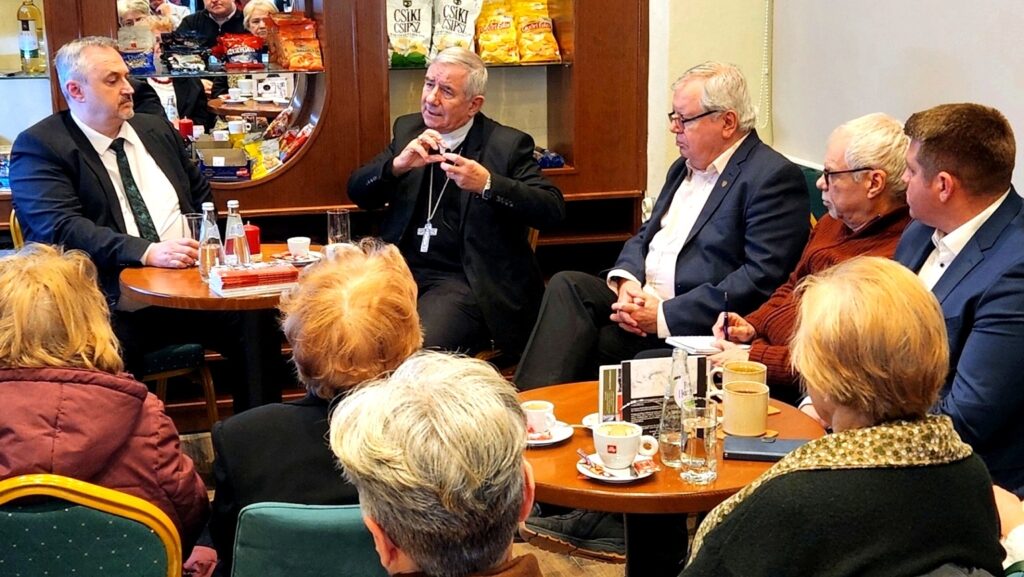
Bishop József-Csaba Pál reflects on synodality in the Church, sharing how listening, fraternity, and spiritual discernment are transforming diocesan life. Drawing from his experience at the Synod and in local pastoral practice, he highlights the power of communion, small communities, and ecumenical openness as paths toward a more missionary and relational Church.

Listening and fraternity in the diocese

József-Csaba Pàl

Bishop József-Csaba Pál is a bishop of the Latin rite in Timisoara, Romania. He participated in the two sessions of the Synod on Synodality and spoke at the International Conference for the Ongoing Formation of Priests sponsored by the Dicastery for the Clergy, in February 2024. We spoke between sessions of the ecumenical conference, Called to Hope, in which he participated together with his friends from different Churches.

Bishop Pál, a year ago you spoke at the International Conference for the Ongoing Formation of Priests. What did you take away from that meeting?

I was surprised and I really liked the atmosphere that was created among us. There was a spontaneous and open fraternity where I could see many joyful, happy priests. It was not only a conference on formation, but we were formed together in communion.

A characteristic of that meeting was the synodal and participatory approach, practiced and proposed as a style for the accompaniment of priests. How have things moved forward in your diocese?

This conference helped me to take a practical step beyond what we were already trying to do: regular meetings for priests and with priests, including a half-day every month in the bishop’s residence with those born in that month, where we have lunch together and each one shares something of his current experience.

At the conference I was very impressed by the effort and the possibility of “making a home” for priests. For this reason, I have decided to set aside several evenings in my calendar for fraternal meetings with priests in small groups, each time in a different parish. Retired priests who live in the surrounding area are also invited. During those evenings there is no assigned topic: the topic is us, our life. And since they are in the evening, there is no rush to finish. Everyone can speak freely, without being interrupted; we listen to one another with respect and full attention. One evening, a retired priest spoke for 40 minutes about his illnesses. The dean wanted to interrupt him, but seeing that I was listening very attentively, he did not. In the end, everyone agreed that there had been a real family atmosphere.

Subsequently, you participated in the Synod twice, each time a month of living synodality. What  particularly impressed you about this experience?

I would highlight two elements: prayer that supported prayerful listening, and communal discernment.

Prayer and prayerful listening. The moments of prayer, which were interspersed in the work, as well as the initial spiritual exercises, helped us to put ourselves back into the presence of God whenever closemindedness or impatience might have prevailed because of fatigue or some judgment or prejudice.

Communal discernment. Keeping ourselves open to one another, and together in front of God, helped us to discern what the Spirit is saying to each of us and to the Church. In particular, the method of conversation in the Spirit allowed us both to share our thoughts with parrhesia and to welcome with complete openness the thoughts of the others, different from our own. And in the end, we were often able to experience the miracle of feeling expressed in the outcome, the miracle of the unity of those who are different, an experience whose author can be none other than the Spirit. We really need to learn how to work in this style at all levels: in our dioceses and in our local communities.

You said that you were struck by no. 89 of the Instrumentum Laboris which speaks of the parish as a “community of communities.” What inspires you about this expression?

This is what the Instrumentum Laboris says: “We must do more to bring to fruition the great flexibility of the parish, which is understood as a community of communities at the service of missionary creativity.”

As I prepared for the Synod, I asked myself what I could do for this, as a bishop. It occurred to me that the first step should be to take stock of what communities are already present in the parishes?

I used to think that small communities only existed in Latin America and other continents, but I realized that, even in my diocese, life goes on in and through these groups.

Small groups or small communities offer millions upon millions of possibilities to populate the earth with Jesus’ presence: “For where two or three are gathered together in my name, there am I in the midst of them.” (Mt 18:20) I am referring to groups or communities where people know each other by name, help each other, pray together, joyfully participate in the Eucharist, take care of those who are elderly and sick, and value small or great charisms..- Sometimes they practice lectio divina, are open, and live for the mission.

So far, I have found about 400 small communities in the parishes. I met with their leaders, along with their respective parish priests, bringing together representatives from two to four parishes at a time, so that there would not be too many in a single meeting. Everyone shared what their group does and what they do for the members of the group. It was wonderful. The parish priests were also very happy. We remain in touch. They want to grow. We have also created a Whatsapp groups, so that all these people receive my pastoral letters. We are only beginning, but we are continuing along this path.

How do you plan to put into practice in the diocese what is proposed in Cardinal Grech’s recent letter regarding the implementation phase of the Synod on Synodality?

When I received the letter, at first I wanted to say: yet another job! Immediately afterwards, however, I understood that it is not a question of doing something, but of adopting a style. And this is exactly what we do in these small groups, where we listen to one another right to the end and where we want to grow in listening together to the voice of the Spirit. In these groups, in which priests also participate, we have the opportunity to grow in communion and also in mission. So we continue this work with joy and great hope.

We are meeting on the occasion of an ecumenical conference. Would you also say something about “ecumenical synodality” and your own experience?

Yes, I am convinced, as Pope Francis often reiterated, that there is no synodality without ecumenism and there is no ecumenism without synodality. These are not two different ways of living. Both within the Catholic Church and in our relationship with other confessions, we have to listen to one another, grow in communion and be beggars of truth together. For this reason, the experience I had in Castel Gandolfo last March, from the 26th to the 29th, at the ecumenical conference Called to Hope with people of different confessions and countries helped me to grow in hope for unity in the Church and among the Churches. There are so many seeds of unity in the world, seeds of hope. They are not immediately visible, but those who trust in the sower, who is the Holy Spirit, have hope that the seeds will grow.

What kind of Church do you think should or could emerge from the synodal process?

The Synod gave me a lot of hope that the Church will be more communal. There are those who are more conservative and those who are more progressive, voices with different opinions. Yet, this did not stand in the way of the synodal process. The Spirit has been able to gather various voices and bring them into an open and profound dialogue. If we think of the composition of the small groups in which we worked, we can see them as models of communities with various vocations, bringing together lay people, religious, priests, bishops, men and women of different backgrounds and cultures are together, united by their love for the Church and their commitment to the world in which we live.

I have seen how relationships are more important than actions at all levels. What we must do first is to build fraternal relationships. Cultivating relationships helps us not to get lost in ideas and theory, but to go out to meet everyone with God’s merciful love. In this way, the Church becomes more missionary.

If we have authentic communities, which are places of true fraternal relationships, we have somewhere to which we can invite people who do not have faith or a good relationship with the Church or have drifted away… And if Jesus is at the center of the community, people do not encounter something – a tradition, a teaching, an idea that may even be a good one – but Someone who can transform their lives.

PDF version

Called to Hope – Key players of Dialogue
July to September 2025
No 28 – 2025/3
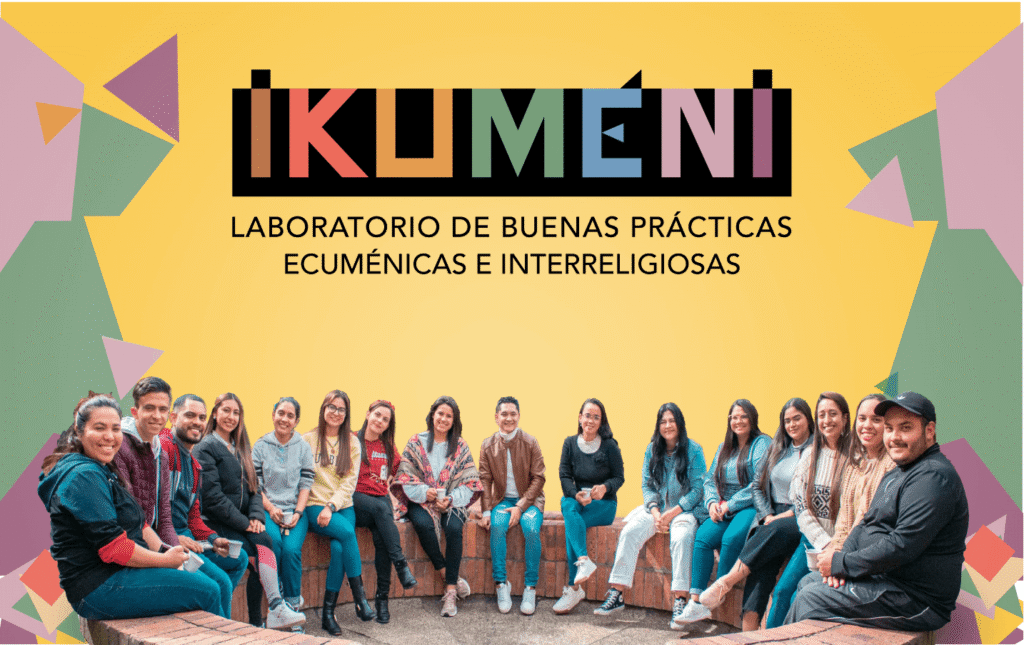
Project Ikuméni and ecumenism in Latin America

focus | witness

Ikuméni: Young voices in Latin America and the Ikuméni Project

Young Christians from Latin America share how the Ikuméni project fosters ecumenical unity, dialogue, and hope through shared faith, service, and commitment to reconciliation.

Project Ikuméni and ecumenism

Eddy Juárez and Laura Camila Jiménez

The two authors recount here the story of Ikuméni, an ecumenical project supported by a number of entities including the Colombian Bishops’ Conference, the Episcopal Commission for Youth and Laity of Peru, Caritas Latin America and the Caribbean, the United Methodist Churches, CELAM1, the Platform of Protestant and Evangelical Universities of Latin America, and the Caribbean Qonakuy. It is characterized by a fraternal, collaborative dimension of “going out” towards the other’s Church and to others, with the aim of transmitting this way of being to the world around them2.

Ikuméni’s best practices

Ikuméni has involved more than 300 young people from 16 Christian Churches and 20 countries in Latin America and the Caribbean. It is based first and foremost on a Laboratory of Good Ecumenical and Interreligious Practices. Born in 2019 through the initiative of Creas, the Regional Ecumenical Center for Counseling and Service, other organizations quickly joined.  The project is led by Elena López Ruf, a young legal researcher with a focus on international cooperation and interreligious dialogue, and whose dialogue formation has its roots through the Focolare Movement.

Ikuméni‘s team members belongs to several Christian Churches. Emphasis is placed on building together spaces of unity in respect and communion between different Christian traditions, a reality that then expands and involves many others. 

The goal is to train young people between 18 and 35 years old, in a leadership style inspired by a welcoming hospitality and cooperation through ecumenical and interreligious best practices that can be implemented in each one’s region or community.

The fourth Ikuméni training course took place as a four-month program of weekly online meetings and a face-to-face meeting that occurred simultaneously in four Latin American and Caribbean countries. A specific course on peacebuilding and reconciliation will also begin in September 2025.

John 17:21

Eddy Juárez spoke of his own experience: I am Catholic and come from the diocese of Chulucanas, in Peru. I would start with a phrase from Psalm 126: “The Lord has done great things for us: we were full of joy”. For me, Ikuméni is a blessing. We are protagonists in an experience of fraternity.

Ikuméni is that home where we can all arrive to, a home free from prejudices, fears and doubts, where we fill ourselves with God’s love, and the art of hospitality teaches us to recognize and welcome our neighbor as a brother.

My own diocese of Chulucanas was born in 1964, in the wake of the spirituality of communion of the Second Vatican Council and the initiatives of laity. I was accustomed, therefore, to speaking and promoting communion. However, we had done very little in  ecumenism.

But thanks to Ikuméni, I could experience the true meaning of communion, of unity in diversity, of love for my neighbor without wanting to change him or adapt him to my way of living the faith, but rather simply by trying to love him or her.

My own ‘best practice’ in ecumenism consisted of establishing a volunteer program to assist the most vulnerable affected by the floods caused by  the El Niño phenomenon3.  This gave us the opportunity to work with young people from two evangelical Churches of the Pentecostal tradition.

Today I am head of a team that coordinates, energizes and animates diocesan pastoral care and, thanks to the tools that Ikuméni  continues to provide me, we began to work on the theme of ecumenism.

Ikuméni made me aware that I have brothers and sisters in other Churches with whom I can share, pray, and work for the common good. It is about communion, synodality and living Jesus’s words: “That they may all be one” (Jn 17:21).

Bridges instead of walls

Laura Camila Jiménez. I am a 23-year-old Colombian youth, and I carry in my heart a deep conviction of redemption. I grew up in a country at war, from the time of my childhood until today.

Five years ago, I left my homeland to study in Buenos Aires, with the aim of studying political science. From day one, my ecclesial community, the Argentine Church Verbo de Vida, an evangelical Pentecostal confession, welcomed me with love and reminded me that the Kingdom of God knows no borders. At the same time, I was a member of a community in Colombia that united brothers and sisters of different denominations with the same purpose: to glorify Christ and spread his message through social action, Bible studies, and Bible circles. Now, in Argentina, God has provided for Student Life4, a project of Campus Crusade for Christ, focused on bringing the Gospel to universities.

In my Ikuméni training, I chose the Peacebuilding path  with a clear objective: to form a group of young Christians of different denominations, ages and professions who were passionate about Christ within the University of Buenos Aires. Like other academic institutions, cross-party, political conflict is the norm here and often overshadows the importance of true democracy. 

I am convinced, in a context such as Latin American marked by polarization and territorial conflicts tearing entire populations apart, that it is essential to form strong youth that know how to build bridges instead of increasing divisions. Ikuméni gave me not only the needed tools but enabled me to see how faith translates into concrete actions. Today, when desperation and polarization seemed to thwart attempts at dialogue, this reminded me that peace begins in the hearts of those who decide to be bridges instead of walls in this wounded world. 

Unity in hope

Like the two of us, there are hundreds of other Latin American and Caribbean youths in diverse contexts — from indigenous populations in the Amazon rainforest to those in major cities facing armed conflict — that want to continue to promote a ‘Samaritan ecumenism’. This kind of ecumenism invites everyone to work cooperatively as Christians of different confessions  with people of other religions and in civil society, all at the service of those suffering in our fragmented world.

Our hearts are full of gratitude to God for all that he has done in our lives and for the life witness of so many other young people committed to loving our neighbor as ourselves, as a sign of hope and unity for humanity.

__________________________________________

1     A body of the Catholic Church bringing together the Bishops’ Conferences of Latin America and the Caribbean.

2     Cf. also B. Isola, Ikuméne. A workshop of formation in dialogue and diakonia, in «Ekklesía» 6 (2023/1) p. 60.

3     The El Niño is a periodic change in sea surface temperatures in the tropical Pacific Ocean that significantly impacts the global climate, manifesting as abnormal warming that causes extreme weather events such as droughts, floods and heat waves in diverse regions of the world.


      For more information on Ikuméni see: https://ikumeni.org/?lang=en

PDF version

Called to Hope – Key players of Dialogue
July to September 2025
No 28 – 2025/3
The Rizal Movement – Prayer and Dialogue in the Philippines

focus | witness

The Rizal Ecumenical Movement – Prayer and dialogue in the Philippines

An inspiring account of the Rizal Ecumenical Movement in the Philippines, where Christians from different traditions live dialogue, prayer and service as a path toward unity and peace.

The Rizal Ecumenical Movement

Isagani Casambros – Len Leyva – Gay Maddela

Three members of the Rizal Ecumenical Movement (REM) belonging to different churches offer a series of snapshots into their shared experience and, consequently, that of going out towards others. They speak of an ecumenism of the people born naturally among them as a life practice.  REM was founded in 2016 from a desire for dialogue, prayer and action. It is composed of people from ten different Christian Churches, all represented in the National Council of Churches of the Philippines.

Isagani Casambros, pastor of the Southern Tagalog Conference of the United Church of Christ:

We continually encounter many challenges, negative perceptions and prejudices on this journey, due to ignorance and the fear of proselytism and conversions. As the fraternal relationship between us has grown, we understand that what matters is only to love. Now there is more openness among everyone and a deep respect for each person and his or her faith. We have come to appreciate the gift that each one brings to the community. Our gatherings have become family gatherings, and our diversity has paved the way for harmony, instead of creating disunity.

Len Leyva: I am a Catholic catechist, and I did not want to participate in ecumenical activities. Once, during an ecumenical celebration, I was asked to contribute a donation of rice for their lunch, and a couple who wanted to share some freshly caught lake fish came to the meeting, too. I had planned to leave immediately after bringing the rice, but seeing the love among those present, my prejudices vanished and I decided to stay. And I have been working for ecumenism ever since.

Gay Maddela: I am an Episcopalian. Working for this dialogue means establishing personal relationships, accepting others, listening, accompanying one another, and truly being like part of a family. 

A priest from another Church, for example, was having a very difficult time. He was persecuted and suspended from ministry for a year. Feeling dejected, he found the courage to share his suffering with us. We listened to and accompanied him with our prayers and unity. Later he confided to us how much strength he drew from our love.

With God and together

Isagani Casambros: In 2019, the Rizal Movement held an ecumenical retreat involving 15 pastors and collaborators from five different Churches. It was for us an experience of God and of mutual love that builds bridges by binding us into one family. Moved by the spirit of communion, everyone generously shared what they live and experience. Providence covered all the expenses and I personally received a special grace. During that retreat time it became clear to me that God was calling me to give myself totally to him. So, I went back to the seminary to become a pastor. 

In 2021, the Philippine Catholic Bishops’ Conference and the National Council of Churches entrusted the Rizal Movement with the opening celebration of the Week of Prayer for Christian Unity. We had little time to prepare, but we tried to put love into everything. Despite the various challenges, we could involve seminarians and youth from various groups and dioceses. It was an extraordinary experience of mutual love among us, and we experienced God at work in a powerful way. The liturgical celebration was simple, solemn and beautiful. It also coincided with the 500th anniversary of Christianity in the Philippines, a celebration of major significance. Although, it was an online event due to the pandemic at the time, it had a strong impact on everyone, due to the tangible presence of God.

Attention to others and concrete love

Gay Maddela: We have also tried to help in addressing social issues impacting our people. We visited a small community of 27 families, whose homes had been swept away by the typhoon. We brought some basic necessities and cooked for them. They were touched by our love, even to the point of preparing a bamboo walkway for our return afterwards, so that we would not need to wade through the river as we left.

Once, due to some communication problems, our guide, instead of accompanying us to the usual indigenous tribe that we visit, took us to another very poor community. We decided that we would give them all that we had brought, and there was much joy.

Then, on the subsequent visit to the indigenous Dumagat tribe that had been our original destination, abundant providence came to our aid in goods, money and volunteers willing to help. We were able to distribute three hundred food parcels to three communities. Truly, no one can surpass God in generosity.

__________________________________________

1     Traditional Filipino boat.

      See also: https://newcityph.net/living-synodality-a-dialogue-open-to-all/

The Rizal Ecumenical Movement
Philippines

 
Time: 9 minutes

Video copyright of Centro S. Chiara Media

PDF version

Called to Hope – Key players of Dialogue
July to September 2025
No 28 – 2025/3
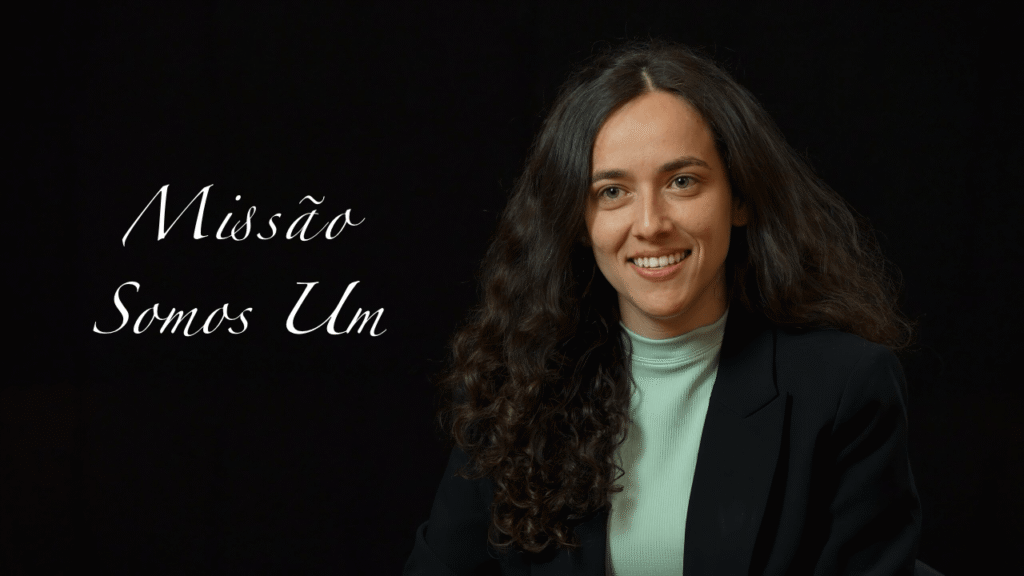
Somos Um Mission in Brazil – Mayara Pazeto

focus | witness

The Somos Um Mission in Brazil

A reflection on unity, hope and healing through the Somos Um Mission in Brazil. Mayara Pazeto shares a personal journey linking faith, suffering and ecumenical reconciliation between Christians.

A sign of hope

Mayara Pazeto

A young woman rereads her own past sufferings, making them the object of theological reflection. Hence the understanding that disunity, just as it causes lacerations and suffering in a family, creates pain even between separated Churches. In the light of personal experience, the author speaks of the Somos Um Mission, dedicated to dialogue between the Pentecostal Church and the Catholic Church. She reflects on the similarities that pass between the history of every Christian and the history of Christianity: errors, misunderstandings and divisions but all of which cannot extinguish hope.

In sharing here, I would like to first lay a foundation: What is a sign? And what is hope? I like the way in which the Gospel according to John elaborates the idea of the sign, using the central concept of signum: to indicate a reality greater than what it represents. The Pauline perspective of Rom 5:3-5 fosters an understanding of hope: “And not only that, but we also boast in our sufferings, knowing that suffering produces endurance, and endurance produces character, and character produces hope, and hope does not disappoint us, because God’s love has been poured into our hearts through the Holy Spirit that has been given to us.”  

In this context, glimpsing hope presupposes a path of suffering to be embraced. Those who do not embrace the suffering inherent in following Jesus cannot truly taste the hope that he gives. This embrace, however, is what generates endurance in us and makes us understand that things and people are not under our control, placing us in front of what I call the dilemma of hope: the measure of endurance is reflected in the experience, and on this depends whether it will be positive or negative.

Further on, Rom 8:24-25 continues: “For in hope we were saved. Now hope that is seen is not hope. For who hopes for what is seen? But if we hope for what we do not see, we wait for it with patience.” Again, patience is linked to hope, with an aggravating circumstance: you have to wait for what you don’t see. This is hope: the ardent expectation of what we have not yet contemplated, in the midst of the tribulation that must be lived in an experience of patience. Having said this, I propose a path by which every pilgrim of hope must be willing to follow, thus becoming a sign. It is a path of suffering, endurance, character, and hope. And these were the steps that led me to encounter the work of Somos Um (“We are One”) Mission.

Step One: Suffering (Tribulation)

This is that act of compression or of squeezing, which has oppression and anguish as its metaphorical meaning.

This step began in my childhood from a family context of division. I was born from my father’s adultery and remained hidden for a long time, experiencing temporary abandonment by my father as a child. In my father’s family, no one knew of my existence. In my mother’s family no one knew who my father was. Thus, my own story was obscure to me and appeared to be a big lie. What I didn’t imagine was that Jesus would begin a process of radical conversion in my father’s life, leading him to become a Pentecostal pastor. As for me, I began attending the Catholic Church as a child, of my own free will. No one invited me. However, something very strong inside me told me that there was a family there, but not yet my home.

Second step: endurance (patience)

Literally, the ability to be stable, constant, and tolerant. This is what it means to act patiently.

For ten years I embodied this truth, waiting to meet my father. At this point in his life, he had already become an evangelical pastor who continued guarding this past life secret.  It could have been a very good reason for me to distance myself from the Church in some way. However, this was not the case.

Faced with the experience of abandonment, I could not help but wonder about that Love that, even in the face of a daughter’s pain, had reached my father. Sometimes I asked myself: “What kind of love can ever overcome the pain I feel?” I discovered it when I was 16. On a graduation cruise, I had an experience of God. One night, sitting on the deck of the ship, the Lord’s  voice spoke clearly to my heart: “You were not born to do what your friends do, Mayara, you are mine.” After what happened there, I became an ardent young Pentecostal. 

Third step: character (experience)

The meaning of this can be translated as a trial, as learning through difficulties or the experience that leads to having a tempered character.

This third step was decisive. At 19, I enrolled in the Pontifical Catholic University of São Paulo to study theology. In a miraculous story, one that only the Spirit is capable of building, I became president of the Academic Center and the Commission of theology students for the State of São Paulo. I grew close to seminarians, had contacts with many dioceses and religious orders and, in my house, the presence of priests became common. At first, my mother joked, “I never imagined that there would be so many priests in my house, Mayara.” And I would never have imagined it either.

In 2019, I received a message on behalf of Pope Francis, granting an Apostolic Blessing for a theological congress I was organizing. I confess that I found it very strange how easily things happened. Simultaneously, I received many invitations to preach retreats and offer biblical formation on Mary, another atypical thing, as a Pentecostal. In light of this, the priests at the university were the first to tell me that they perceived a clear gift in my life.

Because of this experience, I decided to write my final thesis on Christian unity. When I started reflecting, a number of events led me to reflect on my family history. I went through a profound process of forgiveness and reconciliation. It happened like this: while I forgave, I wrote. In every moment, my memory reminded me of how much a divided family could cause suffering. But it was in those same moments that the Lord asked me: “What about my family, the Church?” It was necessary to unite my abandonment to that of Jesus.

In this context, my supervisor said to me: “Make your life theology, Mayara.” A great but challenging tip, after all… It is easy to make a theology of history, but it is difficult to make your own history one of theology. Starting from the shared patrimony of Sacred Scripture, I concluded this painful stage by writing on the theme: The Spirit and the Bride say: Come! The figure of the Bride as a prophetic response to the unity of the Church. It was this step that led me to Catholic-Pentecostal dialogue, to the Commission for Unity of the Catholic Charismatic Renewal Movement of São Paulo, and to Somos Um Mission.

Fourth step: hope  

The expectation of goodness is what Somos Um  Mission represents in my journey. Founded by lay people in the context of a Catholic community (Coração Novo near Rio de Janeiro), it is based on a letter signed by Catholic and evangelical leaders who pursue a common purpose. The letter rests on four pillars that express the essence of what we believe: respect for confessional identities, ecclesiality, non-proselytism, and unity as a gift of the Holy Spirit. The development of these principles ended up generating a law in Rio de Janeiro; that is, there is a week in the official city calendar, called Somos Um Week. For this reason, we were surprised to receive Cultural and Intangible Heritage recognition.

Practically, Somos Um Mission brings together Catholic and evangelical leaders with charismatic-Pentecostal experience in a common purpose: to proclaim Christian unity. For this proclamation, however, some discernments were necessary. These included friendship as the constitutive basis of every action; local, national and international fraternal councils; work with youth, and a theological dialogue that responds pastorally to our needs. The fraternal councils are composed of sensitive participants, ready to discern in a fraternal atmosphere the promptings of the Spirit regarding unity. 

With the establishment of a Catholic-Pentecostal Working Group at the national level, a door opened for theological dialogue aimed at theological reflection, and pastorally on the charismatic-Pentecostal experience.  It serves in the understanding and discernment of specific experiences and initiatives of the Churches and Communities, starting from the Latin American reality. We recently published our first report, fruit of our meetings, which has as its theme, the gifts of the Holy Spirit. The most recent discernment came in 2022, with the Somos Um Youth Mission, a group that engages my whole heart and my service.

For these reasons, I consider Somos Um Mission to be a sign of hope. Firstly, because of  the communion I have lived in, and secondly, because my own personal history is undoubtedly intertwined with it. In starting from the “foundation of hope”, this sign is not manifested in what we have already achieved, since what is visible can no longer be the subject of hope. Hope is not acting on what we have already built, but on what is yet to come as a grace of the Spirit.

Called to be “Pilgrims of hope”, I will conclude by sharing something my father says when he tells the story of our family. He repeats countless times that it was generated amid pain and wounds but flooded with God’s infinite love: “Suffering (Tribulation) has become a vocation”. When he glimpses this reality, he concludes by quoting Rom 5:20:”…[B]ut where sin increased, grace abounded all the more”.

Paraphrasing this biblical text as we commemorate the 1700th anniversary of Nicaea this year, I have the courage to think that in the midst of so many abundant wounds throughout the history of the Church, God certainly makes his hope abound.

PDF version

Called to Hope – Key players of Dialogue
July to September 2025
No 28 – 2025/3
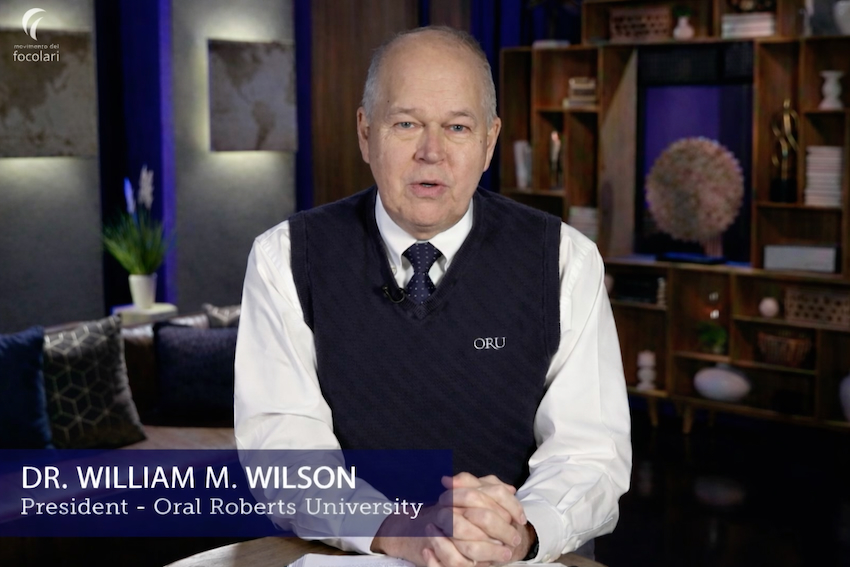
Dr William Wilson – relationship mission spirituality

focus | Christian unity

Dr William Wilson on 3 paths to unity

Dr William Wilson

Relationship, mission, spirituality

Dr William Wilson

On the occasion of the International Conference Called to Hope, promoted by Centro Uno, Dr. William Willson, president of Oral Roberts University, Chair of Empower, and the Pentecostal World Fellowship, addressed a vibrant greeting to the participants gathered from all around the world in person and online.

Extending his greetings “in the name of Jesus and in the love of God,” Willson invoked the joy and presence of the Holy Spirit on the encounter and centered his message on the desire for unity that springs from Jesus’ prayer in John 17: “That they may all be one.”

On the basis of this prayer, Dr. Willson shared three fundamental convictions regarding Christian unity, convictions matured over many years of reflection and experience:

  1. Unity must first and foremost be relational. Just as Jesus is one with the Father, Christians too are called to build authentic relationships with one another, based on God’s love and truth, as part of the family of God. “I believe that out of relationship, God will help us make history for His glory,” Willson said, noting that unity is born of lived relationships.
  2. Unity must be missional. It is not enough to meet or love one another. In order to endure over time, unity needs a direction, a mission. “God calls us to be one so that the world will believe,” Willson said, recalling the evangelical mandate to bring the Gospel to all peoples. Unity is not an end, but a way to make God’s love visible and to work for the transformation of the world.
  3. Unity must be spiritual. “Many forget that God’s presence is required for Christian unity,” Willson stressed. Otherwise, we are nothing more than a “good club trying to do something good”. “But when God gets involved,” he continued, “God gives a dynamic that helps unite us. It melts our hearts down together, so that we can be relational and we can accomplish God’s mission.”

In conclusion, Willson launched a heartfelt appeal: that the Holy Spirit gives everyone a “supernatural synergy”, capable of joining forces, breaking down walls that separate, and conquering strongholds of fear and indifference. “In this best of times and worst of times, we are to share the Gospel with every nation and every person on earth,” he said.

In his final wish and prayer to the participants, Willson invoked God’s blessing on all: “May God unite our hearts so the world may know that Jesus is indeed alive.”


edited by Heike Vesper


PDF version

Called to Hope – Key players of Dialogue
July to September 2025
No 28 – 2025/3

Jesus Celebration 2033 – Martin Hoegger

focus | experiences

Towards the Jubilee of the Resurrection

An exploration of the Jesus Celebration 2033 initiative, uniting Christian Churches worldwide in preparation for the 2000th anniversary of Christ’s Resurrection through dialogue, unity and shared witness. Martin Hoegger

The Jesus Celebration 2033

Martin Hoegger

The Jesus Celebration 2033 (JC2033) project was created with the intention of accompanying Christian churches towards the two thousandth anniversary celebration of the resurrection of Christ, the founding event of Christian faith and the theological foundation of ecclesial hope. It aims to stimulate, in an ecumenical spirit, a common witness articulated around three main axes: unity, witness and celebration. Martin Hoegger, one of the main protagonists behind the project and a pastor of the Reformed Church in Switzerland, is passionate about Sacred Scripture and active on the front line of ecumenical and interreligious dialogue, especially with Jews and Muslims. 

A consensus in an inter-ecclesial context. Since 2016, an interconfessional team has embarked on a path of listening and consultation in light of the two thousandth anniversary of the redemption, involving over 60 countries and more than 1000 ecclesial leaders. The proposal was welcomed as a providential opportunity to manifest a form of visible communion between the Churches and to put the Easter proclamation back at the centre of Christian witness: Christ is risen! He is truly risen!

A three-phase journey:

Years 2024–2030: A time of listening and community discernment, in which the Churches are invited to rediscover together the call to visible unity.

Years 2030–2033: A time of public witness, in which proclamation of the Gospel is renewed  through words and concrete signs of charity and justice.

Easter 2033: A joint celebration open to the world, a celebration of the Paschal Mystery in the multiplicity of Christian traditions.

Emmaus as a theological paradigm. The biblical symbol that inspires JC2033 is the story of the disciples of Emmaus (Lk 24:13–35).  The journeying community recognizes the Risen One in sharing the Word and the Bread. In this spirit, JC2033 promotes an annual ecumenical journey from Jerusalem to Emmaus that involves various local communities, and thus promotes encounters between different confessions, and the rediscovery of fraternity in Christ.

Global collaborations and networks. Over the years, JC2033 consolidated an ecumenical network through international meetings (Brussels 2019, Anafora (Egypt) 2021, Cartagena (Colombia) 2023, Geneva 2025), with representatives of various Christian denominations, especially young people and leaders of movements participating. Among the most significant collaborations is that with the Focolare Movement, which has accompanied and supported this journey from its earliest stages.

Towards a shared agenda for 2033.In the context of preparation for the Jubilee, Pope Francis entrusted Charis1 with  the task of fostering a shared ecclesial agenda. The “Agenda 2033” initiative, launched in 2024, brings together Catholic, Evangelical, Pentecostal and Anglican movements. Meetings in Krakow, New York and Rome marked decisive steps towards an ecclesial convergence that intends to overcome confessional logic, in order to offer the world a unified paschal witness.

Easter common to all the Churches. JC2033 has joined the Easter Together initiative that favors a common Easter date. In view of 2033, the desire is that the proclamation of the resurrection may resonate simultaneously in every language, culture and nation as a sign of our shared faith and a common mission.

An invitation to ecumenical co-responsibility. JC2033’s approach is one of an “ecumenical synodal journey” challenging all baptized persons to become ambassadors of the resurrection. It is not a centralized organization, but a platform open to the creativity of the Holy Spirit and co-responsibility among the Churches. The year 2033 can thus become an ecumenical kairos, in which the shared commemoration of the event of Jesus’ resurrection is translated into a renewed impulse towards unity and mission.  

____________________________________________

1     Charis was established in 2017 by the Dicastery for the Laity, Family and Life at the behest of Pope Francis, as a body at the service of all the realities of the Catholic Charismatic Renewal.

     For more information visit:  https://www.jc2033.world/en/

PDF version

Called to Hope – Key players of Dialogue
July to September 2025
No 28 – 2025/3

The Global Christian Forum – Natasha Klukach

focus | experiences

An open meeting place for all Christians

Dr Natasha Klukack explores the Global Christian Forum as a unique space for encounter among diverse Christian traditions. Through shared faith stories and mutual listening, the Forum fosters ecumenism, unity, dialogue and hope across ecclesial boundaries.

The Global Christian Forum

Dr Natasha Klukach

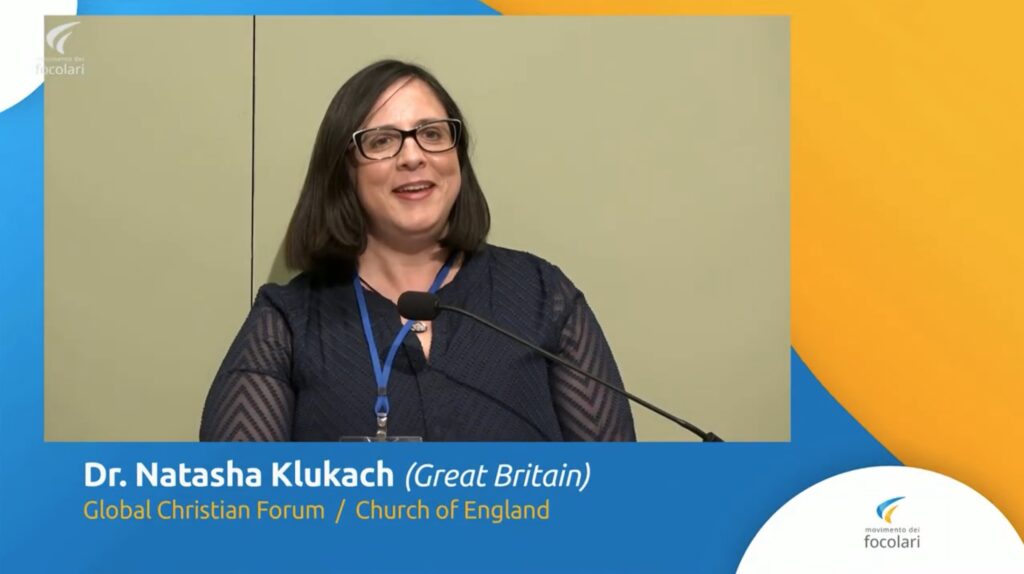
Dr. Natasha Klukach, member of the Executive Staff of the Global Christian Forum (GCF) and director of research and operations, was a participant at the 2025 Called to Hope conference. Her words of reflection were deeply valued by participants, and we asked her about the signs of hope that the Global Christian Forum represents in today’s ecumenical journey.

“We are a unique gathering of global Christian churches and organisations bringing together all the major streams of world Christianity. We create an open space where all Christians can meet to nurture unity by fostering mutual respect and understanding as well as by addressing together common challenges. The charism of the GCF is the sharing of faith stories, using our personal journeys with Christ as a means of building relationships across traditions who might otherwise never encounter one another.”

The Global Christian Forum was founded in 1998 by the World Council of Churches (WCC) for dialogue between the traditional Churches connected to the WCC and the Pentecostal and Free Churches, often not connected to the WCC.

Dr Klukach continues: “Over our 25-year history we have also held regional gatherings, thematic gatherings, and team visits. The Forum exists because there is no other space where this full diversity of Christians feels able to gather. The GCF is non-programmatic and our goal is to expand the table.”

What signs of hope can be expected from the GCF in the coming years? ” You will see more of those spaces where the Holy Spirit can be at work. We will support regional gatherings and hope to be able to spread our humble methodology of faith sharing as a gift to churches from local to global contexts.”


edited by Enno Dijkema

The Global Christian Forum:     https://globalchristianforum.org

The Global Christian Forum
Dr Natasha Klukach

 
Time: 13 minutes

Video copyright of Centro S. Chiara Media

PDF version

Called to Hope – Key players of Dialogue
July to September 2025
No 28 – 2025/3

1700 years since the Council of Nicaea – Mgr Andrea Palmieri and Prof. Martin Illert

focus | insights

Two experts in ecumenism look at the historical importance and relevance today of the Council of Nicea

Mgr Andrea Palmieri Prof. Martin Illert reflect on the 1700th anniversary of the Council of Nicaea and its significance for Christian unity, synodality and ecumenical dialogue today.

1700 years since the Council of Nicaea

Interview with Mgr Andrea Palmieri and Professor Martin Illert

One of the purposes of the Called to Hope Conference was to mark the anniversaries of ecumenical importance which occurred in 2025: the 1700th anniversary of the Council of Nicaea, the common date of Easter and the 60th anniversary of the abrogation of the excommunications between the Church of Rome and the Ecumenical Patriarchate of Constantinople. Representatives of two leading ecumenical institutions were interviewed on the subject: Mons. Andrea Palmieri, under-secretary of the Vatican Dicastery for Promoting Christian Unity, and Prof. Martin Illert, Lutheran minister and member of the Faith and Order Commission of the World Council of Churches. Here are excerpts from these interviews.

Mons. Andrea Palmieri of the Dicastery for Promoting Christian Unity

What does the 1700th anniversary of the Council of Nicaea offer for ecumenism, for the Catholic Church and Pope Francis?

Pope Francis was always aware of the importance of this anniversary and jealously kept in his heart the invitation of the Ecumenical Patriarch Bartholomew to go to Nicaea. Moreover, the ecumenical significance of the 1700th anniversary of the first Council of Nicaea was also mentioned  in the Bull of Indiction of the Jubilee 2025: “Nicaea also represents an invitation to all Churches and Ecclesial Communities to proceed on the path towards visible unity, not to tire of seeking suitable ways to correspond fully to Jesus’ prayer:  “That they may all be one…” (Jn 17:21)” (Spes non confundit, n. 17).

The ecumenical significance of this commemoration is linked to three things: the common confession of faith, the question of the date of Easter, and the theory and practice of the Councils. It is not simply a matter of remembering what happened 1700 years ago in Nicaea, but of drawing inspiration from it to make important choices for ecumenism today.

First of all, the First Council of Nicaea represented a fundamental stage in the elaboration of what is now called the Nicene-Constantinopolitan Creed. This profession of faith has a very great ecumenical importance, because it is shared not only by the Orthodox and Eastern Orthodox Churches and the Catholic Church, but also by the Churches born from the Reformation. As we journey towards the re-establishment of full communion among all Christians, which has to be a unity in faith, the anniversary of the First Council of Nicaea tells us that Christians today, although divided, already share faith in the central mysteries of Christianity. The profession of faith is also called the Symbol of Faith. The word symbol, from the Greek syn-ballo, means to put together. The Creed not only brings together, as mentioned, the principal truths of the Christian faith, but also unites those who profess these truths. 

The Creed unites us, yet we are still divided. One thing we see in the relations between Christians is that unfortunately not everyone feels the lack of reconciliation as a pain. Some influential figures of the  last century experienced this pain, and took courageous and revolutionary steps.


When we recite the Creed, we should feel the pain caused by our divisions. This year also marks the 60th anniversary of the solemn act by which, on the eve of the conclusion of the Second Vatican Council, Pope Paul VI and the Ecumenical Patriarch Athenagoras erased from the memory of the Churches the mutual anathema exchanged in 1054. The coincidence of the two anniversaries should not be overlooked.

A second aspect of the 1700th anniversary of the First Council of Nicaea is the question of the date of Easter. That Council had indicated criteria for calculating the date of Easter valid for all the Churches. Today, even though the vast majority of Christendom is inspired by those criteria, Christians continue to celebrate Easter on different dates except in those cases when the calendars coincide. This division contradicts the commitment of all Christians to bear witness to their faith together. In addition, the date of Easter is a problem when members of mixed families are forced to celebrate the main feast of the liturgical year separately. Pope Francis, in continuity with the Second Vatican Council, restated that the Catholic Church is willing to accept any proposed date for  which there is consensus. The current anniversary could be an opportunity to restart a dialogue between the Churches in search of such a consensus.

And does Nicaea also have something to say about the current process of synodality that the Catholic Church has begun to undertake together with the other Churches?

Yes, the first Council of Nicaea is also of particular importance because it documents the way in which the heated dispute over Christological faith and the pastoral-disciplinary question of the date of Easter were discussed and decided in synodal style. The 1700th anniversary of the Council of Nicaea should therefore also be seen as an invitation and a challenge to learn from Church history. Today’s revitalization of the synodal dimension in the Catholic Church is linked to the synodal traditions of the early Church. Pope Francis has repeatedly recalled the interdependence between synodality and the ecumenical journey, affirming that the synodal journey undertaken by the Catholic Church must be ecumenical, just as the ecumenical journey is synodal. However, it is not enough to repeat the word synodality as a mantra for the Church to be more synodal. It is necessary to experiment with practical ways of exercising synodality at all levels of the Church’s life. The experience lived in Bari in 2018 where the pope and the heads of the Churches of the Middle East, Orthodox and Catholic, met to discuss together the pastoral situation of that region, could be a model to imitate. If the pilgrimage of the pope and Ecumenical Patriarch Bartholomew to Nicaea takes place, the embrace between them and the common profession of faith could send a message of reconciliation for all Christians and represent an invitation to common witness.

Finally, the Catholic Church should be represented by a significant delegation to the International Congress promoted by the Faith and Order Commission of the World Council of Churches, scheduled to take place in Egypt in October[1]. These events are certainly important, but words must be followed by concrete, prophetic decisions. At the moment, it is unknown whether such decisions will be taken in the course of 2025, but I am convinced that the reflections begun this year will contribute to the formulation of decisions that can mark the future of the ecumenical journey.

Interview with Prof. Martin Illert of the World Council of Churches

What is the significance of the celebration of the 1700th anniversary of the Council of Nicaea in the journey of Christian unity?

The Council of Nicaea contributed to the formation of a confession of the common faith that unites the Christian Churches. The Creed represents this link both in synchronic terms [in space] and diachronically [in time]: synchronically, it unites the Churches today, so that we can recite together the text of the Nicaean-Constantinople profession of faith, which in turn derives from the Nicaea Creed. From the diachronic point of view, the profession of faith connects us to the first centuries of the Christian Church and, through the centuries, to many Christians of every age.

Both dimensions are equally important, and neither should be understood without the other: the spatial bond, which emphasizes the totality of our faith, and the bond in time, which reveals the dimension that unites us to those who have gone before us in faith. On the path towards Christian unity, both dimensions then lead to a third, the prophetic-eschatological one: the promise of a unity that will be given to us and to which today’s steps towards  unity – which are still insufficient and imperfect – must be directed. This unity is already present in Christ, who at the end of time will be all in all.

  Would you like to tell us one more word about this prophetic-eschatological dimension?

In my opinion, this eschatological promise also implies a prophetic mission: that unity in Christ may become the way we act and profess our faith, both individually and collectively. I think that a commemoration like that of Nicaea fits very well with the motto that has been the basis of the work of the World Council of Churches since the last General Assembly: A pilgrimage of justice, reconciliation and unity, and not only because the tradition of pilgrimage was born historically after the Council of Nicaea through the pilgrimage of Helen [mother of Emperor Constantine – ed.]. The synchronic and diachronic axes that I have described, as well as the eschatological and prophetic dimensions, which in their interaction are linked to their origins, are well matched, in my opinion, with the theology of Nicaea and at the same time with the idea of pilgrimage.

  Can remembering and celebrating an event from 1700 years ago really be relevant for us today?

The Council reminds us and invites us to pursue common visions of unity through conciliarity and synodality. The basic idea of trying to gain everyone’s agreement is admirable, but it’s also important to point out clearly where this can go too far — where it begins to harm the profession of faith in Christ, by turning Him into something that people can treat as their own possession or manipulate. In this regard, I would like to cite an old example from my own culture and background, which is the evangelical tradition in Germany. It is very clear to me that the words of the theologians, who decided at the Synod of Barmen in 1934 not to mix the Christian faith at all with the terrible ideology of National Socialism, were oriented to the Nicene Creed, aware that at that moment it was necessary to make their profession of faith in Christ.

To this example could easily be added many other circumstances of the time of the Council of Nicaea: as today, a terrible war had pitted East and West against each other, and the desire for unity expressed in Constantine’s letters was always combined with the desire to overcome the divisions that opposed East and West. Looking at the canons of the Council, we can see that in this case and others –  for example social questions –  their efforts to seek what unites all Christians and the Churches was truly exemplary and decisive. This, too, in my opinion, is a further testimony of the fact that Nicaea is part of the common pilgrimage of Christians.

  What impact can this commemoration have on Christian unity? What hope is there for the future?

I am convinced that prayer and common reflection – and the commemoration of Nicaea is basically this: coming together to pray and reflect together – are helping us on the journey  towards unity, because we remember our common roots and our common mission. If I look at my Protestant confession, I realize that for long centuries we Protestants have represented our identity as a counter-identity to the Roman Catholic Church and we have also understood it in this way. Perhaps other denominations might recognize this as well, looking at their history.

A memory like that of Nicaea, on the other hand, emphasizes something completely different: it recalls the common basis of faith and draws from it a common task: to bear witness to our faith in the world. The Creed itself tells us that we, as believers, are included in this common confession, from which derives a common identity that is the basis for common action and prayer.

  What is the significance of the 60th anniversary commemoration of the mutual abolition of the anathemas of 1054 between Catholics and Orthodox, which took place on December 7, 1965?

The reciprocal abrogation of anathemas represents an example of a turning point: one’s own identity is no longer seen as a counter-identity with respect to a confessional counterpart – staged in a polemical or apologetic way – but what we have in common in tradition and spirituality is placed at the center, so that we can participate in a mutual richness.

As a Church historian, I believe that accounts of Church history are still profoundly influenced by the apologetic and polemical aspects that the Churches themselves have already overcome in their daily community life. I remember that especially in the 1960s  the idea of writing an ecumenical history of the Church without confessional boundaries was often brought up. In my opinion, there is still much to be done in this regard, and this could be a contribution to reconciliation, as it would prevent the formation of opposing identities and would allow us to let go of the polemical and apologetic perspectives of our  own points of view.

  What is the World Council of Churches organizing to celebrate and commemorate these two historical events?

The World Council of Churches has decided to celebrate 2025 as an “ecumenical year”. This is due to the fact that individual events, including the centenary of the Life and Work movement, which is being celebrated at this summer’s Stockholm Conference, have given significant impetus to the journey towards Christian unity.

For us, the central moment of the year will be the Sixth World Conference on Faith and Order of the Church, which will be held in the autumn in Alexandria at the invitation of the Coptic Church. The title of the conference is: Where now for visible unity? The conference, divided into three major thematic blocks, will focus on the unity of the Churches and Christians in relation to faith and mission. This conference should inspire our work in the Faith and Order Commission.

  What is the World Council of Churches’ view on the importance of a common date for Easter and what is it doing to promote it?

The World Council of Churches is happy and grateful for the voices coming from the Christian Churches, such as those of Pope Francis, the Ecumenical Patriarch or the Coptic Pope, that are calling for a common date for Easter. We are well aware that this can be an important step towards visible unity. At the same time, we are aware that the Churches must proceed with special care and consideration, so that new divisions are not created –  as we can see in the concern of some brothers and sisters, especially Orthodox – on our journey to this visible unity,

The World Council of Churches addressed this topic in a  special webinar, also inspired by the initiative presented in Aleppo in 1997. We published the results on the occasion of Easter this year2 and will discuss them further at the autumn conference, in the hope of contributing to the common celebration of Easter.

edited by Sandra Ferreira Ribeiro

_______________________

[1] For information on this October 24- 28, 2025 event: “ Catholic Perspectives on Faith, Mission and Unity at the Faith and Order Conference in Wadi El Natrun”.

PDF version

Called to Hope – Key players of Dialogue
July to September 2025
No 28 – 2025/3
Church relationships in Burundi

focus | experiences

Church relationships in Burundi
A reflection on ecumenical life in Burundi, where Catholics, Anglicans and other Christians build unity through dialogue, shared faith and everyday collaboration.

A school of relationships and dialogue

Maria Goretti Nkenguburundi with Léon Sirabahenda

Like in the context of many African countries, the presence of people from different Churches within the same family is a part of daily life.  The authors speak here about ongoing efforts to forge relationships between different Christian communities.

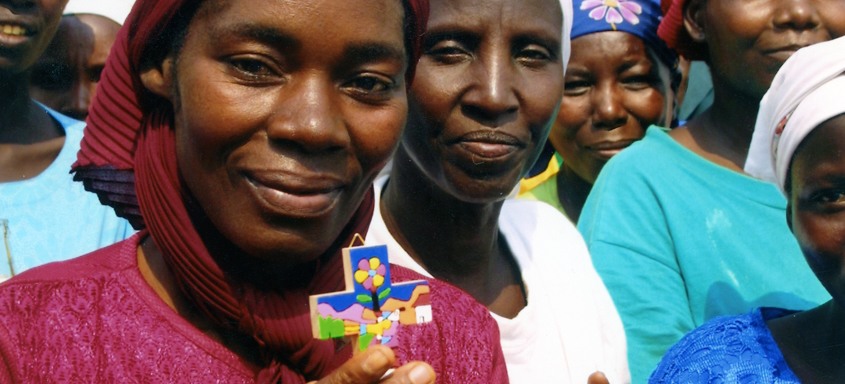
It can happen in a family of six in our country, that each family member belongs to a different Christian denomination, while still maintaining good relationships with one another. Thus, we can say that in many families, a “dialogue of life” is already being lived, because being together places the priority on relationships. In the commitment to try to love everyone, including those who may seem to be adversaries, Christians find themselves in a “life-school” guided by Jesus as the teacher, to learn how to establish true relationships, and dialogue as children of the one Father.

Since 2019, we have lived an ecumenical experience of friendship and mutual esteem with Anglican Church members in Bujumbura, thanks to the Anglican bishop who came to know the Focolare charism of unity through reading the monthly “Word of Life” years earlier as a high school student.

As children of a God who loves us immensely, at a certain moment we understood we needed to “reciprocate his love”1 not only individually but together with others, as Christ’s Church. This brought us to promote meetings between members of the Catholic and Anglican Churches. 

The first experience mainly involved youth, on the occasion of a local Genfest in August 2024. Although some Anglicans were already members of the Focolare Movement, the participation of other young Anglicans accompanied by Pastor Jean-Marie made this moment even more beautiful. All those present remember even now what this brother of ours said about the text of Resurrection of Rome by Chiara Lubich.  He drew out of that text many pearls of the charism of unity, starting from his own experiences in service to the Anglican Church, and as a father of a family and a companion to youth.

In his impression of the Genfest, the pastor expressed his joy saying: “We were happy even though we came from different Churches. We shared God’s Word and experiences from our lives. In the days spent together, we understood that unity is possible, starting from Jesus on the cross, because he saved us all without taking into account our religious affiliations.”

A “synodaljourney begins

During the United World Week 2025 last May, promoted by Youth for a United World, we experienced and touched with our own hands the words of the Psalm: ” How very good and pleasant it is when brothers and sisters live together in unity!” (Ps 133:1). One evening, in fact, many young Catholics and Anglicans were offered a concert prepared together by the Gen Sorriso musical group  of the Focolare Movement, and a choir of youth from the Anglican Church. It marked the beginning of a “synodal” journey for which we want to collaborate further with one another. 


Considering the transportation problems that existed, the number of participants and the atmosphere was surprising. In the end it seemed no one wanted to leave. It was an evening of celebration that has remained etched in the hearts of many who ask when such an experience will be repeated. Pastor Jean-Marie commented: “During United World Week, I realized that youth leaders have a very important role in seeking unity. By working together, young people have the opportunity to sing together and to witness the same teachings. It really was not evident that the protagonists of the concert came from two different Churches. For them too, it was as if they had forgotten that they were not part of the same Church.”

The youth were touched by the love and sense of fraternity that evening. A young woman wrote: “It was a powerful moment of great joy and above all of unity. We did everything together: playing, singing, dancing. It allowed me to see concretely that unity is not a utopia. Despite what makes us different, we could build something that will never be destroyed.”

In collaboration with the Anglican Church, we would like to promote other shared activities to contribute to Christian unity. We know it will not be easy, even if in everyday life, it seems that ecclesial affiliations count for little. On our journey to relate and dialogue with the members of other Churches, we remember the words of Chiara Lubich: “For a fruitful ecumenism, hearts touched by Him2 are needed, hearts which do not flee, but understand him, love him, choose him and know how to see his divine face in every disunity they encounter. They find in him the light and strength not to stop in the trauma, in the split of division, but to always go beyond and find a remedy, every possible remedy”3.

Life teaches us many things, including how to establish friendships and dialogue. Fr Léon of the Bururi diocese in southern Burundi, recounts: “When the head pastor of the Pentecostal Church of Kiremba in Bururi died last year, the bishop of the Catholic Church and some members of his priestly community spent an afternoon with his family to console them. This delicate presence was touching. At the funeral, it was surprising and unusual that a Catholic bishop was given the opportunity to speak, and this moved the large assembly. Later, the feeling of closeness between the two communities grew to such an extent that we share events in a more heartfelt way than ever before.”

The dialogue of life is extremely valuable, especially in Burundian and African contexts. Starting from the mutual esteem and respect observed in so many families regarding Christian faith, we hope to be able to walk together among the Churches in Burundi, certain that unity among us Christians is a vital contribution towards bringing many to God.

___________________________

1     C. Lubich, Essential Writings, edited by M. Vandeleene, New City Press 2007.

2     “He” refers to Jesus crucified and forsaken.

3     C. Lubich, cit., p. 373.

PDF version

Called to Hope – Key players of Dialogue
July to September 2025
No 28 – 2025/3
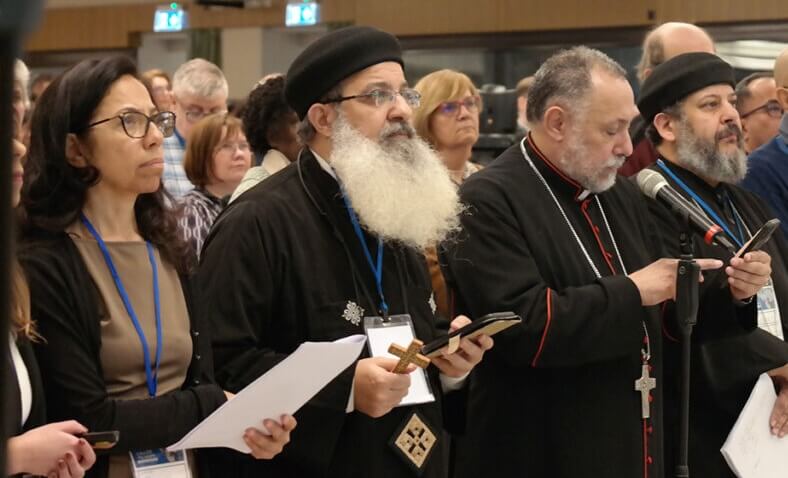
Coptic Orthodox Church in Egypt – Ecumenism

focus | experiences

The commitment to ecumenism of the Coptic Orthodox Church in Egypt

Exploring the Coptic Orthodox Church’s ecumenical journey under Pope Tawadros II, highlighting dialogue and unity among Christians in Egypt.

Bridges between denominational families

compiled by Mervat Kelli

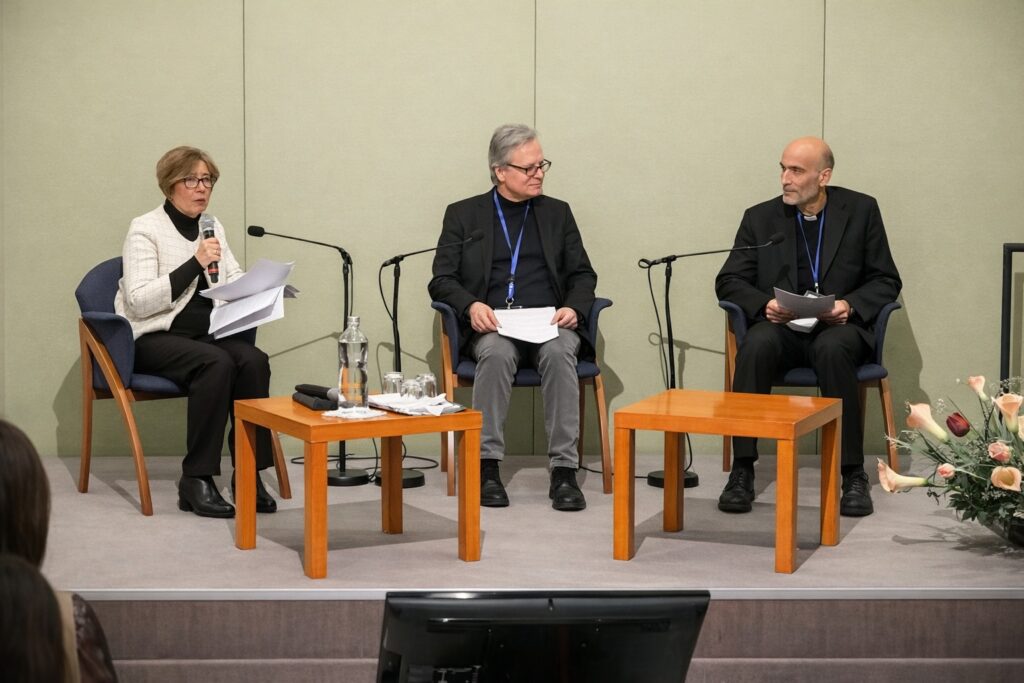
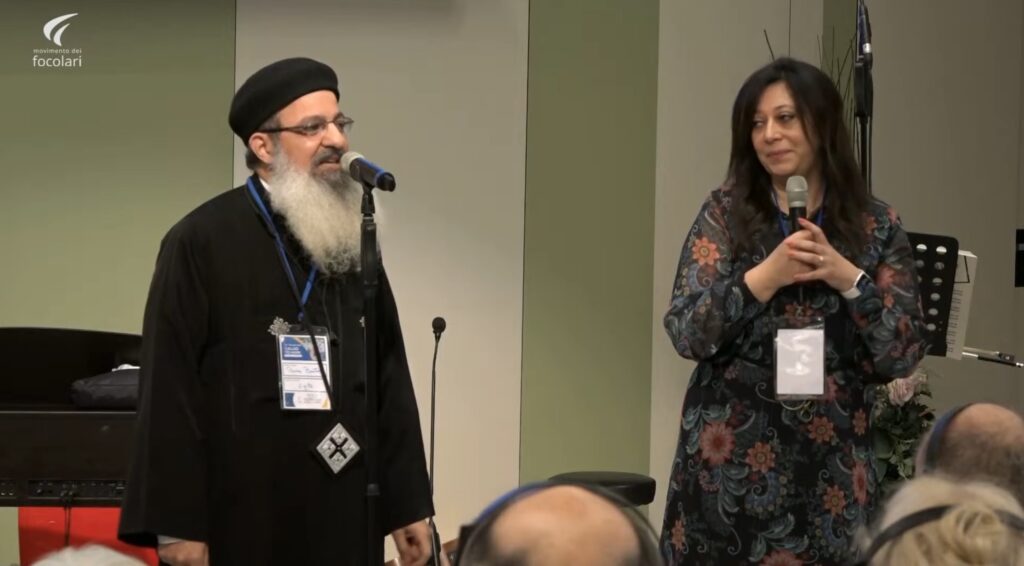
Let’s imagine a large room with 151 ministers from five different Christian confessional families: Coptic Orthodox, Greek Orthodox, Catholics, Anglicans, and others. Each has their own history, traditions and theological language, but all are united by a desire to forge a common path. This is the focus of years of annual meetings for which the Coptic Orthodox Church, led by Pope Tawadros II, has been a protagonist. We share here the news of these meetings as recounted by Coptic Orthodox priest Boutros Fouad, member of the Priests’ Commission of the Council of Churches of Egypt and the Egyptian Family House, as well as a doctoral student in the history department of the Institute of Coptic Studies in Cairo.

“May all be one”

The starting point of the events recounted here is the prayer that Jesus addressed to the Father on the night of his Passion: “That they may all be one” (Jn 17:21). This request is not just a spiritual phrase, but a concrete invitation to overcome centuries of divisions, born of political, cultural and theological reasons.

For a long time, unity was a distant dream. The Christian Churches were divided, leaving deep wounds in their wake. But something has changed in the twentieth century. The desire for dialogue and reconciliation has begun to make its way. The Coptic Church desired to be at the forefront of this journey and has actively participated in ecumenical organizations such as the World Council of Churches, in addition to promoting theological dialogues with other Christian communities.

The approach of the Coptic Church

The Coptic Church’s ecumenical work is based on three pillars.

The first is the search for true unity. Through long and patient dialogues, an attempt is made to understand and clarify doctrinal differences, especially those related to the nature of Christ, which for centuries have divided the Churches.

The second pillar is the cultivation of charity and mutual respect. The late Pope Shenouda III said that “religion is love,” and now Pope Tawadros II, whom many call “the pope of love,” is a vivid witness to this. For Pope Tawadros II, true ecumenical dialogue is born of authentic love that is capable of overcoming every difference or conflict.

The third aspect is practical cooperation. In a world marked by crises, wars and growing secularization, Christian Churches cannot act in isolation. They must join forces to face today’s challenges together, from the defense of the faith to service for the neediest.

Travels, meetings, initiatives…

Pope Tawadros II embodied this vision through his travels and meetings. From the historic meeting with Pope Francis in 2013 to his visit to the World Council of Churches in Geneva in 2014, to the creation of commissions with the Russian Orthodox Church, every step is a tangible sign of openness and dialogue.

In 2017, together with Pope Francis and Patriarch Bartholomew I, Pope Tawadros II participated in a historic ecumenical prayer in Cairo with the presence of the heads of the Egyptian Churches, a moment that showed the whole world the strength of possible unity.

An invitation to build bridges

Pope Tawadros’ words are simple but profound: “God considers division a sin and calls us to preserve unity.” “Christ is present when we are united.” “Knowing the other is the path to unity.” “Love unites, selfishness divides.” “Like the fingers of the hand, different but collaborating, so the Churches must work together.”  And his message becomes even stronger when speaking of the beauty of a person who embraces many cultures and knowledge, and how the lack of love is the root of all divisions.

The ecumenical history of the Coptic Church under the leadership of Pope Tawadros is therefore a history of hope, patience and faith. It is not just a theological dream, but a reality being built day after day, encounter after encounter, word after word, and guided by the conviction that the true Christian journey passes through love and mutual respect, despite our differences. It is an invitation for all of us to build bridges, to reach out, to truly become “one” in the body of Christ.

PDF version

Called to Hope – Key players of Dialogue
July to September 2025
No 28 – 2025/3
30 years of communion among Churches in Košice – Slovakia – Anton Konečný

focus | experiences

30 years of communion among Churches in Košice (Slovakia)

30 Years of Communion among Churches in Košice – Ekuména: A City-Wide Dialogue

Ekuména: a city-wide dialogue

Anton Konečný

The eastern Slovakian city of Košice, with its 250 thousand inhabitants, boasts several recent titles – Capital of Culture (2013), European City of Sport (2016), and European City of Reform (2018).  For this and more, it is also called “The Tolerant City.” And it was precisely in this context that, shortly after the fall of totalitarian regimes in the former Soviet bloc countries, a group of priests, together with laity from the Focolare Movement, helped foster an ecumenical initiative involving not only all the area Churches, but also the Jewish community and the municipality, called Ekuména. The author, a Roman Catholic priest, is one of its early protagonists and remains active to this day.

In 1994, in eastern Slovakia, Ekuména, the Ecumenical Community of Churches of Košice, was founded as a religious entity, and included nine Christian Churches: Roman Catholic, Greek Catholic, Evangelical of the Confessio Augustana (Lutheran), Reformed, Orthodox, Church of the Bohemian Brethren, Apostolic, Fraternal Unity of Baptists and the Czechoslovak Hussite Church. The Catholic University Faculty of Theology is also a member, and the Jewish religious community has been an observer member since the beginning. Over time, Ekuména developed its own Statutes and website: https://ekumenake.rimkat.sk

In 1990, the Košice municipality had established the Commission of Churches as a way of providing for their participation in city management, with this same Commission later welcoming Ekuména among its membership from the moment of its establishment.  A working relationship continues to this day.

Activities

Among members, the Word of God and exchanges of Gospel-based experiences are enduring elements forming the foundation of Ekuména relationships. During the year, their deepest shared commitment is centered around the Week of Prayer for Christian Unity, and the most attended initiative by pastors and faithful is the Passion procession through the various churches of the city on Good Friday. Ekuména also facilitates an ecumenical Veni Sancte Spiritus service at the beginning of each academic year as well as collaboration for the autumn thanksgiving harvest celebration and Advent prayer services.

Ecumenical cultural, social and community events are now part of city life and reflect ongoing requests from municipal government as well. The annual Festival of Sacred Art and Košice City Days are two such examples.

In collaboration with the Faculty of Theology, Ekuména is also committed to theological dialogue, and organizes professional and scientific conferences at an international level. The most recent initiative, at the end of 2024, was a conference commemorating the 25th anniversary of the signing of the Joint Declaration on the Doctrine of Justification. This collaboration with other Christian Churches has also given new impetus to theological dialogue in Slovakia.  Ekuména members visit each other’s offices and have made numerous joint trips abroad. Participation in international conferences, including the ecumenical network events of Together for Europe in 2004 and 2007 in Stuttgart, and later in Munich (2016), as well as the 2017 anniversary commemoration of the Reformation, all serve as strong motivating factors for the community.

Ekuména and the town of Košice

As mentioned, given that the Churches are present in the region Košice, Ekuména facilitates municipal relations as a natural partner, contributing to spiritual programs tied to important social events and local anniversaries, and fosters relationships among its citizens. For this, it was awarded the 1998 Košice City Award.  The municipality, for its part, provides a social space for Ekuména‘s activities and financial support. City representatives also participate, together with community members, in national and international ecumenical events, such as an important Jewish-Christian pilgrimage to Israel in 2006.

Beyond the borders of Slovakia

Beginning in 2013, Ekuména Košice also established ecumenical contacts in Transcarpathian Ukraine, on occasion of the  summer Mariapolis spiritual gathering in which several members of the Košice, Mukacheve and Užhorod ecumenical communities participated. Mukacheve and Užhorod are Ukrainian cities in the triangle on the border between Hungary, Ukraine and Slovakia. From this, emerged collaborative initiatives like the first joint Ukrainian-Slovak delegation that participated in a 2017 Rome congress commemorating the 500th anniversary of the Reformation. This relationship remained even during these years of war in Ukraine, and the spiritual support is stronger than ever.

PDF version

Called to Hope – Key players of Dialogue
July to September 2025
No 28 – 2025/3
In dialogue with the Fraternal Delegates to the Synod on Synodality – Blaumeiser and Kelli

focus | insights

In dialogue with the Fraternal Delegates to the Synod on Synodality

Called to Hope ecumenical conference - March 2025. A roundtable reflection on ecumenical dialogue at the Synod on Synodality, highlighting how shared listening and encounter are bringing Christian unity closer to reality.

Unity is not so far away

Edited by Mervat Kelli and Hubertus Blaumeiser

A central moment of  the ecumenical conference Called to Hope was a round table discussion with representatives of various Churches who had participated in the two sessions of the Synod of the Catholic Church on synodality: Archbishop Khajag Barsamian, representative to the Holy See of the Armenian Apostolic Church; Prof. Elizabeth Newman, president of the Commission for Christian Doctrine and Unity of the World Baptist Alliance; Prof. Dirk Lange,  Assistant Secretary General for Ecumenical Relations of the Lutheran World Federation; Catholic bishop Brendan Leahy of Limerick (Ireland), and Margaret Karram, president of the Focolare Movement. The round table was moderated by journalist Stefania Tanesini.

Stefania Tanesini invited each speaker to begin by sharing their lived experience of the Synod.


Professor Elizabeth Newman.
For me, the Synod was truly transformational. I understood more deeply that synodality is a way of being in communion with God and with others, learning to trust, to “let go”, trusting in the presence and wisdom of God. One’s own point of view must not prevail. One does not have to “win”. The meaning of “losing” or “winning” changes radically when it is considered within the Christological mystery: God works in ways that cannot always be predicted or imagined. Although – understandably – we could not vote, we were given a full chance to speak, listen and discern together, and we were encouraged to do so.


Professor Dirk Lange. I confess that I was a little worried about participating in an ecclesial meeting that would last four weeks. But this concern soon faded. We were seated at round tables, without distinction of rank or call. And the method of Conversation in the Spirit involved us in a discipline of deep listening. Everything and everyone were rooted in prayer. It upended  “business as usual” that happens at too many church conferences. The focus was on listening to all voices, including what Lutherans call the priesthood of all the faithful or the sensus fidei.

The Vigil of Repentance on 1 October was profoundly moving. We recognized our fragility on many levels, and so we began the Synod in the awareness of our need for forgiveness.

At the Ecumenical Vigil, ten days later, Pope Francis shared his unique vision of our ecumenical journey, telling us that we don’t have a ready-made model, but we discover it as we walk together.

Synodality is measured by relationships

Msgr. Brendan Leahy. Msgr. Brendan Leahy. The Vigil of Repentance was also very touching for me. We have heard testimonies of pain, failures, abuse, but also strong words of repentance. This has stayed with me as something to remember;  unity cannot happen without a new beginning, and for this there is always a need for humility. It made me think of the experience of Chiara Lubich and her first companions. When they discovered that they were called to live for unity, they realized that there would never be unity without mercy. And they made what has been called a “pact of mercy.” We, at the Synod, did something similar: a pact of mercy.

I would also like to recall a simple but significant episode. At the end of one of the sessions, one of the Fraternal Delegates, an Orthodox, asked me: “Would you like to come and have lunch with me?” Surprised, I accepted. We experienced a moment of fraternal sharing in which I was able to understand his tradition much better. We became friends. I understood, on that occasion, that synodality is measured by relationships.


Dr. Margaret Karram. Without the Synod I would not have met Elizabeth, Archbishop Barsamian or Dirk. The simple fact of being here together today is already a gift of the Synod.

For me, the Synod was an experience of the universal Church, thanks to the presence of cardinals, bishops, priests, sisters, but also of lay men and women, and above all thanks to the presence of the fraternal delegates. Their participation has enriched the synodal journey and opened up new horizons for us in communion between the Churches. Together we have experienced that – as Pope Francis has said several times – there is no synodality without ecumenism. I would say that the door of communion was already open, but the Synod opened it wider, perhaps becoming a door through which we must all pass. Otherwise, we risk missing an appointment with history. 


Respectful dialogue

Archbishop Khajag Barsamian. I felt truly embraced by a large family of sisters and brothers in  Christ: a profound and enriching experience, which brought together people from all over the world, with  different backgrounds and even with different perspectives, but all united by the same faith. What struck me most was the respectful dialogue. Even when different approaches or ideas emerged around the table, there was respect and love. This reminded us that our differences can coexist in an atmosphere of love and mutual understanding. The presence of the Holy Father Pope Francis at most of the sessions added an unparalleled significance. His personal greeting to each participant was not merely a formality, but one of genuine interest. The synodal process has encouraged an openness to learning from one another, thereby enhancing the spiritual and practical dimensions of ecumenism.


A second round of questions followed, with the moderator asking each speaker specific questions.


Listening and discerning, being silent, giving an echo, praying

Professor Lange: The Lutheran Church has a well-established tradition regarding assemblies, and “power”, we could say, that underlies synods. Was anything new for you in this recent synodal experience?

Yes, absolutely. One of the gifts of the Synod was the process itself. It was not a democratic Yes, absolutely. One of the gifts of the Synod was the process itself. It was not a “democratic” process, trying to get a majority on this or that issue, but a methodology that allowed for intense discussion and gave space to the action of the Spirit. It was wonderful to listen and discern together in the small group, to give feedback, to be silent, to pray. Through all this, a way forward was found, even in the midst of disagreements, and a text was written. The Synod, in this sense, was like a four-week spiritual exercise that had a profound influence on my self-understanding, on my ministry, and also on my Church.

The Lutheran World Federation is carrying out a similar process: we are questioning the doctrinal and communal authority and mutual responsibility of the member Churches, autonomous but committed to being a Communion of Churches. The Synod on synodality has given us a strong impetus and a clear direction. 


Our Relationships: Where God Speaks and Acts

Bishop Leahy: you are constantly in contact with priests, religious, faithful and even people far from the Church. Did this relational method practiced at the Synod affect your daily life and ministry? And what do you foresee for the future?

After the Second Vatican Council we understood that we are called to communion, but we struggled to understand how. With the Synod we began to recognize important elements of discerning together.

I took away the method of “Conversation in the Spirit”, as a way to follow in the diocese. We are at the beginning, we have begun to train people, to prepare them for this style. And I too, of course, am called to live this dynamic: to recognize the positive in the other, to listen more – and this is always a great challenge, because it is easy to have the answer ready – to put judgments aside…

We have, in the Catholic Church, a long tradition of spiritual retreats that teach us to listen to God’s voice within us, but we have less experience in hearing God’s voice among us. The Synod emphasizes that we are saved not only individually, but our relationships are also redeemed. We must learn to value this: our relationships can become the place where God speaks and acts. It is no coincidence that the Synod placed the Risen Christ, who dwells in the body of the Church, at the centre. It is up to us to create the space for him to manifest his presence.

A Church that knows how to listen and walk together

Professor Newman: Has this synodal experience had an impact on your spiritual, ecclesial, personal, academic life? And what prospects does this experience open up in your opinion?

The Synod was a deeply spiritual experience for me. Back home, I cried for three days, not so much because of the fatigue – which there certainly was – but because of the spiritual depth of what we had experienced. For me, it was a moment of “Church in the making”, in which the presence of the Spirit was really tangible. Despite the fact that we were so different – bishops, laity, religious, men and women, from all over the world – we tried to listen to the Spirit together. There was a common desire to build something new, without destroying what is already there, but recognizing that the Spirit calls us to something deeper, more authentic.

In my academic life and in my service in the Church in the United States, all of this has had a tremendous impact. I am trying, with others, to promote moments of community listening, in this spirit. And I see that people are ready, eager to be heard, to speak heart to heart. This, in my opinion, is the core of what synodality can bring: a Church that knows how to listen, that knows how to walk all together and is not afraid of confrontation, because it knows that Christ is at the centre.

I am convinced that synodality, faithfully engaged, can also be a response to political polarization in the Church. In the United States, this polarization has deeply divided the Churches. Synodality is an alternative to this. When we are together, we can trust that God is with us, even in pain, even in division, and bear abundant fruit. 

A style and a spirit to spread

Archbishop Khajag Barsamian:  Your Eminence, what has remained with you from the and what do you think is important to carry forward in the future?

I lived the Synod as a time of grace, a spiritually profound experience. I felt the presence of the Holy Spirit among us.

The traditions of the Armenian Apostolic Church have taught us for centuries to live synodality. I was struck to see so many brothers and sisters of the Catholic Church walking together, listening to each other, seeking God’s will together.

The strongest moment for me was that of common prayer, every morning and every evening. It reminded us that we were not there for ourselves, but to serve Christ and the Church. It was possible to live synodality not only as a structure, but as a spiritual attitude, as a lifestyle. I really hope that this spirit will spread more and more, in communities, in parishes, among bishops, among young people. It is a new time, and we must welcome it with courage.

The Final Document of the Synod brings a deeper understanding of Christian unity. It emphasizes spiritual ecumenism, which goes beyond simple institutional collaboration to focus on shared prayer experiences. The ecumenism of blood, that is, mutual suffering and sacrifice among Christians, showcases a united front against injustice, reinforcing solidarity among Christians

The call for inclusive dialogue, rooted in mutual respect, opens up new possibilities for collaboration on issues such as social justice, interreligious dialogue and global challenges, and can lead to a more comprehensive understanding of Christian mission in today’s world. In all of this, it is crucial to embrace diversity, while recognizing the common faith that unites us as disciples of the Lord Jesus Christ.

Repercussions beyond the sphere of the Churches?

Margaret Karram: During these three years of the synodal journey, you were by the method of Conversation in the Spirit. What are your thoughts on it? Do you think this method can also be useful outside the strictly religious sphere?

The Conversation in the Spirit has made us live the experience of a relational Church, it has given us the opportunity to strengthen our relationships: laity, bishops, people of God, Christian Churches… We are called to continue this journey now at the local level. We need to learn to work together. Otherwise, we will not make any progress in unity. Cardinal Mario Grech, the Secretary General of the Synod, said recently that it is not a question of “adding work to work, but of helping the local Churches to work in synodal style”. He reminded us that this phase of implementation requires a real conversion, a change of mentality, and that needs time.

We too, in the Focolare Movement, are trying to put this method into practice. It strengthens the instruments of spirituality that Chiara Lubich left us: “making ourselves one”, that is, feeling what the other feels, listening deeply, bearing the burdens and concerns of the other and sharing his or her  joys; dialogue, which means respecting the other’s way of thinking and enriching each other; listening to the Holy Spirit, to the voice of God within us.

We have a great responsibility to experience all this authentically. If we can do this, our relationships with others will have a greater impact. And if that becomes a way of life in society, also in politics, economics, etc., I think the world can change. 

The moderator then asked: In the situation of our world today which almost all of you speak of, is hope still possible? What can offer hope?

Hope today

Margaret Karram:  If we look at what is happening daily in many parts of the planet, we could despair. But we are Christians, and we know that hope is a virtue not to be lost. We must cultivate it and nourish it within us, in order to be able to transmit it to others.

We know that our hope is in God, and he does not disappoint. The more we have faith and the more we make small gestures of charity towards our neighbour – gestures of solidarity, communion, openness – the more hope we can have.

This encounter is already a sign, perhaps a small one, but it is like a flame that illuminates the great darkness of humanity. It is a sign of hope that we can spread and that allows us to build networks with those in the world who work for Christian unity, for peace, for the poor, for migrants, etc.

The synodal journey is teaching us that together we can do it. It is this “togetherness” that gives us the strength not to lose courage, not to feel powerless, but to sow seeds of hope wherever we are.


Professor Dirk Lange: I would like to add that I think that if we had had a Conversation in the Spirit in the sixteenth century, with this kind of listening and discernment, perhaps we would not have had the division between Catholics and Lutherans.

I believe that one of the most important aspects of the Synod was precisely to rethink the role of the Bishop of Rome as the one who offers a space for synodality. I have a very firm hope because of what happened on the last day of the Synod, and it still excites me: after the votes and the approval of the Final Document, Pope Francis made what for me, as a Lutheran, was a historic announcement: he welcomed and approved the Document and said that he would not publish a post-synodal apostolic exhortation. That is to say: the voice of the Synod – of lay people, ordained ministers, young people, women, men, ecumenical guests – has acquired an almost magisterial value. It was an incredibly moving moment, and the room was overflowing with joy.


Dr Margaret Karram, as convener, concluded the round table saying:

It is wonderful that fraternal delegates of other Churches could take an active part in this Synod, and we have been enriched by this. This shows how far the Catholic Church has come and it gives us hope. Certainly, much remains to be done, but unity between the Churches is not so far away.

It is important to make these steps known.

Otherwise, there is the risk that we will carry on with the idea that the Catholic Church thinks in a certain way and the Anglican Church in another, and that’s it. The Synod on synodality served to reflect together on a relational Church, in dialogue together and learning from one another. We must be grateful for this experience.

In dialogue with the
Fraternal Delegates to
the Synod on Synodality

 
Time: 1 hour 24 minutes

Video copyright of Centro S. Chiara Media

PDF version

Called to Hope – Key players of Dialogue
July to September 2025
No 28 – 2025/3
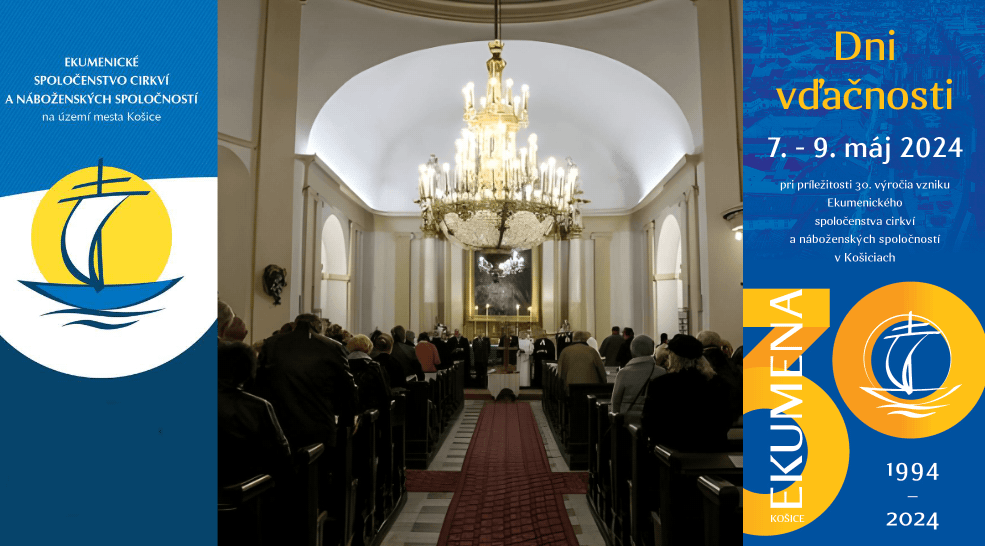
Grassroot ecumenism in the USA – Karen Petersen Finch

focus | experiences

Grassroots ecumenism in the USA

Karen Petersen Finch reflects on grassroots ecumenism in the United States, showing how local dialogue between Christians can foster unity, shared faith and renewed witness.

Image: Samford University

The Clarkston Dialogues

Karen Petersen Finch

The author, an ordained minister in the Presbyterian Church and ecumenical theologian, recounts here an experience of dialogue lived by her community and the Catholic community in Clarkston, Washington (USA). Fidelity to methodological presuppositions of dialogue brought numerous fruits of the Spirit, including unexpected insights from a doctrinal perspective, and serves to highlight the essential contribution of the laity in this ecumenical process.

In June 2018, believers in Clarkston, in the state of Washington (USA), made the unusual decision to merge the Holy Family Catholic Parish and First Presbyterian Church Family Evangelizing Bible Schools. In a nutshell, they decided to share the Good News with their neighbors, together. But the experience also brought doctrinal issues that members of both Churches wanted to address. That is, it was a question of specific teachings of the two respective Churches (Catholic and Reformed) and their judgment as to what is truest and most precious for their Christian identity. In practice, the question was whether these two different Churches could continue evangelizing together, despite the two communities obviously diverging around some doctrinal points.

Against this backdrop, from 2019 to 2021, I and 32 others planned and then conducted three rounds of dialogue. They focused on salvation, the papacy, and the Eucharist/Lord’s Supper. My book Grassroots Ecumenism: The Way of Local Christian Reunion tells the story of these Clarkston Dialogues, of how the faithful of the two communities learned their own theology and that of their neighbors. Skills in dialogue were acquired and differences were faced honestly. The faithful gathered with love and courage, to deepen their Christian commitment and mission to their neighborhood and became consciously ecumenical. And all of this during a global pandemic.

Assumptions and goals

Our goal was to be radically honest about the differences between the teachings of our Churches. Through a dialogue process, we could move closer to a common viewpoint.    of dialogue, a viewpoint that reflected our best understanding of the Good News of Jesus Christ.

This meant that the viewpoint  we sought was biblical, drawing deeply on our shared Scriptures. Secondly, this viewpoint was Trinitarian, rooted in the mission of the Father, the Son, and Spirit.  And finally, that it is apostolic, grounded in the witness of the early Church. Thus, it signified a becoming more deeply Christian together.

To achieve all this, it was necessary to start from common assumptions that were at the basis of all our planning:

– Lay people can thoroughly understand the doctrine of their own Church and can dialogue skillfully with the beliefs of neighboring Churches.

– The work of national and international experts in church unity is not finished until lay persons are participating at the local level.

– Shared witness, service and justice are wonderful, but unity is not solid unless we are also working toward agreement in doctrine, no matter how difficult the conversation or how distant doctrinal unity might seem.

– Local dialogue is a work of the Holy Spirit that can deepen faith in Jesus Christ and commitment to his Gospel.

The last assumption highlights a recurring pattern in the dialogues: Local dialogue and pneumatology go together. Doing theology with the entire people of God taught us to depend, without excuses, on supernatural assistance.  We prayed a lot, and I can bear witness to the fact that all of the Clarkston participants took special delight in praying together.

It was precisely thanks to the help of the Spirit that our goals were possible. We could learn dialogue skills that made room for the Holy Spirit, for openness, transparency and generativity. The Spirit also brought us to come together honestly and respectfully without softening our differences, and to proclaim the Gospel together there, through word and deed.

Two surprises

From what I have shared, you may have already noted what I call, The two surprises.

The first surprise was a recognition of the role of the laity in the local Church context as qualified agents of doctrinal dialogue. It takes the whole people of God to work out our doctrinal differences: clergy and laity. Ecumenical theologians know this, and they hope that their work will “trickle down” and be received in the Churches, even if this does not always happen because of the persistent assumption that only theological experts can participate in theological dialogue. Hence Surprise no. 1: Why not educate lay persons to serve as stewards of doctrine in their neighborhoods?

The second surprise was a rediscovery of the central role that doctrine occupies in this project. Most local ecumenism is focused on building positive experiences and relationships, often through shared worship or Bible study, and shared mission and service. But why leave doctrinal questions out of the local picture? If doctrine is part of the problem, then it needs to be part of the solution. Simple assimilation without doctrinal discussion, in which differences are never resolved, can crumble under pressure. So, why not engage boldly with our differences?

Together these two surprises add up to a proposal for local doctrinal dialogue by the whole people of God—clergy and lay people together — with a special emphasis on lay people, who may not have been included in the past. My desire is that other communities can experience the joy that we experienced from the living into the two surprises.

What Doctrine Can Do in Local Dialogue

Today, many people think that doctrine is divisive. We, on the other hand, have the great joy of witnessing how the dialogue of the laity at the local level, when it also pays attention to doctrine, produces precisely the opposite of division, in that we have seen an increase in reception, hope, emotional participation and legitimacy.

First, open discussion of doctrinal differences fosters what ecumenists call reception: making a tradition one’s own. This work enables all the People of God to better understand and to inhabit their own traditions more fully. In all our Churches there is a great desire to know more about their own doctrines and to respond personally to them; for this reason, dialogue must be accompanied by a process of education. Educated lay people feel deep joy in returning again and again to the central affirmation that Jesus Christ is Lord and that this reception of Christ can inspire both evangelization and ministries of justice, giving rise to a desire to serve our neighborhoods in concrete ways.

Second, open discussion of doctrinal differences brings with it a surprising amount of hope. Paradoxically, the level of exploration required to honestly probe the differences brings us closer to our common ground. This is what I write in my text: The fact that the main differences are not arbitrary, but present themselves according to discernible patterns, is a source of hope because it makes us think of a unity under the rupture, or – to use another spatial metaphor – of an eschatological unity that is before us١. This is true until we succumb to a false peace: “We noticed that our closest approach to that unity was always when we were uncompromisingly clear that we had not yet achieved it.” In the analysis of the differences, we have also experienced glimpses of new shared doctrinal positions that I call “seeds of collaboration” (see below).

– Doctrine is also not only intellectual but, having to do with values, stimulates our feelings. When my children were young, I read a book about sibling rivalry. The author said that, if we give space to negative emotions in the family, positive ones will follow. I can only say that this is my experience of secular dialogue. When members of divided churches feel that they can express their Christian convictions without necessarily having to agree, they suddenly discover a strong desire to get along. And so, love begins to flow: the honest difference, in the presence of love, is almost magical in its ability to move people towards each other.

Fourth, a doctrinal focus can help to give legitimacy to local efforts of the laity for Christian unity. Doctrinal formation allows them to take their place alongside Church leaders and professional theologians as decision-makers in the Church. In this sense, this experience accords very well with the efforts aimed at synodality. It is more likely that bishops, general assemblies and other authorities will recognize that local dialogue can and does change the ecumenical framework, as any progress at the local level helps to ensure a good chance of lasting and spreading.

Seeds of collaboration

To the question of whether the laity can act as guardians of doctrine, through a dialogue that generates new shared doctrinal approaches and new relationships, we can therefore answer positively.

We have experienced what I call “seeds of collaboration”, glimpses of a common point of view as I mentioned above. It is a germ or an idea that could be shared by both communities: an idea that points to our better understanding of the Gospel, a common insight or a glimpse of catholicity under our breakdowns.

An example is what Sharon of the Holy Family parish expressed to us, who one day told us: Heaven is present among us when we live the experience of the Mass/Supper of the Lord.” I don’t remember what happened before and after you compared participating in the Eucharist to suddenly finding yourself in Heaven. As a Reformed Christian, I remember being struck by the similarity between Sharon’s words and Calvin’s vision of the Lord’s Supper as union with Christ “in heavenly places.” Yet, the words and images Sharon used to express her insight were all deeply Catholic, like her. I noticed a silence in the room after she had spoken, as if the members of both Churches were slowly digesting this new insight with increasing appreciation. Sharon understood something true. It was a seed of collaboration.

The laity and doctrine

This story illustrates both surprises: Laity as stewards of doctrine, and doctrine as the fuel for renewal. One could say that the affirmation that “Heaven is present among us as we experience the Lord’s Mass/Supper” is a very small seed of unity. But the Kingdom of God is also like a mustard seed, and, in a sense, the real “seed” is the local dialogue itself.

I pray that the seeds planted in Clarkston will grow and others will also experience the joy of unity in the Holy Spirit through dialogue in their neighborhoods. In this way, each will be strengthened in love and witness, through the crafting of a common viewpoint that is grounded in the person of Jesus.

___________________________

1 K.P. Finch, Grassroots Ecumenism. The Way of Local Christian Reunion, New City Press, New York 2022, p. 30.

2 Ibid.

Clarkston Dialogues
Rev Karen Petersen Finch

Time: 36 minutes
Talk: 24 minutes
Questions and answers: 12 minutes

Video copyright of Centro S. Chiara Media

PDF version

Called to Hope – Key players of Dialogue
July to September 2025
No 28 – 2025/3
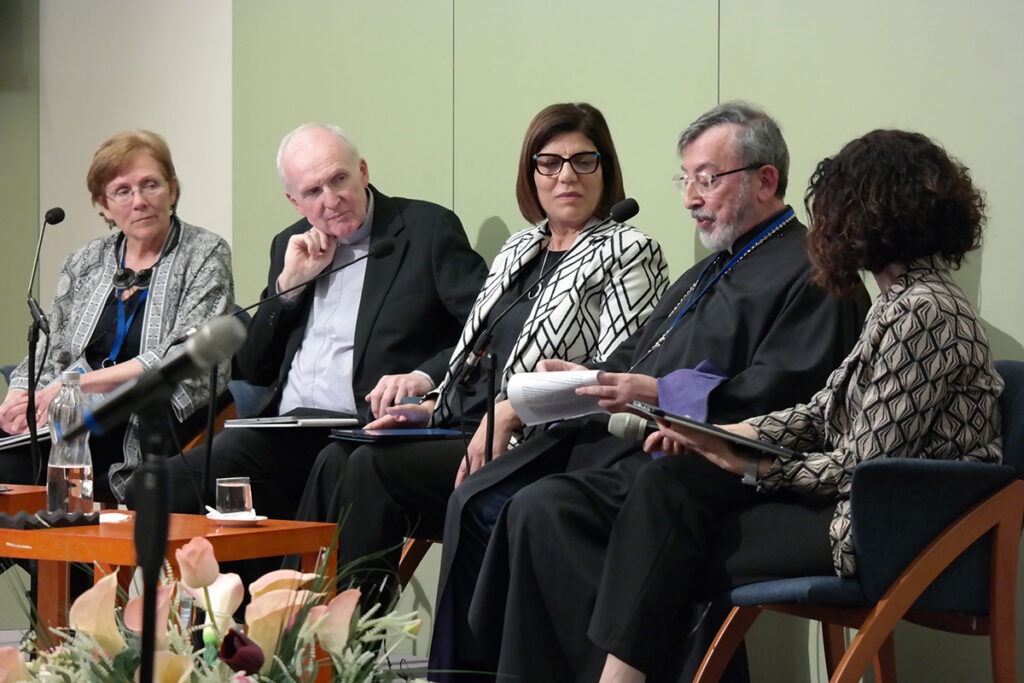
Ecumenical and interfaith dialogue in Italy – Mgr. Derio Olivero

focus | experiences

Ecumenical and interfaith dialogue in Italy

Mgr Derio Olivera reflects on ecumenical and interreligious dialogue in Italy, exploring how shared faith and cooperation can foster social cohesion, peace and a renewed public life.

Generative communities in society

Mgr. Derio Olivero

The author is bishop of Pinerolo (Italy) and president of the Episcopal Commission for Ecumenism and Dialogue of the Italian Bishops’ Conference. He reflects here on the Commission’s work with the National Office for Ecumenism and Dialogue in Italy, and on collaborative changes in approaches to dialogue. Bishop Olivero highlights efforts by Catholics to offer themselves, together with other Christian confessions and other religions, as instruments for common development in civil society. especially in justice and peace education.

Our world needs dialogue. Christians must rediscover their vocation to dialogue starting from the splendid words of Saint Paul VI, who said: The Church must enter into dialogue with the world in which it lives. It has something to say.  message to give, a communication to make.(Ecclesiam suam, n. 65). Then we also remember the words of Pope Francis in his encyclical, Fratelli tutti: Together, we can seek the truth in dialogue, in relaxed conversation or in passionate debate. To do so calls for perseverance; it entails moments of silence and suffering, yet it can patiently embrace the broader experience of individuals and peoples. … The process of building fraternity, be it local or universal, can only be undertaken by spirits that are free and open to authentic encounters. (n. 50).

The Church in Italy, through the work of the Episcopal Commission for which I preside, and with UNEDI (National Office for Ecumenism and Interreligious Dialogue), would first like to announce that the Permanent Council of the Italian Bishops’ Conference has decided to dedicate an upcoming General Assembly of Bishops (probably May 2026) precisely to the theme of ecumenism and dialogue. It will be the first time! It is an important sign, in light of the ongoing activities which I will share briefly here.

Religions as an instrument of social cohesion

Last month I was in Abu Dhabi, together with UNEDI director, Fr. Giuliano Savina, and a group of regional delegates. In the district dedicated to culture, the government has created, the Abrahamic Family House: three places of worship of the same size, a church, a mosque and a synagogue. They have a shared Forum for meetings, seminars, conferences, and children’s education. The concept held by the government struck me; namely that religions can foster social cohesion and brotherhood in the public sphere.

It seems an excellent idea to me. Over the past two years in Italy, we participated in day-long discussions with the heads of Churches present in our country1 and, similarly, held other day-long discussions with heads of other religions. One noteworthy element during our meetings with the heads of religions, was the importance of presenting ourselves as exponents of Christianity, together. And our reflection is increasingly oriented towards themes around religions and the public space.

The Community of Believers as a place of generativity

After the long ecumenical journey dedicated to knowledge and dialogue between Christian confessions in search of common ground, and after beginning dialogue with other religions in Italy (from a “Catholic Italy” to an “Italy of religions”), it is now increasingly urgent to open a joint dialogue with non-believers, the “nones” (atheist, agnostic or “nothing in particular”), and above all with the “secular space”. The Czech scholar, Tomáš Halík, calls this the “third ecumenism”.

It is an effort that will aid us first and foremost in staying together in our differences.

Secondly, it will help us better understand that today, as Christians, we must collaborate to express Christianity in a post-Christian society. We need to make use of our own unique traits, because in this light, differences are a wealth that expresses a diverse richness.

Among the various religions, we can help one another express transcendence in secular society and weave spiritual seeking into today’s post-secular world.

Finally, we can help one another to question religion’s role in society, both by learning how to best enter the public space on tiptoe, and to tease forth a revision of current ideas regarding secularism.

We believers still need to undertake a serious journey in society, one of learning how to be of service as generative communities in dialogue without special privileges, rather than as headmasters or nostalgics. We need to work with a new style and institutional organization, including us Catholics.  

Evangelii Gaudium also applies to us: “Time is greater than space” (n. 222). We need to shift from a Church that controls space, to a Church that that helps sustain the journeys of men and women. From a Church that takes care of itself and its organization, to a Church that equips itself to go towards others, able to offer help in the humanization of society. And certainly, together, we must ask society to review its relationship with religion(s) and its ideas of secularism born after the warring among religions. Etsi deus non daretur. It is as if ‘God did not exist.’

Thus, these meetings together (interspersed throughout the year with online meetings) assist us in creating an “Italian way” of ecumenism and dialogue.

Dialogue as a lifestyle

A second area of work (especially by UNEDI) is one of enlarging the “niche”. Unfortunately, we must acknowledge that ecumenism and dialogue are still issues of most concern to only a small part of the People of God, those working in these fields or with a particular interest. This is also true for individual Catholic dioceses, where ecumenism and dialogue are often entrusted to an individual delegate for outreach. Instead, we are working to ensure greater interaction with other offices in the Church. Dialogue is not one person’s prerogative, but rather it must become a lifestyle for all. 

A third aspect is education. With the Italian Bishops’ Conference education offices, we worked to create factsheets that provide “correct knowledge” about other religions. Sixteen educational factsheets about Judaism have already been published and translated into English as well. It was first and foremost a true work of dialogue, because each was written by a mixed group of experts.  The aim is to impact school environments, with the goal of helping to build the society of the future. As Nelson Mandela said: “Education is the most powerful weapon which you can use to change the world.” The goal of ecumenical work and interreligious dialogue is not only an educated coexistence between confessions and religions, but it is a passionate search for a more just and peaceful world.

1     Cf. Spiritual Conversation between the Churches in Italy, Rome, 16 June 2025: https://www.youtube.com/watch?v=sHLuFVkv6bs

PDF version

Called to Hope – Key players of Dialogue
July to September 2025
No 28 – 2025/3
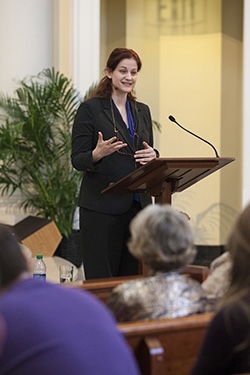
The urgency of unity – Jesús Morán

focus | insights

A Catholic philosopher and theologian responds

Jesús Morán reflects on the urgency of Christian unity, exploring ecumenism as a path toward reconciliation, peace and a renewed ethical vision for humanity.

The urgency of unity

Jesús Morán

Fulfilling the dream of an “ethical constitution” of humanity

I fully agree with Callan Slipper[1] that ecumenism is an imperative. Given the enormous challenges facing the world today, Christian disunity is untimely, out of place, anachronistic and even scandalous. We must ask ourselves why we are divided, when peace is threatened everywhere and carefully built structures of civil coexistence are collapsing under pressure from new forms of despotism and imperialism that threaten to destroy humanity’s ethical progress in recent centuries? I believe the lack of a true ethical conscience in various societal realms – something we see in many of the world’s decision-makers – is among the most delicate challenges of our time. And it is precisely here that religion can play a decisive role. In this sense, Christian unity, by strengthening the role of spirituality as a driver of social change. It is a unique opportunity that cannot wait.

My recent travels in West and East Africa strongly confirmed this belief. I was filled with hope by meetings with leaders of different Churches working together for reconciliation, development and peace in nations like Sierra Leone, the Ivory Coast, Rwanda and Burundi, which were devastated by civil wars of unprecedented cruelty. This willingness to overcome differences and undertake a common journey can be found in many African countries, and the leaders of other religions, especially Islam, share this willingness.

The dream of an “ethical constitution” of humanity regarding human rights and peace, proposed by thinkers of the last century and even more relevant today, can only be fulfilled if Christians really encounter one another; if together we engage in interreligious dialogue and dialogue with our contemporary culture.

In my opinion, two changes of mentality are needed in order to do this.

A move from union to unity

First, the transition from union to unity is needed. According to the Ecumenical Patriarch Bartholomew, we are at an epochal turning point of enormous import. Union is good, but not enough. In a relationship of union, the parties pursue a common good but remain alongside one another in a limited mutual relationship, measured based on their own interests. They support one another but remain substantially unchanged. Moreover, such a union – at least in principle – is not necessarily open to the outside world.

In recent times, we have witnessed the failure of many forms of union. It is enough to consider the organizational crises of institutions like the European Union or the United Nations. Such institutions that could make major contributions to the life of humanity appear useless and ineffective at crucial moments when peace is threatened.

In unity, on the other hand, there is no opposition but profound interconnection. The interests of the parties coincide with the shared interest, which is paramount. Reciprocity is not superficial but deep and open. The growth of each one coincides with the other, because, in the end, when one lives unity, “one lives the other”, as Chiara Lubich says.

While union is fundamentally strategic, unity is creative through the dynamism of the “we.” It does not cancel diversity but recreates and transforms it. A transcendent image of unity is the Trinitarian relationship between the divine Persons, where the Father lives in and through the Son,  and the Son lives in and through the Father in the Holy Spirit.

Ecumenism has made many steps forward in union, but what history now demands is unity (in diversity).

Christianity: a way of being

Secondly, it is important to see Christianity not only as a religion, but above all as a way of being, as Orthodox philosopher and theologian Christos Yannaras emphasizes. This perspective in no way detracts from the transcendent and eschatological nature of Christianity. It is not, in fact, a question of “immanentizing” or reducing it to an ethos or a project of social transformation. Rather it is an appealing to its essence, which is none other than radical conformation to Christ. Christ, the Incarnate Word, entered history to inaugurate a new way of living in the world. Through his life, message, gestures and actions, Christ is the “new humanity” awaited by the old one. “So if anyone is in Christ, there is a new creation: everything old has passed away; see, everything has become new!”, says Paul in 2 Cor 5:17. And again, in his letter to the Galatians:”…a new creation is everything!”(cf Gal 6:15).

With Christ, history embarks on its true journey towards consummation of the universe in unity. Christ is the definitive access to God – now revealed as Father – which the human religious spirit has always sought. This access passes through our humanity, with its greatness and its misery. For as long as Christianity has existed, access to God is both human and divine at the same time. If we can prioritize the existential and transcendent reality of Christ in us, instead of our “Christian doctrines,” we will find ourselves closer than we think.

Here, then, are two fruitful ecumenical paths that could respond to what history is asking of us today: unity rather than union, and Christianity as a way of being rather than a “doctrine”!

PDF version

Called to Hope – Key players of Dialogue
July to September 2025
No 28 – 2025/3
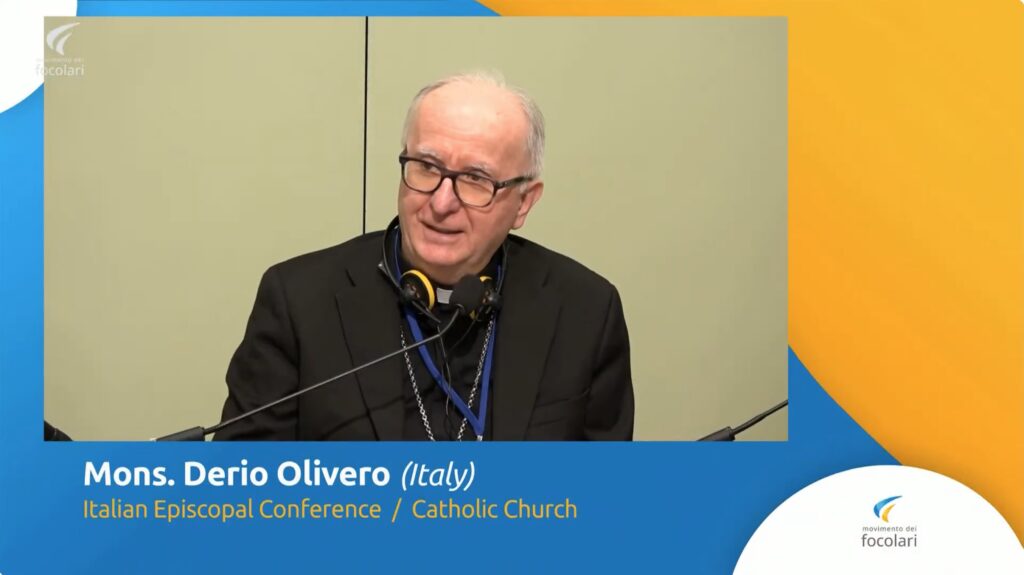
The world needs ecumenism – Callan Slipper

focus | insights

A reflection on Christian disunity in today’s world

In a world marked by division and conflict, this reflection explores why ecumenism is not optional but essential. Drawing on Christian faith and experience, Callan Slipper invites readers to rediscover unity as the heart of the Gospel and a vital path toward healing, reconciliation and renewed hope for humanity.

The world needs ecumenism

Callan Slipper

Ecumenism is anything but a “niche” activity. It concerns the very heart of the Church’s role in the world: to enable people to experience the “new creation” inaugurated by Christ, and to be a sign and instrument of a reconciled world. This task is more urgent than ever in the present global context, and this article invites us to become more aware of it. The author is an Anglican priest, theologian and writer. After several years as head of ecumenical relations for the Church of England, he currently coordinates the national organisation Churches Together in England and the Society for Ecumenical Studies

The world is in desperate need of ecumenism. This statement may seem exaggerated but firmly believe it to be true. Christian unity is a matter of vital importance for all humanity.

Let me explain. We look at the reality around us: the world seems to be falling apart. This happens periodically in history, and, despite the pain, I have no doubt that God is with us on this journey. However, wars, crime, institutional failures, and questionable decisions at the highest levels are evident everywhere. The global balance of power is shifting, making the world a more dangerous place.

The central problem, however, is simple. It is the logic of force, that is, a way of thinking that decrees that I must, or my country must, or my group must dominate and destroy anyone perceived as a threat. In this logic, good comes from the annihilation of enemies and exploitation of the weak. In other words, from being the strongest.

This vision presents itself as the only realistic way of dealing with things as they stand. The only peace it can produce, however, is that of the graveyard, a silence that reigns after everyone is either exhausted or dead.

Confronting violence

It is easy to feel powerless in the face of the tide of violence and division unleashed by this false realism. I have felt so myself. But we are not powerless.

We can pray. But, by God’s grace, we can do more. While prayer is powerful, we can apply a different logic and build a culture in which peace is born from relationships, from encounters between people, from reconciliation and forgiveness which always go hand in hand. We can tackle the problem at its roots.

We can start here and now with the people around us. We can live out a response contrary to the logic of force that leads to conflict and embrace a logic of unity among people that leads to peace. Although this approach may seem weak, because love in its tenderness, in its care, in its yielding to the other seems weak, it is in fact strong. When we love one another as unity calls us to, not only do we enter into relationships that heal humanity’s problems, but an amazing thing happens, God himself becomes present among us. It is something wonderful.  We heal humanity and bring God into our moment in history: here, now.  It is an affirmation of what Christians call the kingdom of God.

The Church: an instrument of reconciliation

This is where ecumenism comes into play. God has chosen an instrument to promote loving relationships in which he dwells among humanity. It is the Church, which is all of us, the community in continuity with the ancient people of Israel, founded by God himself made flesh, Jesus. As the apostle Paul says, “in Christ God was reconciling the world to himself” (2 Corinthians 5:19) and the Church lives and proclaims this reconciliation.

Reconciliation with God leads us to be one with God and consequently with one another. When we live this unity, a new world begins, a new creation, as Paul says a little earlier in the same letter (2 Cor 5:17).

And here lies the tragedy. The Church, in the actual history of Christ’s followers, is unable  to live what she is called to be, because she is divided. The consequences are massive. We have shattered the new creation in its historical expression, weakening our impact on God’s plan for the world. Because of our divisions, we cannot have the beneficial effect we are called to produce.

If we want to respond to the needs of our time, Christian unity is vital. The reconciled body of Christ can be the anticipation, the sign and the instrument of the new creation, in other words, of the kingdom of God. By living in unity in the present moment, we experience the joy of the Kingdom and show it to the world; we are its witnesses, its sign, because we are its real presence; we can share God’s mission, reaching out to others with His love and bringing His living presence into creation. But for all of this to have a real impact, we must overcome our divisions.

God’s longing

We must emphasize that this work of ecumenism does not only respond to the problems of our time. There is something even more wonderful, which we have already mentioned, that guides every effort to build Christian unity.

To understand this better, we need to take a step back. Let us remember that God in his infinite love, desires to dwell with us and share with us the beauty of his being. Even without problems to solve, this is God’s goal. The Church’s primary vocation is to be a unique place where the joy and beauty of God touch the cosmos. But always on one condition: the Church, receiving the gift of grace, must live its essence, be united, be the home where authentic love for one another dwells. The Church community is incredibly special. It is that part of humanity that has accepted God’s wonderful gift in Jesus, and in this community, God is present with us.

An ecumenism that revolutionizes all our actions

The challenge is to live an ecumenism that revolutionizes the way we do all things, recovering a deeper understanding of what Jesus came to bring. Too often we have been content to follow Jesus only through worship and a sprinkling of kindness in daily life. We have reduced his new creation to a mere religion. Of course, it is also a religion, but the religion of Jesus is the refoundation of humanity, which touches every aspect of our lives as individuals and as a society. This is the mission of God in which the Church is called to participate. It is not locking Jesus up in our places of worship.

Christianity is not a hobby for the devout, nor a system of devotional practices. This is not the teaching of Jesus. For him, relationships with others come first. Jesus quoted the prophet Hosea when he said to the Pharisees: “Go and learn what this means, ‘I desire mercy and not sacrifice.’” (Mt 9:13). In Hosea, the quote is even more explicit: “For I desire steadfast love and not sacrifice, the knowledge of God rather than burnt offerings” (Hos 6:6). Our worship, precious as it is, is secondary to how we relate to one another. The same concept is reiterated by Jesus in the Sermon on the Mount: “So when you are offering your gift at the altar, if you remember that your brother or sister has something against you, leave your gift there before the altar and go; first be reconciled to your brother or sister, and then come and offer your gift..” (Mt 5:23-24).

Human relationships: places of encounter with God

How shocking this is. It means that our human relationships are the place of our encounter with God. Have we ever really taken this seriously in the history of Christian spirituality? Have we heard what Jesus meant when, on the eve of his death, he prayed that we might be united as he is one with the Father (Jn 17:11:21-23)? He asked that, together, we be enveloped with Him in the bosom of the Father. He asked that frail human beings, often sinners and limited, participate together in the life and way of being of God himself, that the finite and the fallen participate in the infinite and the holy whole.

This emphasis on relationships does not negate the many ways in which God comes to us: the presence of God within ourselves, in others, in the Word, in the sacraments in which may of us rejoice, to name a few. They affirm the dignity and incredible opportunity of our personal interactions. When we set foot on them, we walk on sacred ground.

Ecumenism, by repairing our personal interactions within the Christian community, allows the Church to be herself. We need what humanity needs. Without it, our spiritual health diminishes, just as every other dimension of human life cannot reach its fulfillment without the reconciliation brought by Jesus, whether on a political, social, economic, environmental or psychological level.

The Church: like a large stained-glass window…

It is as if the Church were a large stained glass rose window, one of those sparkling windows of multi-colored glass found in the façade of certain churches, and extraordinarily beautiful when lit up by the sun. With our divisions, that rose window has been shattered and its fragments are scattered on the ground. Every piece is still beautiful, every Christian community is beautiful, but they all lack the splendour they would have if they were united, placed back in their place, where light can shine through them.

Together with all humanity in its present travail, we need that window to be restored, so that we may be illuminated and enflamed by the glittering beauty that is ours. All of us, as a Church and as humanity, need Christ, the Light of the world.

PDF version

Called to Hope – Key players of Dialogue
July to September 2025
No 28 – 2025/3
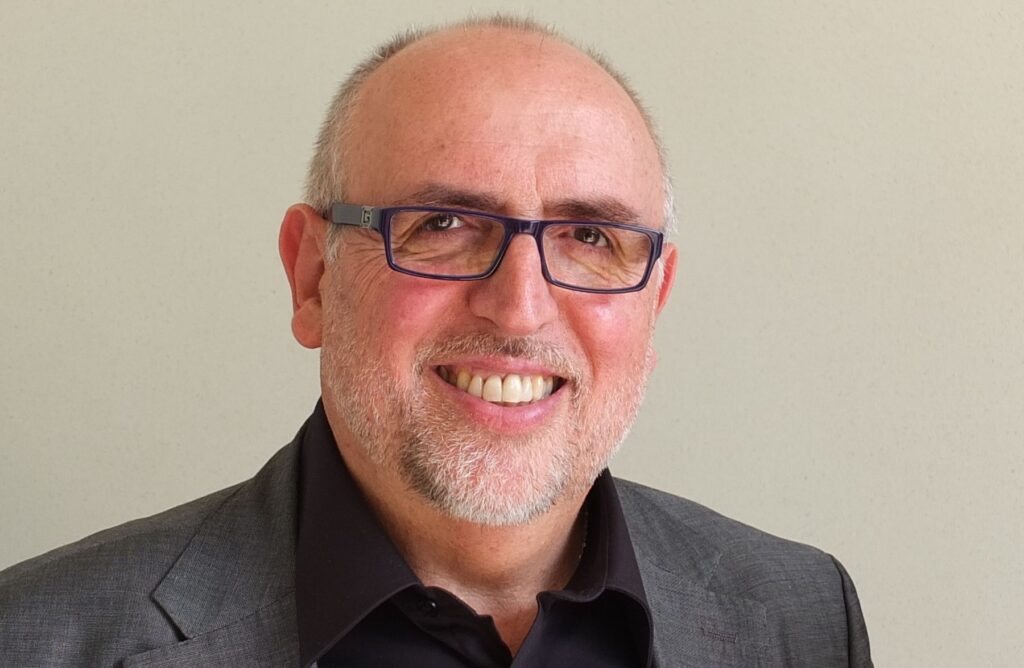
Ecumenism in the Final Synod Document – Mervat Kelli

focus | Church thought

Ecumenism in the Final Synod Document

An exploration of how the Synod’s Final Document presents ecumenism as a vital dimension of synodality, calling the Church to unity, dialogue and shared mission.

Walking together!

curated by Mervat Kelli

In the synodal process initiated by the Catholic Church between 2021 and 2024, one of the most important underlying themes to emerge was ecumenism. The Final Document of the XVI Ordinary General Assembly of the Synod of Bishops, entitled For a Synodal Church: Communion, Participation, Mission, points out that the path towards Christian unity, rather than a question of theological dialogue, is an essential feature of synodality itself.

The Final Document of the XVI Ordinary General Assembly of the Synod of Bishops (2021-2024) dedicates significant space to ecumenism, as an essential feature of synodality. The text thus manifests a profound continuity with the ecclesiology of the Second Vatican Council and with the subsequent magisterium, in particular with the encyclical Ut unum sint (1995) of Saint John Paul II, which indicated the path of unity as an obligatory path for the mission of the Church in the world.

The link between synodality and ecumenism is articulated in the Document by three main ideas: (1) synodality as a laboratory of communion among the baptized; (2) ecumenism lived in the ordinary life of communities; (3) missionary collaboration between Christian confessions. From this it follows that the synodal Church is open by its very nature to dialogue and mutual listening, both within the Catholic Church and in its ecumenical relations with other Churches and Christian communities. Synodality is therefore a practical and ecclesiological path toward unity.

A shared way of being church. The biblical image at the beginning of the Document – the three disciples running to the tomb (Jn 20:1-2) – is the model of a  Church on a journey: Mary Magdalene, Peter and the beloved disciple represent three complementary ways of following the Risen One (n. 13). This icon is a model for synodality, as well as being a light for ecumenism: every Christian tradition, with its own charism and history, is called to journey towards unity in Christ, in a spirit of differentiated communion. Synodality does not seek uniformity, it values reconciled diversity: a communion where every voice is heard and every gift accepted (n. 23,  39-40). In this sense, the Document adopts the perspective of Ut Unum Sint, affirming that unity is already present because we share “one Baptism”, faith in Christ and attentiveness to the Word (UUS 42–43). Visible unity is not an artificial construction, but a gift of the Spirit that grows through mutual recognition and shared life.

Listening to the Spirit and the exchange of gifts. Both synodality and ecumenism are based on listening to the Holy Spirit, who guides the Church through Scripture, Tradition and the sensus fidei of the People of God (nos. 22-23). Listening is not only personal, but also communitarian and guided by spiritual dialogue. The Document affirms that synodality implies a permanent ecclesial “conversion” (nos. 5, 6, 11, 33, 43), it means welcoming the diversity of gifts as an enrichment and not as an obstacle.

This is the meaning of the “exchange of gifts”, central to Ut unum sint. Every Church or Christian community possesses riches that can be shared with a view to building unity (n. 122). The “exchange of gifts” becomes a way of synodal ecumenism. It is not only a diplomatic or theological practice, but a spiritual exchange that encompasses ecclesial life, liturgy, catechesis and pastoral care (n.11, n. 122).

The Church as a sacrament of unity. The Synodal Document takes up the Council’s vision of the Church as the “universal sacrament of salvation” and the “sacrament of unity” (LG 1, 48), interpreting synodality as an expression of the missionary nature and openness to dialogue of the Church. Synodality is not something optional for the Church, but a way of living catholicity in a shared and relational manner (n. 28). Ecumenism should not be a separate activity, or something reserved for specialists, but a comprehensive vision informing the lives of the entire People of God (n. 23). In this way, synodality leads to an understanding of ecumenism that is not limited to doctrinal dialogue but involves local communities in a practical way (n. 40).

A shared mission. From a synodal point of view, ecumenism is an integral part of the Church’s mission. The Document insists that the call to mission is also a call to conversion (No. 5, No. 11). This conversion means putting the logic of competition between Christian confessions behind us and opening ourselves to ways of evangelical cooperation. As John Paul II affirmed, unity is a condition for effective evangelization: “the quest for Christian unity is not a matter of choice or expediency, but a duty which springs from the very nature of the Christian community ” (UUS 49).

According to the Document, the fruits of ecumenical dialogue must be accepted not only by ecclesial authorities, but by all the People of God. In paragraph n. 8 the task of reflecting on the “reception of the fruits of the ecumenical journey in the People of God” is entrusted to the Synodal Study Groups. The experience of listening and “conversation in the spirit” are identified as theological places where the wounds of division can be healed.

Conclusion. The synodal journey is not something closed within itself but is directing the Church towards a full and visible unity of Christians. As the Document states: “Unity ferments within the holy Church of God, prophetically so, for the entire world.” (n. 4). Synodality thus offers an ecclesiological form of ecumenism, capable of integrating theological dialogue, community practice and spiritual experience into a dynamic vision of communion. Ultimately, synodality makes the Catholic Church more able to live an authentic ecumenism, which is dialogical, spiritual and missionary. In full continuity with Ut Unum Sint, the Synod outlines a model of the Church capable of walking together with her Christian brothers and sisters, under the guidance of the Spirit, towards that full unity which is both a gift and a task.

PDF version

Called to Hope – Key players of Dialogue
July to September 2025
No 28 – 2025/3
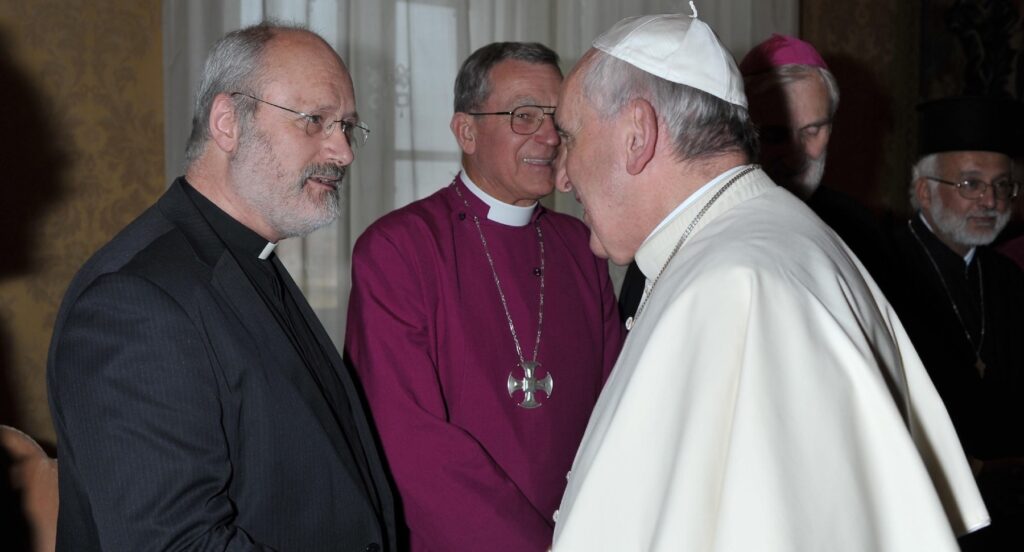
Beyond the trauma of division – Chiara Lubich

focus | spirituality of unity

Chiara Lubich reflects on healing the wounds of Christian division, calling the Churches to unity through love, reconciliation and the transforming power of Christ forsaken

Beyond the trauma of division

Chiara Lubich

“Nothing is more urgent in the world than a powerful current of love,” Chiara Lubich observed on November 29, 1998, at the Ecumenical Prayer in the historic Evangelical Church of St. Anne in Augsburg on the occasion of an ecumenical conference of bishops, and with 800 present. No one could have imagined that only one year later in this same place, the historic Joint Declaration on the Doctrine of Justification (October 31, 1999) between Lutherans and Catholics would be signed. Below is an excerpt from her 1998 talk.

If we Christians take a fresh look at our 2,000-year history, particularly the history of the second millennium, we cannot help but be saddened to see that it has often been a series of conflicts, quarrels and mutual incomprehension. Certainly, it was due to circumstances: historical, cultural, political, geographical, social circumstances. But it was also because among Christians there was a lack of what should be one of their specific unifying features: love.

And so today, as we seek to put right all that was so seriously wrong, we must focus our attention on the source of our common faith, on God who is love, and because he is love, calls us to love […]

In the light of God who is Love

In these times it seems to me that it is really him, God-Love, who, in a certain way, must return and reveal himself anew not only to the heart of each of us Christians, but also to the churches that we compose.

And he loves the churches for the times when throughout history they have acted according to the design that God had for them. But also—and here we see the wonder of God’s mercy—God loves them even when Christians became divided from one another, not corresponding to his design …

It is this very consoling conviction that made Pope John Paul II in 1994, trusting in the one who brings good from evil, give the following answer when he was asked, “Why would the Holy Spirit have permitted so many different divisions?”

While recognizing that it could have been because of our sins, he added: “Could it not be that these divisions have also been… a path continually leading the Church to discover the untold wealth contained in Christ’s Gospel and in the redemption accomplished by Christ? Perhaps all this wealth would not have come to light otherwise.”1.

We must therefore believe that God is Love for us and for the Churches.

Mutual love among Churches

But, if God loves us, we cannot remain inactive before such divine goodness. As true children we must return his love.

Over the centuries, each church has, to a degree, become set in its ways, because of the waves of indifference, lack of understanding and even of mutual hatred. What is needed in each church is a supplement of love.

So, we need love for the other churches, and mutual love between the churches. The love that leads each church to be a gift for the others, so that we can foresee in the Church of the future that there will be just one truth, but that it will be expressed in different ways, seen from different viewpoints, made more beautiful by the variety of interpretations.

Jesus Forsaken, Star of the Ecumenical Journey

Mutual love, however, is truly evangelical, and therefore valid, only if it is practiced in the measure wanted by Jesus: He said: “Love one another as I have loved you. Greater love has no one than this: to lay down one’s life for one’s friends” (Jn 15:13). And Jesus gave his life for us, in his passion and death, where he suffered during the agony in the garden, when he was scourged, and crowned with thorns, and when he was crucified, but he also suffered in that climax of suffering that he expressed in the cry: “My God, my God, why have you forsaken me?” (Mt 27:46) […] 

But if this is so, it is not difficult to see in him, in Jesus forsaken, the brightest star which must throw light on our ecumenical journey. It seems that efforts in the field of ecumenism will be fruitful in so far as those who dedicate themselves to it see in Jesus crucified and forsaken, who re-abandons himself to the Father, the key to understanding every disunity and to re-establishing unity. To find in him the light and the strength, not to stop in the traumas and in the cracks of division, but always to go beyond and find a solution, all possible solutions.

Jesus among Christians of different Churches

Mutual love with this measure leads to the realization of unity. When unity is lived, it has an effect, and this too is a key point for a living ecumenism. It is the presence of Jesus among people, in the community, gathered in his name. He said, “For where two or three are gathered in my name, I am there among them” (Mt 18:20). Jesus in the midst between a Catholic and an Evangelical, who love one another, between Anglicans and Orthodox, between an Armenian and a member of the Reformed Church—how much peace it would bring even now, how much light it would shed on a productive ecumenical journey!

Jesus in our midst is a gift, among other things, that also lessens the pain of waiting for the day when we will all share together his presence in the Eucharist.

And it still requires a great love for the Holy Spirit, love personified, who binds in unity the persons of the blessed Trinity and is the bond between the members of the mystical body of Christ.

I know, too, from experience that if we all live in this way, there will be exceptional fruits, and there will be one effect above all others. By living together these different aspects of our Christianity, we will realize that we form, so to speak, one Christian people that can be leaven, helping to bring full communion among the Churches.

1 John Paul II, Crossing the Threshold of Hope, Mondadori, Milan 1994, p.167.  

PDF version

Called to Hope – Key players of Dialogue
July to September 2025
No 28 – 2025/3
4 corners – Joan Patricia Back

focus | experiences

A festival in Belfast that unites faith, art and community

The miracle of the 4 corners"

Joan Patricia Back

In Belfast, a city still scarred by the “Troubles” (the Northern Irish conflict), an ecumenical festival is rewriting the narrative: no longer division, but dialogue, creativity and reconciliation. It is the 4 Corners Festival, which every year in February transforms the “corners” of the city into points of meeting and hope.

Born thirteen years ago from an idea of Father Martin Magill, a Catholic priest, and Rev. Steve Stockman, a Presbyterian minister, the festival is now coordinated by an ecumenical team including Methodist minister David Campton. “The goal,” says David, “was simple but profound: to get people out of their geographical, religious, political and cultural corners to really meet, in truth and fraternity.”

From divided city to shared city

The name of the festival recalls the four “corners” into which Belfast is historically divided: north, south, east and west. Divisions that are not only urban, but also of identity, and which have been born out of the religious and political conflicts that have marked the life of the city for decades. “They called us the city where Christians kill each other,” David recalls, “but the peace process of the 1990s and the commitment of so many courageous Christian leaders changed the face of our land. The festival wants to build on that change.”

A rich program, for all ages

The 4 Corners Festival offers dozens of events every year: concerts, exhibitions, theatrical performances, prayer meetings, debates, historical walks, sports activities and creative workshops. All this takes place in different places in the city, precisely to push the participants to “get out of their corner”.

The protagonists are mostly local, but there is no shortage of international voices: even Pope Francis sent a video message on the occasion of the tenth anniversary of the festival. But, as David Campton is keen to point out: “It is not a festival of big names: it is above all an opportunity for relationships, encounters, and the discovery of the other.”

A “jersey” that unites

Among the most symbolic events is Knit and Natter – 4 Corners Together, a meeting between knitting enthusiasts from all over the city, conceived by Irene Jovaras. “It is not just a manual activity,” he says, “but a true ecumenism of the people. A network of friendship that continues throughout the year.”


Volunteers, silent protagonists

Among the many volunteers, there is also Sally Campton, David’s wife. “My birthday falls on the first of February,” she jokes, “and the only way to see my husband is to be a volunteer at the festival!” But then she adds, seriously: “In reality, being part of this initiative is a gift. There is a sense of family, where everyone is welcomed and valued.”

Towards a sustainable future

For some years now, the festival has also been committed to being carbon neutral. To offset carbon emissions, it finances the planting of trees in the hills around Belfast. “But we want to do more,” David concludes, “to plant seeds of hope in people’s hearts, in the four corners of the city… and, why not, of the world”.

An open invitation

The 4 Corners Festival is a concrete testimony of how faith, culture and collaboration can contribute to the healing of a wounded city. An experience to be lived, to be told and, perhaps, also to be imitated elsewhere.

For more information, to participate or simply to learn about this extraordinary reality, the invitation is open to everyone1. Because change really begins… around the corner.

The 4 Corners Festival
Ecumenism in Belfast
Northern Ireland

 
Time: 9 minutes

Video copyright of Centro S. Chiara Media

PDF version

Called to Hope – Key players of Dialogue
July to September 2025
No 28 – 2025/3
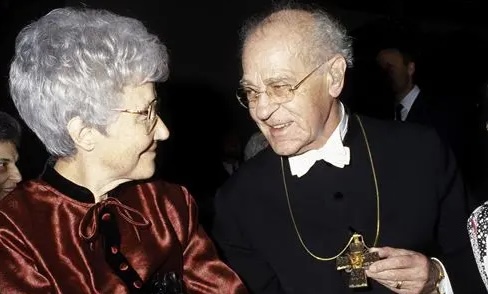
Uni-diversity – Editorial – Blaumeiser and Vesper

editorial

Uni-diversity, editorial, explores a 2025 ecumenical conference in Rome bringing people from 20 different churches to experience unity in diversity.

Uni-diversity: The kaleidoscope gathering of people at the ecumenical conference Called to HopeKey players of Dialogue, held in the Mariapolis Center in Castel Gandolfo from the 26 to 29 March 2025, is still very much fresh in our minds: men and women of very differing ages, backgrounds – priests, bishops… Two hundred and fifty people, with many others connected via the internet and with 14 simultaneous translations being available. Even the variety of clothes, the robes, and headgear demonstrated an impressive array of cultures and ecclesial backgrounds: representing twenty Christian churches and forty different countries.

It was certainly not similarities that made up this display of harmony, but rather openness and mutual acceptance, almost a prophecy of what our planet could be if each one sought the good of the other as much as his or her own and if we thought of unity not in a monocentric way, tailored to our own experience and identity, but as uni-diversity.

All of this was a fascinating picture – also borne out in the talks and testimonies which were shared during those days – and so we suggested to the organizers of the conference, the Centro Uno for Christian Unity, that we could produce an issue of Ekklesía dedicated to this positive ecumenical coming together of the various churches. However, we thought it better to report of the conference not simply as a documentation of an event which has now passed, but, rather, as a narrative which opens our horizons and which invites our readers to live out the same.[1]

It was no coincidence that this meeting was held in this year of 2025 which is, for several reasons, a kairòs – a special and favorable moment – of the ecumenical journey. It is 1700 years since the first “Ecumenical Council” took place in Nicaea, located in modern-day Turkey, and which at that time was the seat of one of Constantine’s imperial residences. It is worth noting that the original sense of the term Ecumenical meant universal or “world”. Even at that time, the unity of the Church was at risk, and the aim of the Council was to bring the differing parts together and unite them into one. This year also marks 60 years since Paul VI and the Ecumenical Patriarch Athenagoras I met together at the conclusion of the Second Vatican Council in order to abolish the reciprocal excommunications of 1054 between the Church of Rome and the Patriarchate of Constantinople. That gesture was as courageous as it was prophetic but is still waiting to find a complete fulfilment. A further fact, of great importance: on April 20, all Christians were able to celebrate Easter on the same date, due to a coincidence of the two different calendars, the Julian and Gregorian – a circumstance that stimulates us to take further steps in this direction. And that is not all. 2025 also marks the 500th anniversary of the Anabaptist Movement that began in Zurich in 1525 and the 100th anniversary of the first meeting of the Life and Action Movement of the World Council of Churches.

Called to hope. This title of the Conference is suggested not only by the ecumenical events just mentioned, but also by the Holy Year of the Catholic Church focused on hope. Hope, in fact, asks us not to remain prisoners of the past and of existing barriers but to look ahead, not to stop – as Martin Luther explains so well – looking at the superficial reality, at only the facts, but to turn our gaze to God who, even in the most difficult of circumstances, is always at work. This is particularly urgent in the times in which we live now. 

This issue of Ekklesía, therefore, is dedicated to the ecumenical journey. But does ecumenism – one wonders – really concern us all? Is it only a matter for experts or for those who are passionate about this issue? In reality, it is a task that challenges all of us wherever we grapple with differences that can degenerate into polarizations instead of leading us to unity (uni-diversity!): in the neighborhood and in the workplace, in our parish and civil communities. We are all challenged to understand ourselves as family, of ecclesial and social coexistence not as a monolith but in a symphonic key: the result of numerous voices and contributions that do not allow themselves to simply be reduced to each other, but are made to become a gift for one another. If nothing else, creation itself tells us so: extraordinarily multifaceted and articulated in its biodiversity, it is a whole in which everything is related. It could not and cannot be otherwise if it bears within itself the imprint of a God who is at the same time One and Three. 


[1] It was not possible – and it was not even our intention – to report here all of the talks given at the meeting. What guided us was the desire to offer a selection that gives voice to the various geographical areas which could spur our readers. The entire Conference is available, in the form of a video in several languages, on YouTube under CALLED TO HOPE – Key players of Dialogue.

PDF version

Called to Hope – Key players of Dialogue
July to September 2025
No 28 – 2025/3
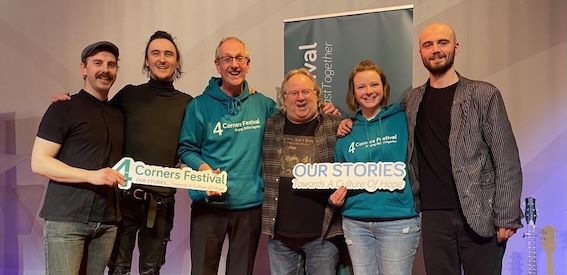
Heike Vesper – Called to Hope – key players of dialogue”

Ecumenical Conference “Called to Hope – key players of dialogue”

Called to hope

Called to Hope

Heike Vesper

The year 2025 is full of significant anniversaries for all of Christendom. This jubilee year of the Catholic Church with its theme of Pilgrims of Hope reflects 1700 years since the Council of Nicaea, 60 years since the abolition of mutual excommunications between the Church of Rome and the Church of Constantinople (December 1965), and 100 years since the first ecumenical Faith and Constitution Conference in Sweden in 1925. Moreover, it is not mere coincidence that Christians from East and West celebrated Easter on the same date this year. Rather it appears as a prophetic sign, a “divine” witness together to unity in an increasingly fractured and polarized world. Not surprisingly, one publication even described it as the courage to proclaim that Jesus unites1.

From March 26-29, 2025, the ecumenical conference Called to Hope – Key Players of Dialogue was held in Castel Gandolfo, Italy. It was sponsored by the international secretariat of the Focolare Movement for Christian Unity, “Centro Uno”. There were more than 250 participants, belonging to 20 Christian Churches and some 40 countries, including Brazil, Cameroon, Congo, Egypt, the Philippines, Great Britain, Ireland, Lebanon, Russia, Serbia, Slovakia, USA, Ukraine, and Venezuela. There were simultaneous translations in 14 languages, with eight streamed in order  to connect four thousand live listening points2 worldwide.

“Today, more than ever, in the world in which we live, so full of divisions, tragedies, conflicts, where people struggle to dialogue, coming together has a very great meaning,” said Margaret Karram, the president of the Focolare Movement, in an interview published in Vatican News.

To deepen and actualize the above-mentioned historical events, Msgr. Andrea Palmieri, undersecretary of the Dicastery for the Promotion of Christian Unity, and Prof. Dr. Martin Illert, representative of the Ecumenical Council of Churches, spoke, with historical reflections offered by Drs. Sandra Ferreira (Catholic) and Mervat Kelli (Syrian Orthodox) of “Centro Uno” and Dr. Kostas Mygdalis (Greek Orthodox).

The conference, opened by Jesús Morán, co-president of the Focolare Movement, and Callan Slipper, an Anglican theologian, posed the central question: Does Christian unity still have urgency in today’s world? Morán had no doubt about this, saying: “Unity rather than union, and Christianity as a way of being rather than doctrine, can be two fruitful paths for ecumenism, in response to what history demands of us today. In the face of the world’s great challenges, division among Christians is inappropriate, inconvenient, anachronistic, and even scandalous.”  Similarly, Callan Slipper affirmed:  “Ecumenism, by repairing our personal interactions within the Christian community, allows the Church  to be itself. What serves humanity also serves us. Our spiritual health diminishes without it, just as every other dimension of human life cannot reach its fulfillment without the reconciliation brought by Jesus.”

Methods for a path to unity were shared in a dialogue of life, dialogue of the people, and receptive ecumenism used in theological dialogue. According to Presbyterian pastor Karen Petersen Finch, lecturer at Montréal Presbyterian University, there is a need for lay people to also dialogue about doctrines still dividing the churches. Mutual knowledge opens horizons and keeps the desire for unity alive.3

These reflections were complemented by accounts of many ecumenical initiatives involving churches, priests and laity, theologians and scholars, adults and youth, individuals and groups. Speakers included: Dr. Natasha Klukach from the Global Christian Forum , a video message from Dr. William Wilson (Pentecostal World Fellowship); the ecumenical youth training program “Ikumenì “4 in Latin America; and the ecumenical network Together for Europe.  Likewise, national initiatives such as the Catholic-Pentecostal dialogue Somus Um in Brazil and the John 17 movement (USA) were also presented, while Msgr. Derio Olivero, president of the CEI Episcopal Commission for Ecumenism, outlined ecumenical activities in Italy. Testimonies from the Philippines, Northern Ireland, Serbia, the Netherlands, Venezuela, Germany and Uganda were also presented.

An in-depth look at synodality and ecumenism through the testimony of five participants of the Synod of the Catholic Church: fraternal delegates Archbishop Khajag Barsamian (Armenian Apostolic Church), Rev. Dirk G. Lange (Lutheran World Federation) and Dr. Elizabeth Newman (Baptist World Alliance), Msgr. Brendan Leahy (Catholic Bishop of Limerick-Ireland) and Focolare president Margaret Karram.  Their experience of the Synod and the fraternal relationships which had been built were contagious and prophetic for a vision of the One Church.

On the second day, a pilgrimage to the Rome Basilica of St. Lawrence Martyr and the Abbey of the Three Fountains – which tradition situates as the place of the martyrdom of St. Paul – was an encounter with the first martyrs of the undivided Church. By their authenticity of life and faith and their witness, they instilled the courage to proclaim Christ today. Then, the pilgrimage concluded with an ecumenical prayer for reconciliation and peace at the Basilica of St. Paul Outside the Walls.

Many echoes afterwards spoke of the fruits of the conference, of offering an experience of fraternity “in presence” and thus one of mutual knowledge. Participants also spoke of the challenging richness of diversity that gave new inspiration and renewed hope, all serving as fuel in becoming protagonists in dialogue in every sphere.

1      L’Osservatore Romano del 28 March2025.

2      The program is still available on the Focolare Movement’s YouTube channel:

       https://youtube.com/playlist?list=PLKhiBjTNojHqagL3wOalryEL0CqjEjWpy&feature=shared

3      He wrote a book about this experience with the title Grassroots ecumenism published by New City Press.

4      Cf. B. Isola, Ikumèni. Un laboratorio di formazione al dialogo e alla diaconia, in «Ekklesía» 6 (2023/1) n. 18, p. 60.

PDF version

Men and Women: Together
April to June 2025
No 27 – 2025/2

Dorothea Greiner – Woman Bishop in the Lutheran Church

Experience of a Lutheran Bishop

"You will be a blessing"

Dorothea Greiner

The author invites us to broaden our perspective through the experience and practice of the Evangelical Church. In the years after World War II, and especially beginning in the 1960’s, a process was undertaken in some Regional Lutheran Churches that gradually paved the way for the ordination of women. For the Lutheran Church in Bavaria (Germany), it is exactly 50 years since the Regional Synod allowed woman’s ordination as pastors. The author herself was a pastor, and then a regional evangelical bishop until recently retiring.  

During the two weeks before my ordination, I heard a constant refrain in my heart. It was not a song, as sometimes happens, but those words from the Book of Genesis, where God promises Abraham: “I will bless you, and you will be a blessing.” (Genesis 2:12)

At my ordination, and in accord with custom, I was on my knees while Bishop Johannes Merz and assistants laid hands on me. One after the other, they spoke a biblical word over me. And I was deeply touched when one of the assistants said, “God says, I will bless you and you will be a blessing.” Spontaneously, my body moved from kneeling upright to resting on my heels, because I perceived these words as a promise about my life.

Family, parish, studies…

God has kept his promise. In retrospect, my childhood was already a blessing for me. I grew up in a family that followed the Pietistic tradition in Lutheranism. We went to church every Sunday morning and returned in the evening for the so-called “hour”, where my father was one of the lay preachers. In the Christian Youth Association (YMCA) I learned to pray for myself, to read, and to meditate on the Bible. I knew that my life belonged to Jesus Christ, and I silently told him so on my knees in my room, at the age of 16.

Then, a year later, on a bright summer Sunday morning, as I was about to return home from morning service after also musically accompanying the parish community on the pump organ—a dreadful instrument – my pastor called me across the street: “Dorle, you could become a pastor. Study theology.”

My studies began four years after our Church introduced the ordination of women. There, I met my husband Gottfried, also a theology student. He has always supported my path, and I was able to complete my formation, even with the birth of two children.

A young pastor

After ordination, my husband and I together took over the care of the  Pfuhl/Burlafingen parish (in the deanery of Neu-Ulm, Germany). Soon, however, we were called to the Seminary of Preachers in Bayreuth to devote ourselves to the formation of vicars  (future pastors). Then, two years later, I took a sabbatical and wrote my doctoral thesis in systematic theology on the topic of ‘blessing’. In 1996, we moved together to the parish of Holzkirchen in Upper Bavaria. At that time, the parish was building a new church. It was to be named, the Church of the Blessing, without me having given the slightest indication of any kind…

The call to regional service

I was in great need of God’s blessing when, after two years in my first pastorate in Holzkirchen, the then regional bishop of Bavaria phoned to ask if I would be available for an interview with the committee on church appointments.  At the age of 39, I was the first woman called to serve on the regional church council of the Evangelical Lutheran Church. My responsibilities included initial and ongoing formation, and after three years I was also given the responsibility for personnel for theological and theological-pedagogical roles in our Church.

They were intense years, because we were not used to economizing. During the Church’s process of economic consolidation, I needed to generate substantial savings in personnel expenses. And I also needed to learn then to take care of my soul. Since that time, in fact, I started taking time for an annual retreat, such as for a week in silent retreat at the Christusbruderschaft in Selbitz (Germany).1

This deepening of my spiritual journey was necessitated by the weighty responsibilities entrusted to me, and it has become a source of lasting joy and strength. It changed the way I provide guidance and put Christian spirituality at the center of human resource development. In fact, this directional shift has been welcomed positively by almost everyone in our Church, and is a part of the blessing that God has granted.

After ten years of responsibility for personnel, I was grateful that the way was paved for me to become the regional bishop of Bayreuth. I happily moved to Upper Franconia in Spring 2009, not least because my husband is from this region. Over these past 15 years now, this ministry has been a source of deep joy and fulfillment: ordinations, the accompaniment of people and communities, and decision making at the Regional Church Council. All of these have never become a boring routine.

Two experiences remain powerfully with me.

Assisting refugees

First, in 2015, large numbers of refugees arrived to our country, including Christians of varied languages and nationalities. For this reason, and together with a large team in Bayreuth, I initiated a monthly “International Celebration”, which was welcomed with growing participation by these Christians of differing backgrounds. But also Muslims participated, including some who were about to become Christians. After intensive courses of faith and baptismal preparation, more than 170 people were baptized. However, officials in the government offices and courts often did not know how to account for conversions of Muslims to Christianity, and thus there was a great risk that these new converts would be deported to countries where they could be killed by their families or imprisoned by the government. Thanks to positive relations with the Bavarian  government, many were able to be saved from deportation processes that had already begun. I am convinced that God entrusted me with this task in Bayreuth, also to help these young Christians.

A Passion for unity

A second experience regards my own journey, in that from early on I was increasingly led towards ecumenism. Catholics were “heretics” in my family of origin because they prayed not only to God but also to the saints, and their piety – so the prejudice went – was oriented towards external rites rather than an interior bond with Christ.

But Prof. Joachim Track2, with whom I did my doctorate, had an impact on me already during my earliest studies.  He was “at home” in ecumenical dialogue, and I learned to recognize the dimension of truth in other confessions and see it as a richness. Then, the fraternal attitude and Christ-centered devotion that I found in several Catholic ministers in Holzkirchen and in Bayreuth swept away any last prejudices.

Inertia and, especially the authoritative claims of various denominations, still prevent mutual recognition and ecclesial communion. But heart-felt compassion, with Christ in the midst, will prevail in the Churches, because Christ prayed to the Father for the unity of all (!) those who believe in him (cf. John 17:20-21).

This is also the reason why, since being invited to meetings of Bishop-Friends of the Movement, I felt intimately connected to members of the Focolare Movement. Here we meet pastors and committed lay people who live rooted in their own denominations first, and at the same time carry in their hearts this yearning of Jesus for unity.  They have as an integral part of their own spiritual practice what Chiara Lubich called “knowing how to lose”.  It is a knowing how to lose, a giving up their own power, as people set free by Christ on the cross to self-giving and humility. I would like to continue this journey with the focolarini, together with my husband. The promise of being blessed, and of being a blessing, is fulfilled in the life of faith and in an ecumenism of the heart.

1 The Christusbruderschaft of Selbitz is a community of sisters and brothers, founded in 1948 by Pastor Walter Hümmer and his wife Hannah within the Lutheran Church of Bavaria. It includes celibate and married persons in the style of the Third Order.


2 Joachim Track (1940-2023) was a professor of systematic theology. As a member of the Council and Executive Committee of the Lutheran World Federation he was deeply involved in ecumenical discussions, including dialogue with the Catholic Church that led to the signing of the Joint Declaration on the Doctrine of Justification in 1999.
[See https://lutheranworld.org/resources/publication-joint-declaration-doctrine-justification]

PDF version

Men and Women: Together
April to June 2025
No 27 – 2025/2

Christian Krause – Lutheran Bishop

focus | insights

At the crossroads of history

Lutheran Bishop Christian Krause

Dieter Rammler

Bishop Christian Kruse

Shortly before his 85th birthday, Bishop Christian Krause returned to the Father’s house. A well-known leader in the Lutheran world and past president of the Lutheran World Federation (WFL), he signed the Joint Lutheran-Catholic Declaration on the Doctrine of Justification in Augsburg on October 31, 1999. Author Dieter Rammler is a scholar of church history, a Lutheran pastor, and was Christian Krause’s closest collaborator for six years. He is editor of his 2023 biography in German1, which will be published in English in the coming months.

Guided by a vision to the end


“Fear not, for I have called you by name” (Is 43:1) was the biblical verse assigned to Christian Jakob Krause for baptism2. For him, this motto connected with a vision that inspired him to the end: “From the east I will bring forth your seed, from the west will I gather you. I will say to the north: Return! and to the south: Do not withhold; bring back my sons from afar, and my daughters from the uttermost part of the earth, … You are my witnesses-oracle of the Lord!”(Isaiah 43:5-6,10). For Christian Krause this vision signified hope in a “momentous turning point” wrought by God. United in witnessing to God, the call not to entrench ourselves behind old or new frontiers resonates powerfully.


The news that came during the last weeks of his life left him troubled and broke his recollection. However, Krause did not want to give up. “”We are once again back to square one! We need Christians especially now! … With their hope, commitment to peace and against war, against racism and in defense of human dignity, and especially also for refugees!” he said in a last interview a few weeks before his death on November 28, 2024.


He recounted one day how childhood images returned to him in a dream: “It was the spring of 1945; the sky was red-hot all day and night because of the continuous bombing and burning of Berlin. My mother wanted to take us children to safety and then return immediately to Döberitz. But that did not happen. I don’t remember how we finally managed to get on the overcrowded train. People were sitting on each other. Some were crying. Most with their eyes lost in nothingness, exhausted.” He never forgot those scenes throughout his life, and once remarked, “One should not underestimate how famine, injustice and fear leave a mark on people and are passed on from generation to generation. But thank God this happens also through solidarity and proximity as well!”


Wherever Christian Krause was, he had two things at hand: the Losungen book 3 from Herrnhut and family photos. These were the sources from which he drew. Already as a youth leader in Göttingen, he came across this elementary biblical piety, which he practiced for the rest of his life. He had learned it from animators who had been in the war, as it had been their source of comfort in the darkest hours. God’s Word, trust in his guidance, forgiveness and healing presence – all had served to mature in him an ever-deepening faith: “To be on the way, trusting in God’s Word, more and more each day! For life in fullness comes not from our sowing and reaping, but from the miracle of God’s love. Without roots in the soil of God’s goodness and mercy, our hope dies, and every longing turns into despair.”


“Following the Star”


Born on January 6, 1940, in Dallgow-Döberitz near Berlin on the Epiphany, Christian Krause was a child of Epiphany and remained so throughout his life! He loved the biblical story of the Magi coming from the East. And They Followed the Star, is the title of a book dedicated to him. His whole existence was a journey toward this broad horizon. As a young theologian he worked at the Lutheran World Federation in Geneva and upon being ordained pastor, he followed the call to move to Tanzania (1971) to work in the Tanganyika Christian Refugee Service.


At that time, the peoples of the Global South were struggling for freedom and independence. Civil wars were raging in many places, forcing thousands to flee, including to neighboring Mozambique. This period of commitment to refugee camps along the border occupied only a brief stretch in his life, but it had an enormous impact on him.


Finally, the colonies became independent states and the former missionary societies, partner churches. During that time, Christian Krause was a pioneer of international ecumenism for the Lutheran Churches in Germany (1972-1985), helping to shape many of the newly emerging partnerships. This would later serve him well during studies in Chicago, where he had learned the skill of translator. “As an interpreter, you must first understand yourself before you can make others understand,” he said. This characterized his attitude toward foreigners and his irrepressible curiosity in approaching unknown territories.


Bridge builder from east to west, north to south


He had a special way of connecting with people and helping them find clarity in themselves and on their own path. He valued personal freedom and therefore honored it in others as well.


Christian Krause was a great storyteller. He was like a magnet that attracted the life stories of others. There are many who became his lifelong friends. “Each of us can be a final witness to many things, and to people and experiences that will inevitably disappear with him or her,” writes Rüdiger Safranski in his book entitled ‘Time’. In this sense, Bishop Krause witnessed the lives of many people at crucial points in recent history.


Now, in the memory of so many, he is part of that “cloud of witnesses” (cf. Heb. 12:1). Friends from his time at the Secretariat of the large gatherings of the German Evangelical Church (Deutscher Evangelischer Kirchentag)4, of which he was secretary general (1985-1994), recall his push for “political action in Christian responsibility.” Friends of the once-divided Germany remember him as a bridge-builder and diplomat, even before the fall of communism in 1989, and even more so afterward. The Federal Cross of Merit with Star (2001) awarded to him by Federal President Johannes Rau explicitly referred to his efforts for East-West dialogue. The Braunschweig Regional Church remembers him as the bishop (1994-2002) who took an interest in people’s lives. “If you want to be a bishop, take a donkey and ride through the country. There is one who has shown us the way,” publicist Heinz Zahrnt had written to him for his installation in the Braunschweig cathedral. Fellow travelers worldwide, and particularly from Africa, have not forgotten his surprising election as Lutheran World Federation president in Hong Kong in 1997. They wanted him at the helm, because he had not left them alone in their time of struggle. This was also the reason why, in 2009, President Motlanthe awarded him the highest honor the Republic of South Africa bestows on deserving foreigners.


President of the Lutheran World Federation


From then on, Christian Krause represented the Lutheran World Communion on trips to Latin America, East Africa, Eastern Europe, India and Southeast Asia. He sensed the historical significance of the Joint Declaration on Justification and made significant contributions to its implementation during the delicate final stage. In his October 31, 1999 homily on the day of the signing at St. Anne’s Church in Augsburg, he said: “It is a precious thing, in following Jesus, to belong to a universal community that is able to spend itself for one another even at the level of the whole world. The message of peace from Bethlehem needs those who proclaim it. How can this be done if we did not begin with ourselves?”


After the celebration concluded, Catholic sisters and brothers were waiting for him in front of the church with the desire to invite him to meet their ecumenical movement: Chiara Lubich, president of the Focolare Movement, Cardinal Miloslav Vlk of Prague and others. “We no longer want to let go of the hands we hold out to each other,” he had just said in his sermon at St. Anne’s. And indeed, they never let go again! In fact, the award in Aachen Cathedral of the Klaus Hemmerle Prize, established by the Focolare Movement in 2006, would later give vivid witness to this special relationship.


For more than two decades, Bishop Christian Krause was intimately connected to the Focolare Movement in multiple ways, such as through the shared commitment of the Together for Europe network.  This was a result of the prior events in Augsburg and that of the Focolare’s ecumenical group of bishop friends. He liked to call them the colorful bishopsbecause of their colorful robes and encouraged them to continue to “globalize” themselves as witnesses of unity in Christ.


Already for some time he had been feeling a sense of restlessness that hinted at the fact that Christianity and the Churches were grappling with a change of epoch. His encounter with the Focolare reinforced that impression of something within Christendom that was hidden but that was blossoming as new life. He could not yet name it, but he sensed it in the “fire” of the Focolare. How much he longed that we could arrive to share the Eucharist as communion at God’s table with His people throughout the world: “It would be a sign that would unite Christians, that the world could not ignore!”


From global action to a Baltic Sea island.


When Christian Krause retired from active service, he continued in numerous honorary roles where his international experience was needed: The Protestant Development Service, in whose reorganization he played a key role as board chair (1999-2005); the Luther Center in Wittenberg (Germany), of which he was co-founder and president (1999-2007); and as chairperson of the Hermann Kunst Foundation for the promotion of research on New Testament texts. 


When even these later tasks started fading into the background and there was time, he stumbled upon his beloved vacation island in the Baltic Sea. His memory remains alive in this island community, too. He sometimes said, “Here I can be myself without major commitments, sitting in the church pew on Sundays as part of a community.” He had experienced so much that he now needed time to reflect, taking long walks on the beach. Events, travel, and encounters came back to him as in an interior movie. Every now and then he would stop to catch his breath, greet someone, or make small talk. This, too, was Christian Krause, a person to whom one could entrust a story, confident that he would cherish it.


Bishop and brother


His ‘sendoff’ bore witness to the person of Krause. He was a true witness of faith! He was a pilgrim between borders and a bridge builder, an interpreter and a storyteller. A bishop, but for many he was simply Brother Christian. He traveled throughout his life and placed his trust in God.


At the time of the blessing of his body, many were reminded of the Elder Simeon. When Joseph and Mary arrived at the temple with Jesus, he was overwhelmed with joy. He took the child in his arms and said, “Lord, let your servant depart in peace, for my eyes have seen your Savior!” (cf. Lk. 2:29-30). Bishop Christian departed in peace. What he saw in his life, he conveyed through many stories. They speak of the Star that is worth following, from east and west, north and south. This is what unites us! As Christians, we are made for one another! And lest we find ourselves back to square one!


__________________________

1 D. Rammler, Christian Krause. Weite wagen, Neue Stadt, München 2023.

2 Editorial note: In the Lutheran Church, as well as other Reformed churches, it is customary to assign people a Bible verse at baptism and also at confirmation.

Die Losungen [Keywords] are a collection of biblical texts and daily meditations prepared annually since 1731 by the Evangelical Church of the Moravian Brethren (The United Brethren of Herrnhut). They are translated into approx. 60 languages.

4 Lay body of the Evangelical Churches in Germany that organizes major biennial events of faith, culture and political discussion. The counterpart in the Catholic Church in Germany is the biennial Katholikentag. In 2003 and 2010 the two events merged into an ecumenical assembly. 


Migration: challenges and opportunities
January to March 2025
No 26 – 2025/1

Mervat Kelli – Coptic Orthodox and Roman Catholic Church dialogue

focus | Church in dialogue

The Coptic Orthodox and Roman Catholic Churches in dialogue

Mervat Kelli

A tested and rediscovered friendship

The Coptic Orthodox and Roman Catholic Churches in dialogue

For eleven years, Pope Francis and the Coptic Orthodox Pope, Tawadros II, have woven a deep fraternal relationship. Already from the time of Pope John Paul II and Pope Shenouda III, there had been lively contact, especially when John Paul II, at the beginning of his February 2000 Jubilee pilgrimage to Mount Sinai, wanted to visit Shenouda III in Cairo, marking the first visit of a bishop of Rome to the Coptic Orthodox patriarch.


Tawadros II, elected in 2012 after the 41 years of the pontificate of Shenouda III, made his first visit abroad to Rome in May 2013, on the 40th anniversary of that of his predecessor. During that occasion, Tawadros II proposed to Pope Francis to forge a close perennial spiritual bond of friendship in Christ. Since then, May 10 is the Day of Friendship between the Catholic Church and the Coptic Orthodox Church. Pope Tawadros II was the first Coptic Orthodox Patriarch to attend the enthronement of a Coptic Catholic Patriarch – Patriarch Ibrahim Isaac Sidrak – in January 2013 and promoted the creation of a National Council of Christian Churches in Egypt in February 2013.


In April 2017, Pope Francis went to Egypt. During his visit with Pope Tawadros II, they signed a new Joint Declaration of a pastoral nature. It expressed, among other things,  both the hope to find a common date for the Easter celebration, and not to repeat baptisms administered in the respective Churches. Further conversation with Pope Francis followed in July 2018, when Pope Tawadros II participated in the meeting of reflection and prayer for peace in the Middle East organized in Bari (Italy).


Then, this past year, controversy arose following release of the Declaration Fiducia supplicans of the Catholic Church. It created consternation in the Coptic Church, so much so that the Holy Synod of the Coptic Church, on March 7, 2024, issued a Declaration reiterating the rejection of ‘so-called homosexual marriage’. According to some, the Church must not put its head in the sand as if these situations did not exist but face them with courage. Others wondered what the blessing of homosexual couples is for.  Is it to heal their relationships and help in a return to the Church, or is it so that those blessed might have their souls at peace and say the Church has blessed us? 

On May 22, 2024, Pope Tawadros II received Card. Victor Fernandez, Prefect of the Dicastery for the Doctrine of the Faith. The Cardinal brought the greetings of Pope Francis, recalling the various meetings that took place and in particular Pope Tawadros’ last visit to the Vatican on May 10, 2023. On this occasion, the 50th anniversary of the bilateral joint Christological agreement signed by Pope Shenouda III and Pope Paul VI was celebrated, as well as the tenth year of the annual day of Friendship.


The meeting between the cardinal and Pope Tawadros II focused on Fiducia supplicans. After recalling that both in Fiducia supplicans and the subsequent Doctrinal Declaration of the Dicastery, Dignitas infinita, it is reiterated that marriage is only a union between a man and a woman open to the transmission of life, Card. Fernandez confirmed that the Catholic Church is also opposed to same-sex marriage, and therefore shares the teachings of the Declaration of the Holy Synod of the Coptic Church of March 7.


He also clarified that union between people is not blessed. If they come together, they bless the people, making a sign of the cross on each one and adding a short prayer. But this must take place in a brief, spontaneous way, without any rite, without liturgical vestments and without any external manifestation that could confuse that blessing as a marriage. These types of simple, spontaneous and pastoral blessings, explained the Cardinal, can also be imparted on the street, on pilgrimages, and be received by everyone, in whatever condition they find themselves. In fact, in this case it is not a question of ‘sanctifying grace,’ but of those aids of the Holy Spirit that Catholics call ‘actual graces’, pushing the sinner towards conversion and maturation.


For his part, Pope Tawadros II explained to Fernández the historical, cultural and societal ethos of the Egyptian people.


The cardinal also shared that he had provided a comprehensive clarification on this issue in a detailed letter, as requested by the Oriental Orthodox Church delegation, in the Committee for Dialogue with the Catholic Church, held in January 2024.


At the conclusion, Pope Tawadros II asked the cardinal to bring his greetings of love and appreciation to His Holiness Pope Francis.


This served as a witness to many of how sincere relationships of friendship also help to overcome inevitable challenges and difficulties.


PDF version

A Synodal Way: Mysticism and Method
July to September 2024
No 24 – 2024/3

Callan Slipper – How to dialogue?

focus  |  insights

Callan Slipper

How to dialogue?

Receptive Ecumenism: A Path to Unity

Dialogue between Christian churches by Anglican priest Callan Slipper
There are various expressions of dialogue between the Churches: from theological dialogue to common prayer and joint commitment to the service of society. At the heart of all there cannot fail to be the dialogue of life, which means mutual acceptance and reciprocal gift, and which makes us experience the living presence of Christ who gathers his own into one and makes them his Body. The author is an Anglican priest and was until 2022 nationally responsible for the ecumenical relations of the Church of England.

In a famous piece of writing, “If we are united, Jesus is among us”, Chiara Lubich affirms that this is the hour of Jesus in the midst of people gathered together (cf. Mt 18:20):

It is he who, inspiring his saints with his eternal truths, makes history in every age.

This too is his hour: not so much the hour of a saint but of him, of him among us, of him living in us as we build up – in the unity of love – his Mystical Body and the Christian community.[1]


What a gift for the world this is! In this very moment, in a world torn apart by bloodshed, dissension, and criminality on a global scale, Jesus can be present and act for the good of humanity. With Jesus in our midst, the Church is, in the here and now, the instrument of God’s outstretched arms of love.


The tragedy is that this united Church exists mostly in prophetic experiences. Despite the many historic advances in reconciliation among Christians, at the moment our divisions make it impossible for us to reach anything like our full potential really to be the living body of Christ. It is as if we were a large rose window, one of those windows sparkling with multicolored glass that you find in some large churches, stunningly beautiful when the sun shines through. But with our divisions that window is broken, its pieces scattered on the ground. Each piece is indeed still beautiful, but all lack the splendor they would have if joined together and were back in place where the light can stream through.


And the world needs that light. It longs for Christ.


A style of dialogue


Against this background, I would like to speak of a style of dialogue that is increasingly used as the Churches grow together ecumenically. It is called receptive ecumenism.


Receptive ecumenism began to be explored in 2003 with the arrival of Paul Murray at the Catholic Studies Centre of the University of Durham. The university website says:  ” The essential principle behind Receptive Ecumenism is that the primary ecumenical responsibility is to ask not “What do the other traditions first need to learn from us?” but “What do we need to learn from them?”[2]


It is deceptively simple. It has been found fruitful in several official dialogues. For instance, the Third Anglican Roman Catholic International Commission (ARCIC III), used it in the largest of its documents so far, called Walking Together on the Way. This document says of ecumenism:

We suggest that the current twofold task, as we seek to walk the way towards full communion, is (i) to look humbly at what is not working effectively within one’s own tradition, and (ii) to ask whether this might be helped by receptive learning from the understanding, structures, practices, and judgements of the other.[3]


Two attitudes to take


This asks us to do two things. The first is an act of profound humility. We recognize our need to learn. In this we find that all the things that we tend to be ashamed of, our defects and difficulties, are our friends. They show us our need to learn. As divided Christian communities, therefore, we can look the problems in our own traditions in the face without fear. How necessary this is in an age of abuse scandals, institutional cover-ups, authoritarian misuse of power, in-fighting, and ethical and doctrinal confusion!


The second thing is that we are asked to learn from others. Within the whole body of Christ there are the gifts we need for our healing. The ARCIC document says:

We must explore what God has given to our partners which, as Pope Francis has said, “is also meant to be a gift for us” (EG §246). This is particularly so when such “treasure[s] to be shared” address difficulties in one’s own tradition.[4]


Through receiving the gifts we find in other traditions, our own Churches can grow in the life of Christ. As we come closer together, we become spiritually more alive. And, of course, as we grow in Christ, we become more united.


Readiness to learn and sharing of gifts


Each of these two pillars of receptive ecumenism is reflected in the charism of unity. Our humility finds a decisive model in Jesus Forsaken, as Chiara Lubich wrote in 1949:

It is necessary to put ourselves before everyone in an attitude of learning, for we really have something to learn. And only nothingness gathers all into itself and clasps to itself each thing in unity: it is necessary to be nothing (Jesus Forsaken) before each brother or sister in order to clasp Jesus to ourselves in them.[5]


This readiness to learn from each person, in the practice of receptive ecumenism, opens a way of genuine dialogue among Churches. It is also an essential attitude for developing love among Christians. It is love that makes us able to enter into a deeper communion when the second pillar of receptive ecumenism, the sharing of gifts, takes effect. As Chiara said in 1997, during the Second European Ecumenical Assembly in Graz, when speaking about a spirituality for reconciliation at the service of ecumenism:

Love and mutual love, therefore, between Christians and mutual love between the Churches. That love which leads to putting everything in common, each one becoming a gift to the others, so that we can foresee in the Church of the future that one and only one will be the truth, but expressed in various ways, observed from various angles, enriched by many interpretations.[6]


A threefold pattern


Receptive learning, which is at the heart of receptive ecumenism, is in fact a spiritual discipline of conversion. It is more than just a methodology. Rather, it is an attitude of welcome in our approach to each other, a way of thinking, taking place in relational encounters. It has three moments.


In its first moment, it begins, as we have seen, with a recognition of reality: we have a lot to learn. This honesty is a conversion to humility and already changes our relationships. We cannot be harsh, judgmental, or too quick to teach. This is in no sense to deny any of the gifts there may be in each of us, just as among Churches there is no need to deny any of the spiritual, doctrinal, ministerial, liturgical, institutional, or practical gifts that exist in each specific Christian communion. But we need to be realistic and acknowledge our frailty. We come to the party, as it were, just as we are.


Next there is the reception of the gifts of the other. It is above all an attitude of appreciation for all the good the other brings. This appreciation together with our self-awareness channels our approach to the other away from merely instrumentalizing them as a means for self-improvement. It is a practice of respect that welcomes the other as other, seeking to perceive their gifts. It is a look of love. Of course, such a love can only be a gift from the Holy Spirit. It too is a moment of conversion.


The conversion intensifies in the third moment of receptive learning, which can be called restoration. We engage in restoration when we take what we have learned and apply it in our own lives or, among Churches, within our own communion, in ways suitable to the integrity of our identity. Among Churches, given that all Christian communions belong to the one body of Christ, whatever riches exist in any part of that body in principle belongs to all and so receiving these gifts is, in fact, restoring something that belongs to those who receive. More than likely in some way, perhaps undeveloped and unrecognized, the gifts already exist in those who learn, but they are now found afresh, with greater understanding. In any case, it is a conversion that respects our identity, indeed it makes us more authentically ourselves.


Receptive Learning & Mission


Possibly one of the most attractive things about receptive ecumenism is that it points to a receptive learning that applies beyond the internal dialogue of Christians among themselves. It is fruitful for mission. We can approach others who do not have faith in Christ 1) knowing we always have a lot to learn, 2) ready to appreciate their gifts, and 3) willing to change in the light of what we learn. This threefold conversion liberates love in us. But it is also an invitation to the others to do likewise. They are made able 1) to relate to us just as they are, without needing to put on a good face, 2) to appreciate our gifts, which are above all the riches of the gospel, Christ in us, and 3) to apply those gifts in their own lives according to the integrity of their own identity.


This approach, although it is not the only way to evangelize, has enormous potential because it is respectful of Jesus in us and of Jesus in those we meet. And it is rooted in Jesus crucified and forsaken, to whom we bear witness right from the start with our radical openness and acceptance of the other.


It is also consoling that receptive mission, as it could be called, can be practiced by imperfect persons or Churches. A seminal Anglican document, Mission-shaped Church[7] at one point quotes a theological statement from the Church of England’s House of Bishops which asserts that the Church is more than a voice speaking about divine things but is rather the living experience of them, making the powerful and beautiful claim:

The church does more than merely point to a reality beyond itself. By virtue of its participation in the life of God, it is not only a sign and instrument, but also a genuine foretaste of God’s Kingdom, called to show forth visibly, in the midst of history, God’s final purposes for humankind.[8]


But an awareness of the facts means that Mission-shaped Church immediately goes on to say:

As such it [the Church] is always incomplete. The inevitable weakness and sinfulness of the Church at any particular time cannot simply be excused, but it is, through God’s grace, the place where forgiveness and the power for a change of life can be seen and experienced.[9]


Receptive learning copes very well with the double nature of Christian experience: both the lofty gifts of grace and the struggle we all have of living up to it, both holiness and failure. Such learning takes us beyond superficial relationships and, together with others, enables us to discover wonderful and transformative things.


Our Opportunity


What is more, each of us in our everyday lives can enter into “receptive” relationships, free to acknowledge the truth of our experience in all its dimensions and, at the very same time, to discover the beauties that exist in everyone. In this genuine meeting of love we will experience the presence of Jesus among us and, with him, we will revive the body of Christ, the one Church to which we all belong, in its vocation of service to humanity.


___________________________

1 Commentary on the Word of Life: “The eye is the lamp of your body. If your eye is pure, your whole body will be enlightened” (Lk 11:34). November 1949, Paradise ’49, cpv 897-898. Cf. C. Lubich, The Spiritual Doctrine, Città Nuova, Rome 2006, p. 161.
2 <https://www.durham.ac.uk/research/institutes-and-centres/catholic-studies/research/constructive-catholic-theology-/receptive-ecumenism-/>
Walking Together on the Way: Learning to Be the Church – Local, Regional, Universal, An Agreed Statement of the Third Anglican-Roman Catholic International Commission (Arcic III), Erfurt 2017, Section III, 78. English translation: Walking together on the road
https://iarccum.org/archive/ARCIC3/2018_ARCIC-III_Camminare-insieme-sulla-strada_Il-Regno-2019-01_it.pdf. This translation has been slightly revised. Italics in original.
Ibid., 17.
5 28 August 1949, Paradiso ’49, cpv 540.
6 Chiara Lubich, A Spirituality for Reconciliation, Address to the Second European Ecumenical Assembly, Graz (Austria), 23 June 1997 <https://www.focolare.org/1997/06/23/una-spiritualita-per-la-riconciliazione/>
7 The Archbishops’ Council, Mission-shaped Church: Church Planting and Fresh Expressions of Church in a Changing Context, Church House Publishing, London 2004.
Ibid., p. 95.
Ibid., p. 96.


PDF version

One Christian People
October – December 2023
No 21 – 2023/4

Chiara Lubich – One Christian People

focus  |  spirituality of unity

Chiara Lubich

One
Christian
People

Chiara Lubich - Ecumenism - One Christian People

On 17 January 1998, on the eve of the Week of Prayer for Christian Unity, Chiara Lubich gave a speech in the Palermo Cathedral entitled, ‘A Spirituality for Dialogues’. Below are two key excerpts relevant to the ongoing ecumenical journey.

… Thus, we need love and mutual love between Christians, and mutual love between

the Churches. The love that leads people to put everything in common, each Church to

be a gift for the others, so that we can foresee in the Church of the future that there will

be just one truth, expressed in different ways, seen from different viewpoints, made more beautiful by the variety of interpretations.


In his book “Crossing the Threshold of Hope”, Pope John Paul II wrote, “It is necessary for humanity to achieve unity through plurality, to learn how to come together in the one Church, even while presenting a plurality of ways of thinking and acting, of cultures and civilizations.” (p. 167)


It is not that one Church or another will have to “die” (as is sometimes feared), but each Church should be reborn as new in unity. Living in this Church in full communion will be something marvelous, as fascinating as a miracle, which will attract the attention and interest of the whole world.


Mutual love, however, is truly evangelical, and therefore valid, only if it is practiced in the measure wanted by Jesus: He said: “Love one another as I have loved you. There is no greater love than this, that a man should lay down his life for his friends” (see Jn 15:12-13).

[…]


An ecumenical spirituality lived in this way can produce exceptional fruits.


But we can foresee that it will have one effect above all. Since it is communitarian, it will bind into one all those who live it, so that there will be solidarity amongst them and they will be, in a certain way, already one. They will realize that they form, so to speak, one Christian people, and that together with all that is being done in so many other ways through the action of the Holy Spirit in this ecumenical age, they can be a leaven helping to bring full communion among Churches.


In fact it will be the living out of a fourth ecumenical dialogue, in addition to the dialogues of charity and of prayer and the theology. It will be the dialogue of the people. Not a people formed only of laity, of course, but the whole people of God. It is a dialogue which will enable us to discover more clearly, and more effectively, the rich heritage already shared by Christians, including Baptism, Sacred Scripture, the first Councils, the Fathers of the Church, etc.


We are eager to see this people. Already here and there it can be glimpsed, and we long to see this people in every Church.

PDF version

One Christian People
October – December 2023
No 21 – 2023/4

Hubertus Blaumeiser – Ecumenical Synodality – Editorial

editorial

Hubertus Blaumeiser

Ecumenical
Synodality

Hubertus Blaumeiser - Ecumenical synodality

At a time in which it might appear that ecumenism has lost its initial momentum, the synthesis report of the recent Synodal Assembly of bishops had the courage to speak of an ecumenical Kairos (7a), that is, of a favourable moment to reaffirm that “There can be no synodality without an ecumenical dimension” (7b).

Listening to other Christians has been very much part of the worldwide synodal process of the Catholic Church from the very beginning. Pope Francis has missed no opportunity to stress its importance: “I would like to emphasize that today, for a Christian, it is not possible or feasible to go about alone with one’s own denomination.” “Never alone. We cannot do it.” (May 6, 2022; see more in the article in this issue: Pope Francis – Never Alone).

As is well known, at the suggestion of the Prior of the Taizé Community, the Synod Assembly was preceded for the first time by an Ecumenical Vigil attended by a good number of church leaders and their respective faithful. Twelve ‘fraternal’ delegates then participated in the Assembly itself: a presence that was greater than in the past and, according to the synthesis report, should also increase in number in the future. This would fulfil the desire to “continue to involve Christians of other denominations in Catholic synodal processes at all levels” (7m). The proposal to “convene an ecumenical synod on common mission in the contemporary world” was also put forward (7n).

These are not side issues. The Good News of reconciliation, fraternity and hope rooted in the resurrection of Jesus will resound in the world in an entirely different way if we understand how to overcome the contrasts and indifference among ourselves. The People of God, then, will be able to be much more of an instrument of unity with God and amongst humanity which is called to be – as foreseen by the Second Vatican Council and the New Testament before it – if the Churches walk together.

The reality is that a lot has happened in the past one hundred years. Apart from as few painful exceptions, the advance of the ecumenical movement has seen a rediscovery of fraternity among Christians. Among many churches there is now a mutual recognition of baptism. Various theological dialogues have brought about points of convergence and contributed to the healing of past hurts. In some instances, genuine agreements have been reached, as happened in the 1970s with the various Eastern Orthodox Churches regarding Christological matters. 1999 also saw and Lutherans and Catholics reach an agreement on the doctrine of justification which three other communions – the Reformed Churches, the Methodists and Anglican Churches – put their name to so much so that, based on the 2013 Catholic-Lutheran document From Conflict to Communion, the fifth centenary of the Protestant Reformation could be commemorated together in 2017 in an atmosphere of renewed fraternity.

Now it is a matter of going a step further and giving birth to true ecumenical synodality. If the worldwide process of the Catholic Church aiming to ensure that the synodal style is recognized and practiced as “the specific modus vivendi et operandi of the Church, the People of God,” the same needs to be done in the ecumenical sphere: to ensure that sharing and cooperation cease to be sporadic and casual, intensifying only in particular moments such as the Week of Prayer for Unity, and become instead a fundamental dimension of being Church.

Witnessing that this is not only possible but is already the reality in a wide variety of places is the purpose of this issue of Ekklesía and which we were able to draw on the expertise and generous cooperation of Centro Uno, the Focolare Movement’s Ecumenical Secretariat. In the process of putting this issue together we identified prophetic figures to highlight such as Ecumenical Patriarch Athenagoras I and Igino Giordani; did an interview with the President of the Dicastery for the Promotion of Christian Unity, Card. Kurt Koch and reflected with Callan Slipper on one of the new frontiers: receptive ecumenism. Above all, we tried to include several experiences which demonstrate an ecumenism of life in action.

Of course, a lot depends on how we look at things. If we look at them from an earthly perspective, we see the gulfs that have been created historically, the wounds and differences, the struggle to agree…; but if we look at them from above, from the heart of God, we see that the values of the Gospel everywhere have been spread everywhere; that by common baptism we belong to each other and that we can correct and complete each other; that we can learn from each other and that an exchange of gifts is possible that leads not to uniformity but to the miracle and fascination of plural unity.

PDF version

One Christian People
October – December 2023
No 21 – 2023/4

Five Christian World Communions in Consultation – Heike Vesper

A people journeying together

focus | ecumenism

Two decades after the Joint Declaration on the Doctrine of Justification

Five Christian World

Communions in Consultations

Heike Vesper

Last October 31, 2019, marked twenty years since the signing of the Joint Declaration on the Doctrine of Justification (JDDJ) in the evangelical church of Saint Anne in Augsburg, Germany. It was a solemn act signed by the then presidents of the Lutheran World Federation, Dr. Christian Krause, and the Pontifical Council for Promoting Christian Unity, Cardinal Edward Cassidy.

Gathering the fruits of several decades of theological dialogue between Lutherans and Catholics, the JDDJ wonderfully resolved one of the principal conflicts that had led to mutual excommunications at the time of the Reformation. It is both interesting and significant that since then, three other Christian World Families adhered to the Declaration: The World Methodist Council (WMC), the World Communion of Reformed Churches (WCRC) and the Anglican Communion. Thus, there is now a fundamental theological document held in common by five global Christian Families. But that’s not all. The JDDJ allows us to jointly proclaim our core belief in the triune God and the grace of salvation in and through Jesus Christ, even if various forms and expressions remain within each Church according to their own traditions.

To ensure the JDDJ will continue as more than just a historical document, representatives of the five world Communions came together in March 2019 for a consultation at the University of Notre Dame in Indiana (USA). It was a first step in seeing how relations between them had developed, how to make their friendship and mutual trust more visible, and what a message of reconciliation between Christians can offer to a divided world. Thus, a journey together towards deeper ecclesial communion and a more visible witness of collaboration began, one that encompasses and goes beyond initiatives for social action. In fact, among the meeting topics were mutual recognition of ministries; cooperation in pastoral ministry; catechetical tools; and deepening the bond of common baptism. Rather than a focus on past, present, and future divisions, there is the desire to give priority to traveling along a path of consensus in the basic truths, as found in the Joint Declaration, while allowing for legitimate differences in confessional expression.

Participants also upheld the first of the ecumenical imperatives agreed to by Pope Francis and Lutheran Bishop Yunan on 31 October 2016 in Lund (Sweden) during the 500th anniversary commemoration of the Protestant Reformation: namely, to always start from the perspective of unity rather than division. In fact, the Consultation’s concluding, public panel discussion was called, From Conflict to Communion: The Future of Christians Together in the World, a title that proved deeply meaningful in this regard.

PDF version

A people journeying together
July to September 2019
No 4 – 2019/3

By virtue of Baptism – Stefan Tobler

A people journeying together

focus | insights

A contribution from the evangelical perspective

By virtue of Baptism

Stefan Tobler

The author is an Evangelical theologian. Born in Switzerland, he completed his theological studies in Zurich, earned his doctorate in the Netherlands and began teaching in Tübingen (Germany). Professor Tobler currently teaches systematic theology at Lucian Blaga University’s Institute for Ecumenical Research of Sibiu (IERS), in Romania. He is also a member of the Abba School, the interdisciplinary study center of the Focolare Movement.

The link between the priesthood of all the faithful and ordained ministry is fundamental for understanding synodality in the life of the Churches of the Reformation. Beginning with his 1520 address, To the Christian Nobility of the German Nation, Martin Luther developed the concept that every Christian received, by virtue of baptism, the full dignity and power necessary in order to proclaim the Gospel in Word and Sacrament. According to Luther, the fact that it was permissible only for ordained ministers to exercise this authority publicly was a matter of order, not of (sacramental) quality. Therefore, all faithful are called to participate in the election of ministers, ensure faithfulness to Gospel teachings, and the establishment of ecclesiastical order. A synodal Church governance in which a given number exercise these powers on behalf of all the faithful, is therefore the most appropriate structure.

While this principle was shared by all reformers, its development was different for the Lutheran and Reformed churches.

In the German Lutheran territories, civil rulers (municipal councilors, nobility, etc.) were generally delegated to exercise their authority on behalf of all the faithful. Thus, a close bond between Church and State developed, one of episkopé (supervision) exercised by civil governing bodies.

Even in the Reformed territories, civil authorities played an important role in establishing new ecclesiastical structures. But these structures were generally synodal at both the local and national level. This offered much greater autonomy with regard to the State. These synods were always a mix of theologians/ministers and lay people, with the laity being in the majority.

Beginning with the nineteenth century, synodal structures gradually began to develop in the German territories (Lutheran and other) inspired by, among other things, the many Huguenot refugees from France, and this served to reduce the State’s influence on Church affairs. Mixed synods were formed between ordained and lay ministers. After 1918, synods were established and entrusted with full governing power regarding ecclesiastical rules, election of bishops and collegial councils of governance (Kirchenrat), finances, etc. throughout Germany.

Although this synodal form of governance uses democratic procedures, it is not enough to speak of a “democratic” governing of the Church. Rather, emphasis needs to be on the element of royal priesthood: each member of these bodies who exercises a function on behalf of all the faithful is to be conscious of the dignity conferred upon them through baptism. Therefore, each is a messenger of the Gospel, called to consider and weigh every decision through the Word of God and its interpretation as contained in the Confessions of faith. The synod, if it is authentic, is an expression of Gospel sovereignty over the Church.

Synodal structures are always combined with the collegial and personal elements of episkopé (supervision). The combination of these three forms and the weight given to each element vary markedly among the Churches of the Reformation. But ecumenical dialogue has served to reveal the coexistence of these three elements and is most certainly a point upon which progressive approaches to various positions can also be envisioned. There never exists a “synodal system” alone. Thus, democracy is not the question here and “hierarchy” is not a happy word either. It serves little purpose to discuss and contrast these two if we desire that it is truly God in his Spirit who reigns over his Church, and more precisely, reigns in the form of Christ, that is, in kenosis (the act of self-emptying).

PDF version

A people journeying together
July to September 2019
No 4 – 2019/3