

focus | Church in dialogue
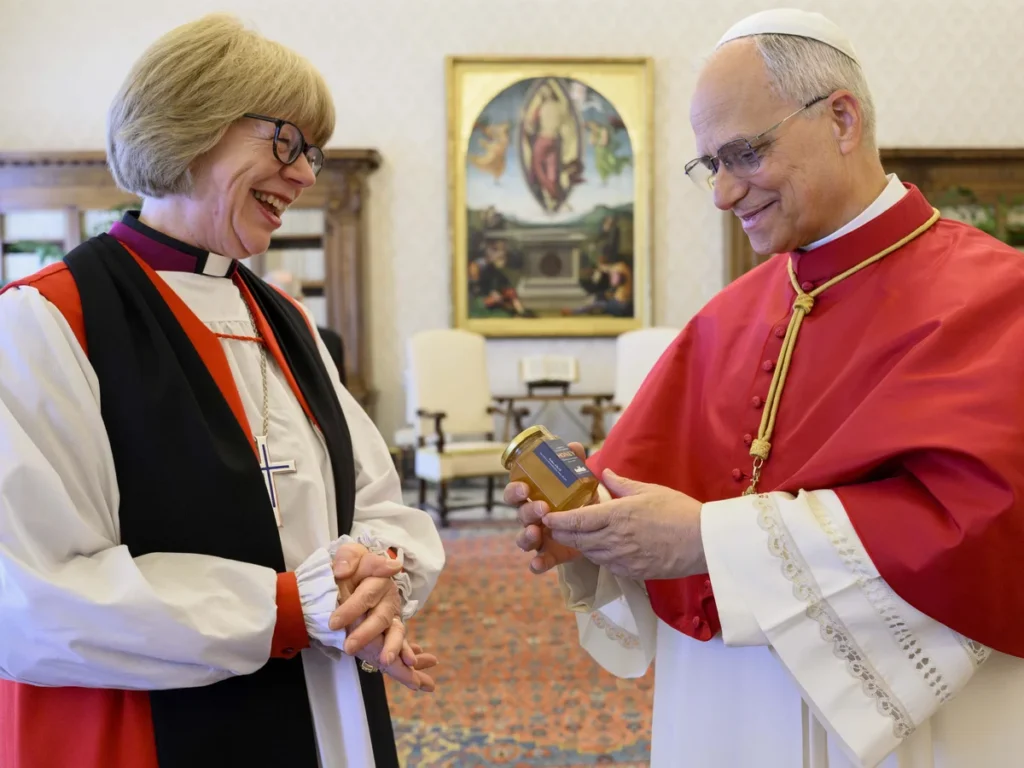
Visit of the Archbishop of Canterbury to Rome
The visit to Rome by the Archbishop of Canterbury, Sarah Mullally, relaunches dialogue between Anglicans and Catholics, in the name of unity and peace.
Four intense days, between prayer, institutional meetings and highly symbolic gestures. The visit to Rome by the Archbishop of Canterbury, Sarah Mullally, from 25 to 28 April, represented much more than a diplomatic appointment: it was a significant step in the ecumenical journey between the Anglican Communion and the Catholic Church.
Among the main moments: the prayer at the tombs of the apostles Peter and Paul, the audience with Pope Leo XIV and the meeting with the Dicastery for Christian Unity. The culmination of the trip was on 27 April, in the church of St. Ignatius of Loyola, during the Choral Evensong at which Bishop Anthony Ball was officially installed as the representative of the Archbishop of Canterbury to the Holy See and as director of the Anglican Centre in Rome.
This role has its roots in the historic 1966 meeting between Paul VI and Anglican Archbishop Michael Ramsey, the first after the Protestant Reformation. From that gesture – also made famous by the gift of the episcopal ring as a sign of fraternity – a new season of dialogue was born and the decision to establish a stable Anglican presence in Rome. The Anglican Centre continues to promote relations, theological study and joint initiatives, in collaboration with Vatican bodies.
The meeting between Archbishop Mullally and the Pope is part of this continues flow in relations. In the private audience in the Vatican, which culminated with a moment of shared prayer, the spiritual dimension of dialogue emerged forcefully. The Pope recalled common responsibility in a world marked by conflicts and divisions: the fractures between the Churches, he stressed, weaken the credibility of the proclamation of the Gospel and it would be a “scandal” not to commit ourselves to overcoming them.
Words that are echoed in the intervention of the archbishop, who insisted on the urgency of a shared witness, capable of speaking to today’s world. In the face of violence, inequality, and profound change, Christians are called to build bridges, to promote the common good, and to reaffirm the infinite worth of every person.
It is not without significance that Archbishop Mullally is the first woman to hold the role of Archbishop of Canterbury: her presence in Rome also makes visible the persistence of significant ecclesial differences. Yet, these differences have not prevented a frank and collaboration-oriented dialogue, the sign of a journey that, although complex, has never been interrupted.
The visit thus took on the face of a true ecumenical pilgrimage. A journey that, almost sixty years after its inception, continues in a clear direction: beyond divisions, to be credible witnesses together of an “unarmed” peace, capable of responding to the pain of the world with the gentle strength of the Gospel.
________________________________________
1 Cf. the services on the websites www.archbishopofcanterbury.org and www.vaticannews.va.

PDF version
Humans in a digital revolution
April to June 2026
No 31 – 2026/2