

focus | the synodal path
Bishop József-Csaba Pàl on putting synodality into practice
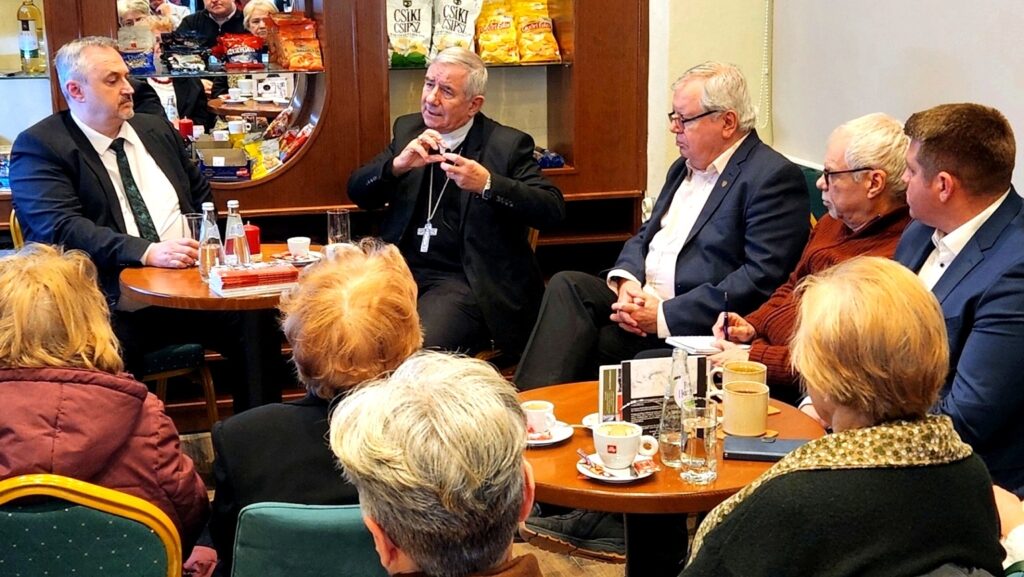
József-Csaba Pàl
Bishop József-Csaba Pál is a bishop of the Latin rite in Timisoara, Romania. He participated in the two sessions of the Synod on Synodality and spoke at the International Conference for the Ongoing Formation of Priests sponsored by the Dicastery for the Clergy, in February 2024. We spoke between sessions of the ecumenical conference, Called to Hope, in which he participated together with his friends from different Churches.
Bishop Pál, a year ago you spoke at the International Conference for the Ongoing Formation of Priests. What did you take away from that meeting?
I was surprised and I really liked the atmosphere that was created among us. There was a spontaneous and open fraternity where I could see many joyful, happy priests. It was not only a conference on formation, but we were formed together in communion.
A characteristic of that meeting was the synodal and participatory approach, practiced and proposed as a style for the accompaniment of priests. How have things moved forward in your diocese?
This conference helped me to take a practical step beyond what we were already trying to do: regular meetings for priests and with priests, including a half-day every month in the bishop’s residence with those born in that month, where we have lunch together and each one shares something of his current experience.
At the conference I was very impressed by the effort and the possibility of “making a home” for priests. For this reason, I have decided to set aside several evenings in my calendar for fraternal meetings with priests in small groups, each time in a different parish. Retired priests who live in the surrounding area are also invited. During those evenings there is no assigned topic: the topic is us, our life. And since they are in the evening, there is no rush to finish. Everyone can speak freely, without being interrupted; we listen to one another with respect and full attention. One evening, a retired priest spoke for 40 minutes about his illnesses. The dean wanted to interrupt him, but seeing that I was listening very attentively, he did not. In the end, everyone agreed that there had been a real family atmosphere.
Subsequently, you participated in the Synod twice, each time a month of living synodality. What particularly impressed you about this experience?
I would highlight two elements: prayer that supported prayerful listening, and communal discernment.
Prayer and prayerful listening. The moments of prayer, which were interspersed in the work, as well as the initial spiritual exercises, helped us to put ourselves back into the presence of God whenever closemindedness or impatience might have prevailed because of fatigue or some judgment or prejudice.
Communal discernment. Keeping ourselves open to one another, and together in front of God, helped us to discern what the Spirit is saying to each of us and to the Church. In particular, the method of conversation in the Spirit allowed us both to share our thoughts with parrhesia and to welcome with complete openness the thoughts of the others, different from our own. And in the end, we were often able to experience the miracle of feeling expressed in the outcome, the miracle of the unity of those who are different, an experience whose author can be none other than the Spirit. We really need to learn how to work in this style at all levels: in our dioceses and in our local communities.
You said that you were struck by no. 89 of the Instrumentum Laboris which speaks of the parish as a “community of communities.” What inspires you about this expression?
This is what the Instrumentum Laboris says: “We must do more to bring to fruition the great flexibility of the parish, which is understood as a community of communities at the service of missionary creativity.”
As I prepared for the Synod, I asked myself what I could do for this, as a bishop. It occurred to me that the first step should be to take stock of what communities are already present in the parishes?
I used to think that small communities only existed in Latin America and other continents, but I realized that, even in my diocese, life goes on in and through these groups.
Small groups or small communities offer millions upon millions of possibilities to populate the earth with Jesus’ presence: “For where two or three are gathered together in my name, there am I in the midst of them.” (Mt 18:20) I am referring to groups or communities where people know each other by name, help each other, pray together, joyfully participate in the Eucharist, take care of those who are elderly and sick, and value small or great charisms..- Sometimes they practice lectio divina, are open, and live for the mission.
So far, I have found about 400 small communities in the parishes. I met with their leaders, along with their respective parish priests, bringing together representatives from two to four parishes at a time, so that there would not be too many in a single meeting. Everyone shared what their group does and what they do for the members of the group. It was wonderful. The parish priests were also very happy. We remain in touch. They want to grow. We have also created a Whatsapp groups, so that all these people receive my pastoral letters. We are only beginning, but we are continuing along this path.
How do you plan to put into practice in the diocese what is proposed in Cardinal Grech’s recent letter regarding the implementation phase of the Synod on Synodality?
When I received the letter, at first I wanted to say: yet another job! Immediately afterwards, however, I understood that it is not a question of doing something, but of adopting a style. And this is exactly what we do in these small groups, where we listen to one another right to the end and where we want to grow in listening together to the voice of the Spirit. In these groups, in which priests also participate, we have the opportunity to grow in communion and also in mission. So we continue this work with joy and great hope.
We are meeting on the occasion of an ecumenical conference. Would you also say something about “ecumenical synodality” and your own experience?
Yes, I am convinced, as Pope Francis often reiterated, that there is no synodality without ecumenism and there is no ecumenism without synodality. These are not two different ways of living. Both within the Catholic Church and in our relationship with other confessions, we have to listen to one another, grow in communion and be beggars of truth together. For this reason, the experience I had in Castel Gandolfo last March, from the 26th to the 29th, at the ecumenical conference Called to Hope with people of different confessions and countries helped me to grow in hope for unity in the Church and among the Churches. There are so many seeds of unity in the world, seeds of hope. They are not immediately visible, but those who trust in the sower, who is the Holy Spirit, have hope that the seeds will grow.
What kind of Church do you think should or could emerge from the synodal process?
The Synod gave me a lot of hope that the Church will be more communal. There are those who are more conservative and those who are more progressive, voices with different opinions. Yet, this did not stand in the way of the synodal process. The Spirit has been able to gather various voices and bring them into an open and profound dialogue. If we think of the composition of the small groups in which we worked, we can see them as models of communities with various vocations, bringing together lay people, religious, priests, bishops, men and women of different backgrounds and cultures are together, united by their love for the Church and their commitment to the world in which we live.
I have seen how relationships are more important than actions at all levels. What we must do first is to build fraternal relationships. Cultivating relationships helps us not to get lost in ideas and theory, but to go out to meet everyone with God’s merciful love. In this way, the Church becomes more missionary.
If we have authentic communities, which are places of true fraternal relationships, we have somewhere to which we can invite people who do not have faith or a good relationship with the Church or have drifted away… And if Jesus is at the center of the community, people do not encounter something – a tradition, a teaching, an idea that may even be a good one – but Someone who can transform their lives.

PDF version
Called to Hope – Key players of Dialogue
July to September 2025
No 28 – 2025/3
