

focus | insights
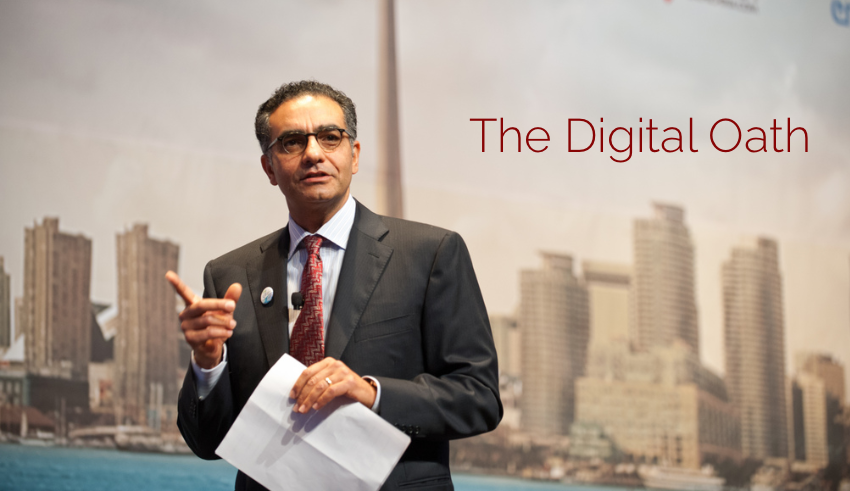
Fadi Chehadé’s proposal
There is a growing awareness in civil society that the digital universe needs to be regulated. Among the proposals is one put forward by Fadi Chehadé and addressed to AI developers: a Digital Oath, modeled on the Hippocratic Oath taken by those working in health care, which would morally bind its signatories not to cross limits that could threaten the integrity of the human person.
Faced with the sweeping digital revolution, Pope Leo XIV sees the need for a renewed response on the part of the Catholic Church as well. The Pope, a mathematician and jurist, chose the name Leo in part for this very reason.
The Catholic Church has faced other moments in history when it has had to ask itself how relevant its presence in the world was, and it has not always managed to respond promptly or adequately. Today, however, the problems are so urgent and technological progress so rapid that it is not only the Church that is struggling to keep up; academia, politics, and civil society are lagging behind as well. The overwhelming power of the digital giants, whose financial resources exceed the budgets of countries such as Switzerland and Spain, raises pressing questions for economics and politics, communications and academia, ethics and neuroscience, education and psychology, as well as health care.
And that is not to mention the military sphere, where new digital technologies are brutally transforming what happens on the battlefield. Nor is warfare now confined to the battlefield. Wars are fought on many different levels – economic, intelligence, diplomatic, cyber, and informational, as well as military – and digital technologies clearly play a decisive role in all of them.
The digital giants have allowed themselves to be questioned about the serious distortions caused by the mass use of their technologies, but they have failed to provide satisfactory answers. One reason is that they have yielded to the god of the dollar – or the euro, or the yuan – in pursuit of ever greater multibillion-dollar profits. This has muted concern about the serious social harm caused, for example, by the polarization to which billions of people are being driven, producing psychological disorders, populist drift, and even large-scale social damage, especially among the most vulnerable age groups.
And yet the most objective observers point out that, despite these far-reaching problems, the potential of the digital revolution still calls for confidence in a phenomenon that has already shown enormous possibilities for personal and collective human development. We need only think of advances in health care or in public administration. The Covid-19 period was weathered without even greater damage also, and perhaps above all, because of increasingly advanced and personalized digital technologies.
In response to these developments, there is growing support within civil society for some form of regulation of the digital world. Europe is ahead in thinking about and legislating for the digital sphere, even if the relentless pace of technological change seems constantly to make the regulations designed to make the digital world fairer and more equitable obsolete.
Countless initiatives have also emerged to help citizens act responsibly in the digital environment. We can think of issues surrounding privacy, parental controls, workplace ethics, and the regulation of remote work. Ethical codes, various kinds of “pacts,” and professional standards are spreading everywhere, all intended to bring greater judgment and responsibility to procedures involving digital technologies.
Fadi Chehadé has been on familiar terms with the digital world since the 1970s, when still a very young student, he left Lebanon for the United States to study computer engineering and Artificial Intelligence – yes, people were already talking about it even then. His career advanced rapidly, eventually taking him to the position of CEO of ICANN, the organization responsible for the basic architecture and functioning of the Internet. Among other things, it assigns IP addresses – identities and locations – to the billions of devices that become part of the network, devices that are becoming ever more widespread and sophisticated.
Chehadé – a Coptic Orthodox Christian of Egyptian origin who, while in Lebanon, came to know and spend time with the Focolare Movement, retaining its aspiration for a more united world and sharing its foundational ideals – understood early on that the digitalized world would be radically different from the analogue one, opening up previously unimaginable possibilities while at the same time creating entirely new risks.
Later, he chose to work in the digital business sector – he now heads an investment company called, significantly, Ethos Capital – while never concealing his ambition to pursue “clean” business practices. At the same time, he developed his own vision of global governance, one capable of bringing together institutions, civil society, and the private sector, at a time when digital companies had not yet reached their current scale.
Fadi Chehadé is convinced that digital engineers hold such power in their hands – power extending far beyond the field of technology into politics, economics, and even anthropology – that they too need an oath modelled on the Hippocratic Oath taken by health care professionals. Hence his proposal for a Digital Oath: a pledge that would morally bind its signatories not to cross the digital “Pillars of Hercules,” beyond which there is a risk of undermining the integrity of the human person.
The idea quickly circulated in digital and academic circles – thanks in part to the work of the Sophia University Institute – as well as within civil society. It will soon be brought more fully into the public arena as a covenant embracing the entire digital sphere, including Artificial Intelligence, and the future developments of a digital revolution that appears to be only at its beginning.
There are already codes, pacts, professional standards, philosophies, and even theologies of the digital world. What may still be lacking is a true “wisdom of the digital,” a sophia that alone could prevent epoch-making distortions in the digital sphere: a wisdom that arises from within the infosphere itself rather than standing outside it.

PDF version
Humans in a digital revolution
April to June 2026
No 31 – 2026/2