

focus | witness
Ikuméni: Young voices in Latin America and the Ikuméni Project
Eddy Juárez and Laura Camila Jiménez
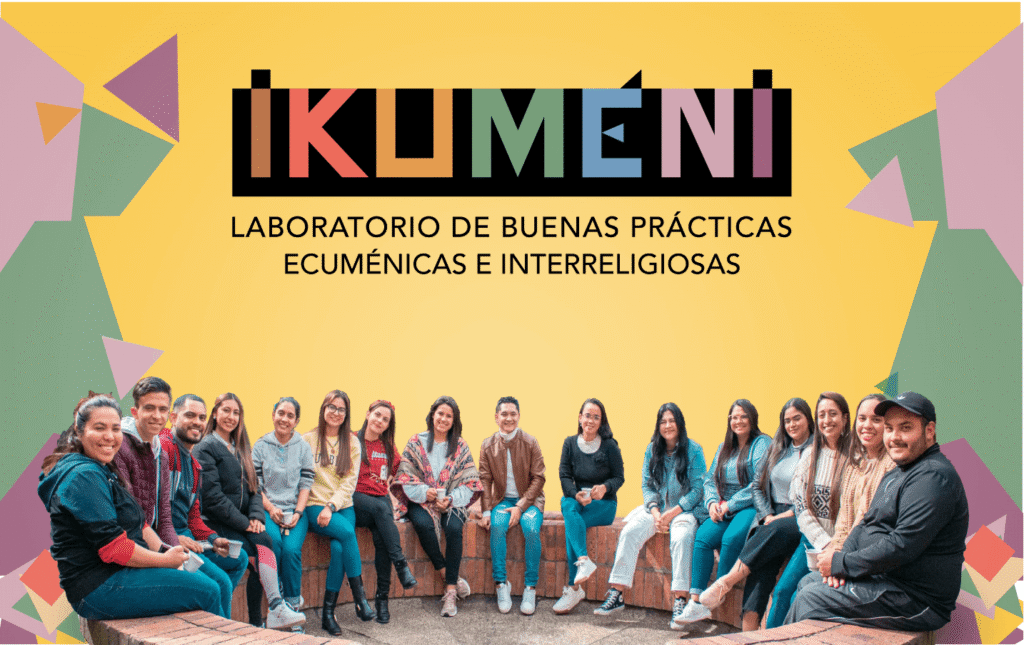
The two authors recount here the story of Ikuméni, an ecumenical project supported by a number of entities including the Colombian Bishops’ Conference, the Episcopal Commission for Youth and Laity of Peru, Caritas Latin America and the Caribbean, the United Methodist Churches, CELAM1, the Platform of Protestant and Evangelical Universities of Latin America, and the Caribbean Qonakuy. It is characterized by a fraternal, collaborative dimension of “going out” towards the other’s Church and to others, with the aim of transmitting this way of being to the world around them2.
Ikuméni’s best practices
Ikuméni has involved more than 300 young people from 16 Christian Churches and 20 countries in Latin America and the Caribbean. It is based first and foremost on a Laboratory of Good Ecumenical and Interreligious Practices. Born in 2019 through the initiative of Creas, the Regional Ecumenical Center for Counseling and Service, other organizations quickly joined. The project is led by Elena López Ruf, a young legal researcher with a focus on international cooperation and interreligious dialogue, and whose dialogue formation has its roots through the Focolare Movement.
Ikuméni‘s team members belongs to several Christian Churches. Emphasis is placed on building together spaces of unity in respect and communion between different Christian traditions, a reality that then expands and involves many others.
The goal is to train young people between 18 and 35 years old, in a leadership style inspired by a welcoming hospitality and cooperation through ecumenical and interreligious best practices that can be implemented in each one’s region or community.
The fourth Ikuméni training course took place as a four-month program of weekly online meetings and a face-to-face meeting that occurred simultaneously in four Latin American and Caribbean countries. A specific course on peacebuilding and reconciliation will also begin in September 2025.
John 17:21
Eddy Juárez spoke of his own experience: I am Catholic and come from the diocese of Chulucanas, in Peru. I would start with a phrase from Psalm 126: “The Lord has done great things for us: we were full of joy”. For me, Ikuméni is a blessing. We are protagonists in an experience of fraternity.
Ikuméni is that home where we can all arrive to, a home free from prejudices, fears and doubts, where we fill ourselves with God’s love, and the art of hospitality teaches us to recognize and welcome our neighbor as a brother.
My own diocese of Chulucanas was born in 1964, in the wake of the spirituality of communion of the Second Vatican Council and the initiatives of laity. I was accustomed, therefore, to speaking and promoting communion. However, we had done very little in ecumenism.
But thanks to Ikuméni, I could experience the true meaning of communion, of unity in diversity, of love for my neighbor without wanting to change him or adapt him to my way of living the faith, but rather simply by trying to love him or her.
My own ‘best practice’ in ecumenism consisted of establishing a volunteer program to assist the most vulnerable affected by the floods caused by the El Niño phenomenon3. This gave us the opportunity to work with young people from two evangelical Churches of the Pentecostal tradition.
Today I am head of a team that coordinates, energizes and animates diocesan pastoral care and, thanks to the tools that Ikuméni continues to provide me, we began to work on the theme of ecumenism.
Ikuméni made me aware that I have brothers and sisters in other Churches with whom I can share, pray, and work for the common good. It is about communion, synodality and living Jesus’s words: “That they may all be one” (Jn 17:21).
Bridges instead of walls
Laura Camila Jiménez. I am a 23-year-old Colombian youth, and I carry in my heart a deep conviction of redemption. I grew up in a country at war, from the time of my childhood until today.
Five years ago, I left my homeland to study in Buenos Aires, with the aim of studying political science. From day one, my ecclesial community, the Argentine Church Verbo de Vida, an evangelical Pentecostal confession, welcomed me with love and reminded me that the Kingdom of God knows no borders. At the same time, I was a member of a community in Colombia that united brothers and sisters of different denominations with the same purpose: to glorify Christ and spread his message through social action, Bible studies, and Bible circles. Now, in Argentina, God has provided for Student Life4, a project of Campus Crusade for Christ, focused on bringing the Gospel to universities.
In my Ikuméni training, I chose the Peacebuilding path with a clear objective: to form a group of young Christians of different denominations, ages and professions who were passionate about Christ within the University of Buenos Aires. Like other academic institutions, cross-party, political conflict is the norm here and often overshadows the importance of true democracy.
I am convinced, in a context such as Latin American marked by polarization and territorial conflicts tearing entire populations apart, that it is essential to form strong youth that know how to build bridges instead of increasing divisions. Ikuméni gave me not only the needed tools but enabled me to see how faith translates into concrete actions. Today, when desperation and polarization seemed to thwart attempts at dialogue, this reminded me that peace begins in the hearts of those who decide to be bridges instead of walls in this wounded world.
Unity in hope
Like the two of us, there are hundreds of other Latin American and Caribbean youths in diverse contexts — from indigenous populations in the Amazon rainforest to those in major cities facing armed conflict — that want to continue to promote a ‘Samaritan ecumenism’. This kind of ecumenism invites everyone to work cooperatively as Christians of different confessions with people of other religions and in civil society, all at the service of those suffering in our fragmented world.
Our hearts are full of gratitude to God for all that he has done in our lives and for the life witness of so many other young people committed to loving our neighbor as ourselves, as a sign of hope and unity for humanity.
__________________________________________
1 A body of the Catholic Church bringing together the Bishops’ Conferences of Latin America and the Caribbean.
2 Cf. also B. Isola, Ikuméne. A workshop of formation in dialogue and diakonia, in «Ekklesía» 6 (2023/1) p. 60.
3 The El Niño is a periodic change in sea surface temperatures in the tropical Pacific Ocean that significantly impacts the global climate, manifesting as abnormal warming that causes extreme weather events such as droughts, floods and heat waves in diverse regions of the world.
For more information on Ikuméni see: https://ikumeni.org/?lang=en

PDF version
Called to Hope – Key players of Dialogue
July to September 2025
No 28 – 2025/3
