

editorial
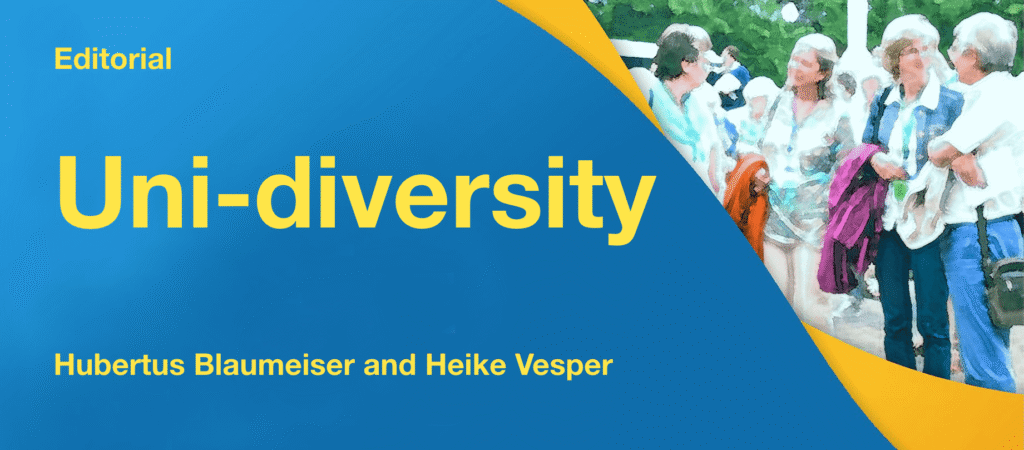
Uni-diversity: The kaleidoscope gathering of people at the ecumenical conference Called to Hope – Key players of Dialogue, held in the Mariapolis Center in Castel Gandolfo from the 26 to 29 March 2025, is still very much fresh in our minds: men and women of very differing ages, backgrounds – priests, bishops… Two hundred and fifty people, with many others connected via the internet and with 14 simultaneous translations being available. Even the variety of clothes, the robes, and headgear demonstrated an impressive array of cultures and ecclesial backgrounds: representing twenty Christian churches and forty different countries.
It was certainly not similarities that made up this display of harmony, but rather openness and mutual acceptance, almost a prophecy of what our planet could be if each one sought the good of the other as much as his or her own and if we thought of unity not in a monocentric way, tailored to our own experience and identity, but as uni-diversity.
All of this was a fascinating picture – also borne out in the talks and testimonies which were shared during those days – and so we suggested to the organizers of the conference, the Centro Uno for Christian Unity, that we could produce an issue of Ekklesía dedicated to this positive ecumenical coming together of the various churches. However, we thought it better to report of the conference not simply as a documentation of an event which has now passed, but, rather, as a narrative which opens our horizons and which invites our readers to live out the same.[1]
It was no coincidence that this meeting was held in this year of 2025 which is, for several reasons, a kairòs – a special and favorable moment – of the ecumenical journey. It is 1700 years since the first “Ecumenical Council” took place in Nicaea, located in modern-day Turkey, and which at that time was the seat of one of Constantine’s imperial residences. It is worth noting that the original sense of the term Ecumenical meant universal or “world”. Even at that time, the unity of the Church was at risk, and the aim of the Council was to bring the differing parts together and unite them into one. This year also marks 60 years since Paul VI and the Ecumenical Patriarch Athenagoras I met together at the conclusion of the Second Vatican Council in order to abolish the reciprocal excommunications of 1054 between the Church of Rome and the Patriarchate of Constantinople. That gesture was as courageous as it was prophetic but is still waiting to find a complete fulfilment. A further fact, of great importance: on April 20, all Christians were able to celebrate Easter on the same date, due to a coincidence of the two different calendars, the Julian and Gregorian – a circumstance that stimulates us to take further steps in this direction. And that is not all. 2025 also marks the 500th anniversary of the Anabaptist Movement that began in Zurich in 1525 and the 100th anniversary of the first meeting of the Life and Action Movement of the World Council of Churches.
Called to hope. This title of the Conference is suggested not only by the ecumenical events just mentioned, but also by the Holy Year of the Catholic Church focused on hope. Hope, in fact, asks us not to remain prisoners of the past and of existing barriers but to look ahead, not to stop – as Martin Luther explains so well – looking at the superficial reality, at only the facts, but to turn our gaze to God who, even in the most difficult of circumstances, is always at work. This is particularly urgent in the times in which we live now.
This issue of Ekklesía, therefore, is dedicated to the ecumenical journey. But does ecumenism – one wonders – really concern us all? Is it only a matter for experts or for those who are passionate about this issue? In reality, it is a task that challenges all of us wherever we grapple with differences that can degenerate into polarizations instead of leading us to unity (uni-diversity!): in the neighborhood and in the workplace, in our parish and civil communities. We are all challenged to understand ourselves as family, of ecclesial and social coexistence not as a monolith but in a symphonic key: the result of numerous voices and contributions that do not allow themselves to simply be reduced to each other, but are made to become a gift for one another. If nothing else, creation itself tells us so: extraordinarily multifaceted and articulated in its biodiversity, it is a whole in which everything is related. It could not and cannot be otherwise if it bears within itself the imprint of a God who is at the same time One and Three.
[1] It was not possible – and it was not even our intention – to report here all of the talks given at the meeting. What guided us was the desire to offer a selection that gives voice to the various geographical areas which could spur our readers. The entire Conference is available, in the form of a video in several languages, on YouTube under CALLED TO HOPE – Key players of Dialogue.

PDF version
Called to Hope – Key players of Dialogue
July to September 2025
No 28 – 2025/3
