
focus | witness
War and peace in Sierra Leone
My Life as a Child Soldier
Joseph Konah
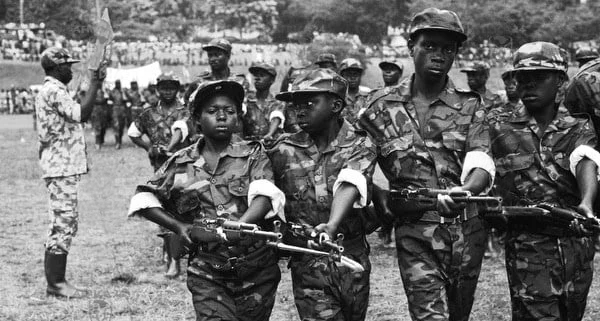
Sierra Leone is an African country sadly famous for its civil war linked to diamond mine exploitation. In the 90s, guerrillas terrorized the population, causing death and misery. Joseph Konah, born during these turbulent years, recounts his experience as a child kidnapped from his family and recruited to be a soldier.
A few words about my country. The American Revolutionary War, during 1760-1770, offered thousands of slaves an opportunity to earn their freedom by fighting for the English cause. When the war ended, over 15 thousand former slaves emigrated to England, where they suffered unemployment and poverty.
In 1787, a group of English philanthropists purchased 52 km² of land in present-day Sierra Leone from an indigenous chief, to establish a Freedom Province for former slaves. Thus the city of Freetown (“Free City”) was born and is the country’s current capital. Life, however, was not easy for these former slaves, and soon afterwards the region became an English colony.
Independence eventually happened in 1961, but the years that followed were very difficult. Then the situation degenerated further in late 1989, when thousands of Liberians were forced to seek refuge in neighboring Sierra Leone. Then, fighting spread across the border the next year, with a rebel front occupying almost the entire eastern part of the country. The 1990s were years of civil war, characterized by ferocious clashes among various armed guerilla groups, fomented by attempts to seize control of the diamond mines.
Kidnapped by the rebels!
I was born in this period and lived with the rebels for five years as a child soldier.
When I was a child, rebel groups formed and there was fighting against the government army, even in my native region of Kabala. One day a group of armed men arrived in my village, broke into my house, and kidnapped me to be a part of their army of “child soldiers”.
I found myself together with many others of my age. We had to walk all night to reach the guerrilla base. During that journey, one child became tired and asked to rest. A rebel captor looked at him and said: “Ok, you stay here to rest and we will go”. And without hesitation he shot him.
We left our village as children afraid of gunshots, to then become those who did the shooting.
Escape
I was only six years old, and I had to learn to live with the rebels. The rebels were looting and burning villages. They murdered and cut off the hands of adults and children so that they would not have fingerprints to vote.
I was captive there with them for five years and had to watch my friends who, after being drugged, were forced to commit atrocities as well.
My boss had lost a son in the war and had chosen me to replace him. I was the one who served him directly. Thus, I enjoyed, in a certain sense, a more privileged situation than many other kidnapped children.
During our travels, women from nearby villages were obliged to bring us food. One day I recognized my mother among those women, who for years I had believed was dead. At that moment I told her, using our dialect that no one understood, not to rejoice but to remain indifferent. Despite her joy in having found me, she managed to pretend nothing had happened and we made an appointment to meet in the nearby forest.
That night, I told my boss that I wanted to go for a walk and he gave me permission. I joined my mother and together we ran back to the city to look for the government army, that assisted us until the end of the war.
The peace process
On July 7, 1999, the Lomé Peace Agreement treaty was signed, and the UN sent the largest and most financially backed peacekeeping mission ever deployed to Sierra Leone. Efforts to disarm the rebels ended in February 2002 (over 40,000 firearms were destroyed), and the first free and peaceful elections were held. An independent war crimes tribunal and a Truth and Reconciliation Commission were also established that year.
Despite everything, and even if people wanted nothing more than serenity, there still remained, in some, resentment and a desire for revenge against the rebels, who were still alive. The wounds were many and the peace process was struggling to bring results.
But I remember one day the president asked a little girl whose hands had been cut off, “If you saw the people who did this to you, what would you do?” The little girl replied: “I must forgive the rebels because if we do not forgive, the war will never end”.
These words were spread everywhere. Perhaps thanks to people like this young girl, reconciliation took place in our country. More than 20 years have passed and it can be said that there is a peaceful coexistence, despite many social, economic and political challenges.
Another way of life
After returning home, I could attend school, and met the Xaverian missionaries who lived in my city. They too had suffered from the war, had escaped, and lived as refugees in the forest for a long time.
They spoke to me about the Gospel, the “art of loving” and the experience of Chiara Lubich, who had experienced war and had also forgiven. I tried to live the phrases of the Gospel like them, trying to do to others what I would have liked them to do to me, to love as Jesus teaches. I felt myself change inside.
With them I committed myself to transmitting the art of loving to many other people, in the villages where we went on missions, in schools, and elsewhere. I knew so many to whom I could communicate the discovery that forgiveness and peace are possible. The missionaries also helped me to continue my studies and to obtain a master’s degree in Economics in Italy, at the Sophia University Institute (Loppiano). There, I had the opportunity to live with people from various parts of the world and of many diverse cultures. I have tried to welcome diversity and love each one with all my heart. I have come to realize that there is another way of living, without fear.
At the same time, I am working with an NGO, Action for a United World, in the area of global citizenship education, and I follow school projects in Sierra Leone.
In the future, after my studies, I would like to return to Sierra Leone and work with my people, especially with children and young people, to train them to live for universal brotherhood and sisterhood with all.
In Today’s Times and Places
October to December 2025
No 29 – 2025/4