

editorial
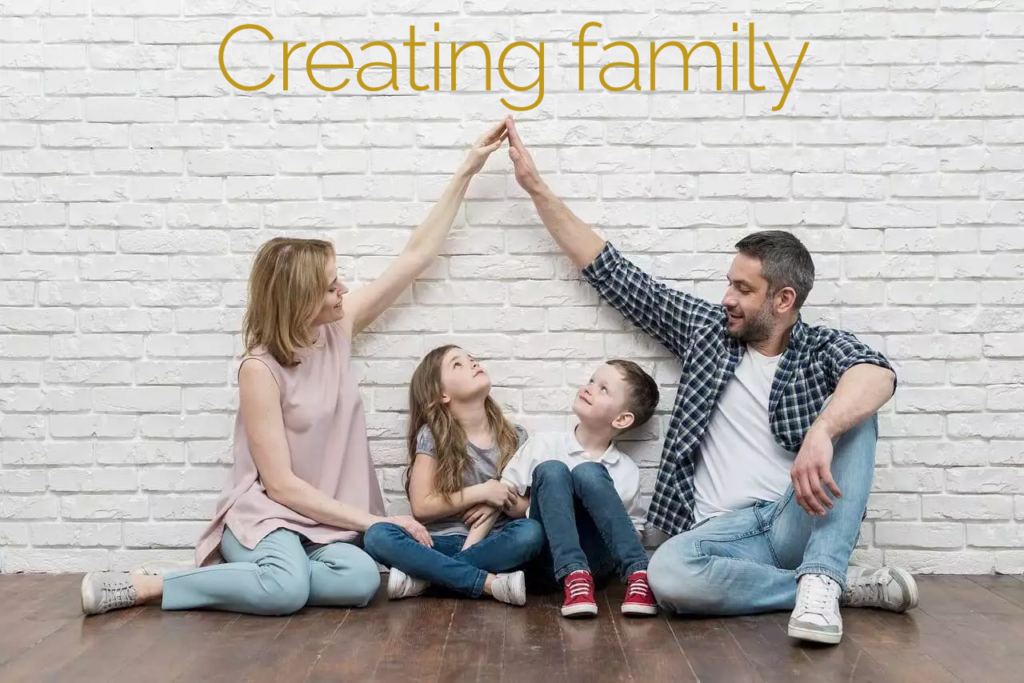
Creating family
Sixty years ago, the psychoanalyst Alexander Mitscherlich observed that we live in a society that has lost the notion of ‘father’. In the light of contemporary experience, we might add: a society that has lost its sense of home. And this not only in the face of the staggering phenomenon of mass migration, nor solely because of the dramatic living conditions of people in Gaza and in so many other war-torn regions, but also because of the growing complexity of what the sociologist Zygmunt Bauman so perceptively described as a ‘liquid society,’ one which has been shaped by mobility and globalization. In such a context, stable points of reference fade away; family bonds shrink into ever smaller and more fragile units; and at the same time, each individual is caught in a vast network of “contacts” that demand attention and engagement without offering any unifying centre.
Against this backdrop, it is significant that the global synodal process of the Catholic Church has concluded that the Church today is called to a relational conversion (Final Document, 50), one that enables her to become “an effective leaven of bonds, relationships, and fraternity within the human family” (FD 20). The Church, then, as a “home” which is to be understood not “as a closed, inaccessible space to be defended at all costs,” but as a reality to be lived as a “possibility of welcome, hospitality, and inclusion,” as a “sacrament of encounter and salvation” (FD 115). A “home,” therefore, that is mobile and open, made up of people who are “rooted and yet pilgrims,” capable of being present in the places and times where human life unfolds.
Like Jesus, who, when asked, “Teacher, where do you stay?”, could reply, “Come and see” (cf. Jn 1:38–39). He was not bound to a specific physical location or a fixed structure; rather, he was constantly on the move. And yet he had a stable point of reference: the Father. From this he drew the strength not only to form a community with the Twelve and with the women who followed him, but to make a “home” for so many who were thirsty, disoriented, wounded by life, and in need of attention and care.
This brings to mind the small Christian communities that, under various names and with different methodologies, are increasingly spreading across every continent, and making the Church present among people. They are not built of bricks but of people; the cement that holds them together is relationships; their root is the Word of God and the presence of Christ crucified and risen. Half a century ago, Chiara Lubich had the inspiration to see such small communities, sometimes only made up of two or more, as small “flying Churches” which are able to take shape anywhere and can introduce the leaven of the Gospel into apartment buildings, schools, offices and factories—into the very places of everyday life.
Also, fifty years ago, the young Vietnamese Bishop Van Thuan, who was imprisoned on 15 August 1975, discovered in his own way this possibility of building “the house and family of God” even in adverse circumstances. He did this by forging bonds of fraternity with his guards; by recognizing in his fellow prisoners, crammed together with him in the hold of a cargo ship, his “cathedral”; and by celebrating the Eucharist in the re-education camp with three drops of wine and a single drop of water in the palm of his hand. These are ways of being “Church” in extreme conditions, yet they underscore both the necessity and the possibility of entering into every situation of human life.
If for centuries we have been accustomed to locating the “sacred” in churches, pilgrimage sites, remote chapels perched on hilltops, or in the tabernacle of a city-centre church, the recent Synod calls us to broaden this spatial and temporal approach with a more qualitative one, one which is focused on the presence of God’s life in everyday relationships.
In this regard, the Synod’s Final Document notes that the Church today must be characterized “as a space in which relationships can flourish, thanks to the mutual love that constitutes the new commandment left by Jesus to his disciples (cf. Jn 13:34–35).” It also highlights its importance: “Within cultures and societies that are increasingly individualistic, the Church, ‘a people brought into unity from the unity of the Father, the Son and the Holy Spirit’ (LG 4), can bear witness to the power of relationships grounded in the Trinity” (FD 34).

PDF version
In Today’s Times and Places
October to December 2025
No 29 – 2025/4