

focus | experiences
Faiths, cultures and dialogue in Serbia today
Vida Rus
Serbia is a crossroads of cultures, faiths and historical memories. With an Orthodox majority, it also has a significant Catholic and Evangelical presence, as well as diverse ethnic groups especially in the northern region of Vojvodina. There is also a small Muslim community in the capital of Belgrade, and a larger community in the southwestern Sandzak region. In addition to Orthodox Serbs, who represent 82.86 percent of the population, in the north there are Hungarians, Croats, Bosnians, Ruthenians, Ukrainians, Slovaks, Czechs, Slovenians, Germans, and Romanians as well. Instead, Montenegrins, Macedonians, Bulgarians, Turks, Albanians and others are found mainly in the south-eastern part of Serbia. In total, Orthodox represent 85 percent of the population, Catholics 10 percent, Muslims (Sunnis) 3.3 percent, Evangelicals 0.92 percent, and the rest define themselves instead without religious reference.
This social and cultural complexity still needs to be brought into focus, but by coming to know one another, we draw closer and this can become an enrichment for one another. The State fosters collaboration between different ethnic groups and religious communities so that seeds of hope will emerge that trigger respectful coexistence based on a shared collaboration for the common good. Through many small gestures it is possible to build a culture of encounter and peace.
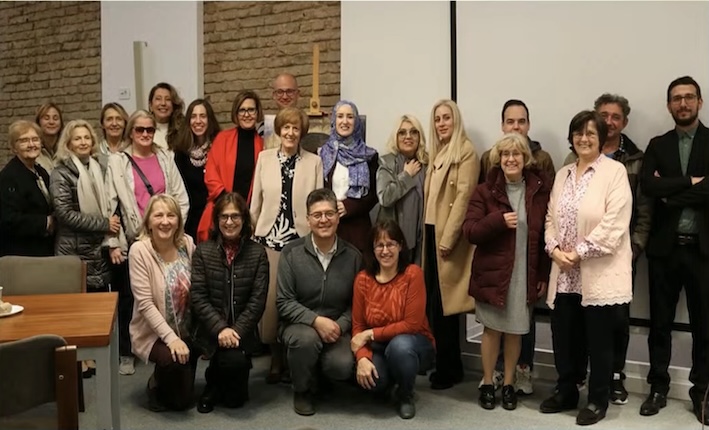
For some time now, meetings and cultural initiatives involving representatives of the Serbian Orthodox Church, the Catholic Church (Latin and Byzantine rite) and the Islamic Community have taken place, with the support of the Serbian government. Among the protagonists are the Orthodox Institute for the Study of Culture and Christianity, the Focolare Movement and the Muslim Cultural Association, Gajret. Some of those involved in this initiative share their experiences below.
An hour for peace
Cinzia Panero, Italian, Roman-Catholic: The symbolic moment from which it all began was the first Prayer for Peace, held on November 23, 2023, in the Belgrade Catholic cathedral, which brought together people of different religious and ecclesial affiliations, from associations, cultural centers and various academic environments. Attendees included students, artists, theologians and political scientists, and above all people who “nourish in their hearts the desire for peace and fraternity among human beings”. As the evening ended, the promoters shared their experience of spiritual peace, referring to the Gospel words: “Were not our hearts burning [within us] while he spoke to us on the way…? ” (Lk 24:32). This event of true communion also generated new initiatives, including the Kulturni kafe.
The Cultural Café for a Culture of Encounter
Danijela Marković, Serbian Orthodox theologian: This Kulturni kafe (Cultural Café for a Culture of Encounter) was a remarkable success with the public, thanks to the variety and depth of the topics addressed. In fact, contributions from these events are being published.
The lively, intense meetings are like feasts in which the possibility of living a new Pentecost in the concreteness of daily life is evident. As it has been said: “I am happy that this is the beginning of a reunion in friendship”.
“The World in Images – Image of the world”
Snežana Pavlović, Serbian Orthodox and Ministry of Justice official1: The centrality of today’s visual communication finds a clear expression in the exhibition The World in Images – Image of the World. This exhibition was born from close cooperation between people of different faiths eager to experience the beauty of different spiritual expressions as a message that unites and supports mutual understanding.
The starting conviction of the exhibition was the principle: “We will respect each other in the measure that we are able to come to know each other”.
The large participation of artists was unexpected, with the variety of works reflective of their religious and cultural heritage. The level of creativity inspired by faith, and an aesthetic capable of expressing values lived and shared by believers, was evident.
The multiplicity of artistic mediums – from photography to applied art, from icons to mosaics, from short films to paintings – offered a rich overview of the image of the world that every believer carries within him or herself. With today’s profound crisis of values, this diverse creativity constitutes an unprecedented basis for more authentic relationships based on beauty and dialogue.
At the exhibitions opening, Serbian Patriarch Porfirije stressed: “It is important that these collected works of art express in a particular way the vision of authentic peace […]. We perceive the works as a sign of national unity and an invitation to strengthen fraternal dialogue and mutual respect among all people. […] Being together in our uniqueness is necessary and indispensable for every human soul.”
The exhibition was promoted by the Directorate for Cooperation with Churches and Religious Communities of the Ministry of Justice of the Republic of Serbia. It is the result of years of collaboration and commitment in promoting a culture of encounter.
Music, young people and a festival called “Emmaus”
Janko Katona, Greek-Catholic Ruthenian: The Emmaus Fest was born in 2023 and is in its third edition. “Emmaus” expresses the purpose of the Festival: To encounter Jesus together, along the way, as a community (journeying) towards unity.
It took place in the Serbian city of Kucura, as a spiritual youth meeting entitled: Conference of Spiritual Music and Poetry. After overcoming initial setbacks, the project was reborn as an ecumenical concert, with a series of conferences with priests from different Christian denominations and Run4Unity, and it included activities for children and teenagers. More musical groups are now participating as enthusiasm grows, and it has been transformed into a kind of mega-festival bringing together children, youth, priests and faithful Catholics (Latin and Byzantine rite), Evangelicals, and Orthodox.
Subsequent events testify to the ever-greater quality of technical organization and artistic presentations that generate profound emotion among spectators, with many said to have been moved to tears.
A small seed… with great fruits
Cinzia Panero: We have seen through these initiatives that meetings among different cultures and religions are not only possible but bring concrete fruits. Relationships born around a table or in front of a work of art, or in a moment of prayer, can change us and help us build a more just, peaceful and fraternal society together.
1 Directorate for Cooperation with Churches and Religious Communities.

PDF version
Called to Hope – Key players of Dialogue
July to September 2025
No 28 – 2025/3
