
focus | experiences
Ecumenical and interfaith dialogue in Italy
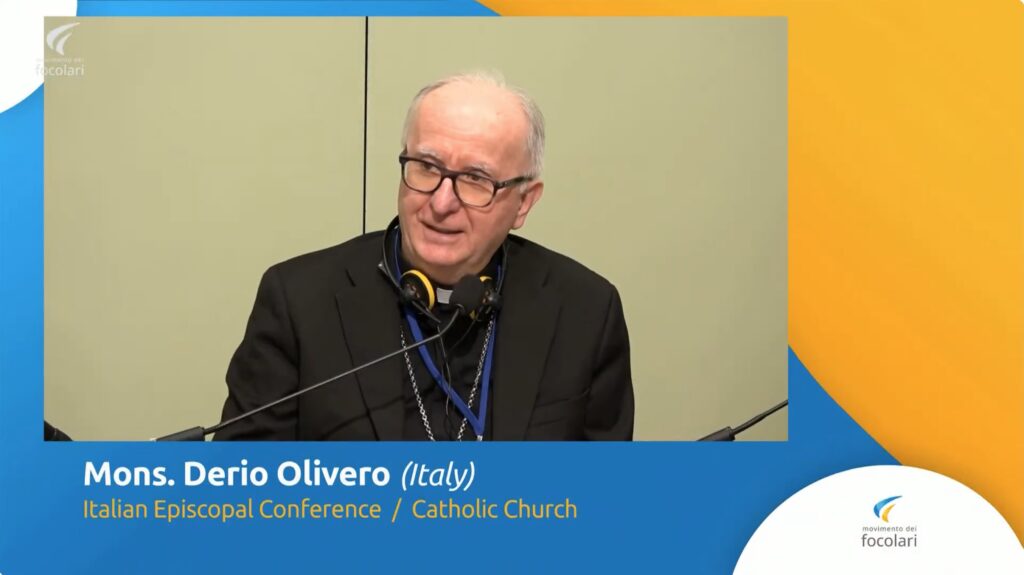
Mgr. Derio Olivero
The author is bishop of Pinerolo (Italy) and president of the Episcopal Commission for Ecumenism and Dialogue of the Italian Bishops’ Conference. He reflects here on the Commission’s work with the National Office for Ecumenism and Dialogue in Italy, and on collaborative changes in approaches to dialogue. Bishop Olivero highlights efforts by Catholics to offer themselves, together with other Christian confessions and other religions, as instruments for common development in civil society. especially in justice and peace education.
Our world needs dialogue. Christians must rediscover their vocation to dialogue starting from the splendid words of Saint Paul VI, who said: “The Church must enter into dialogue with the world in which it lives. It has something to say. message to give, a communication to make.“(Ecclesiam suam, n. 65). Then we also remember the words of Pope Francis in his encyclical, Fratelli tutti: “Together, we can seek the truth in dialogue, in relaxed conversation or in passionate debate. To do so calls for perseverance; it entails moments of silence and suffering, yet it can patiently embrace the broader experience of individuals and peoples. … The process of building fraternity, be it local or universal, can only be undertaken by spirits that are free and open to authentic encounters.“ (n. 50).
The Church in Italy, through the work of the Episcopal Commission for which I preside, and with UNEDI (National Office for Ecumenism and Interreligious Dialogue), would first like to announce that the Permanent Council of the Italian Bishops’ Conference has decided to dedicate an upcoming General Assembly of Bishops (probably May 2026) precisely to the theme of ecumenism and dialogue. It will be the first time! It is an important sign, in light of the ongoing activities which I will share briefly here.
Religions as an instrument of social cohesion
Last month I was in Abu Dhabi, together with UNEDI director, Fr. Giuliano Savina, and a group of regional delegates. In the district dedicated to culture, the government has created, the Abrahamic Family House: three places of worship of the same size, a church, a mosque and a synagogue. They have a shared Forum for meetings, seminars, conferences, and children’s education. The concept held by the government struck me; namely that religions can foster social cohesion and brotherhood in the public sphere.
It seems an excellent idea to me. Over the past two years in Italy, we participated in day-long discussions with the heads of Churches present in our country1 and, similarly, held other day-long discussions with heads of other religions. One noteworthy element during our meetings with the heads of religions, was the importance of presenting ourselves as exponents of Christianity, together. And our reflection is increasingly oriented towards themes around religions and the public space.
The Community of Believers as a place of generativity
After the long ecumenical journey dedicated to knowledge and dialogue between Christian confessions in search of common ground, and after beginning dialogue with other religions in Italy (from a “Catholic Italy” to an “Italy of religions”), it is now increasingly urgent to open a joint dialogue with non-believers, the “nones” (atheist, agnostic or “nothing in particular”), and above all with the “secular space”. The Czech scholar, Tomáš Halík, calls this the “third ecumenism”.
It is an effort that will aid us first and foremost in staying together in our differences.
Secondly, it will help us better understand that today, as Christians, we must collaborate to express Christianity in a post-Christian society. We need to make use of our own unique traits, because in this light, differences are a wealth that expresses a diverse richness.
Among the various religions, we can help one another express transcendence in secular society and weave spiritual seeking into today’s post-secular world.
Finally, we can help one another to question religion’s role in society, both by learning how to best enter the public space on tiptoe, and to tease forth a revision of current ideas regarding secularism.
We believers still need to undertake a serious journey in society, one of learning how to be of service as generative communities in dialogue without special privileges, rather than as headmasters or nostalgics. We need to work with a new style and institutional organization, including us Catholics.
Evangelii Gaudium also applies to us: “Time is greater than space” (n. 222). We need to shift from a Church that controls space, to a Church that that helps sustain the journeys of men and women. From a Church that takes care of itself and its organization, to a Church that equips itself to go towards others, able to offer help in the humanization of society. And certainly, together, we must ask society to review its relationship with religion(s) and its ideas of secularism born after the warring among religions. Etsi deus non daretur. It is as if ‘God did not exist.’
Thus, these meetings together (interspersed throughout the year with online meetings) assist us in creating an “Italian way” of ecumenism and dialogue.
Dialogue as a lifestyle
A second area of work (especially by UNEDI) is one of enlarging the “niche”. Unfortunately, we must acknowledge that ecumenism and dialogue are still issues of most concern to only a small part of the People of God, those working in these fields or with a particular interest. This is also true for individual Catholic dioceses, where ecumenism and dialogue are often entrusted to an individual delegate for outreach. Instead, we are working to ensure greater interaction with other offices in the Church. Dialogue is not one person’s prerogative, but rather it must become a lifestyle for all.
A third aspect is education. With the Italian Bishops’ Conference education offices, we worked to create factsheets that provide “correct knowledge” about other religions. Sixteen educational factsheets about Judaism have already been published and translated into English as well. It was first and foremost a true work of dialogue, because each was written by a mixed group of experts. The aim is to impact school environments, with the goal of helping to build the society of the future. As Nelson Mandela said: “Education is the most powerful weapon which you can use to change the world.” The goal of ecumenical work and interreligious dialogue is not only an educated coexistence between confessions and religions, but it is a passionate search for a more just and peaceful world.
1 Cf. Spiritual Conversation between the Churches in Italy, Rome, 16 June 2025: https://www.youtube.com/watch?v=sHLuFVkv6bs

PDF version
Called to Hope – Key players of Dialogue
July to September 2025
No 28 – 2025/3
