

focus | experiences
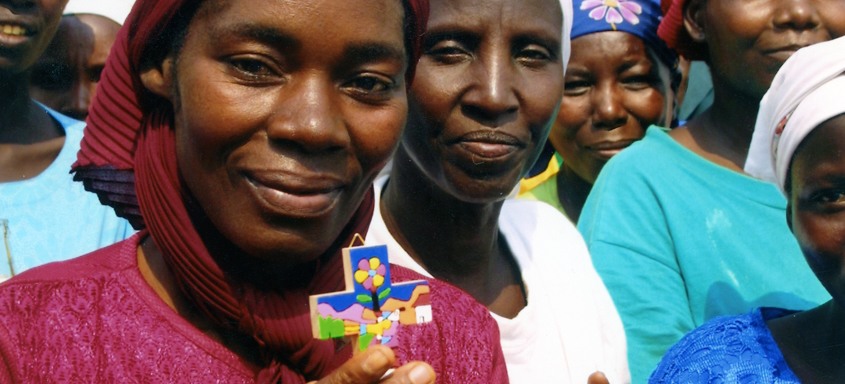
Maria Goretti Nkenguburundi with Léon Sirabahenda
Like in the context of many African countries, the presence of people from different Churches within the same family is a part of daily life. The authors speak here about ongoing efforts to forge relationships between different Christian communities.
It can happen in a family of six in our country, that each family member belongs to a different Christian denomination, while still maintaining good relationships with one another. Thus, we can say that in many families, a “dialogue of life” is already being lived, because being together places the priority on relationships. In the commitment to try to love everyone, including those who may seem to be adversaries, Christians find themselves in a “life-school” guided by Jesus as the teacher, to learn how to establish true relationships, and dialogue as children of the one Father.
Since 2019, we have lived an ecumenical experience of friendship and mutual esteem with Anglican Church members in Bujumbura, thanks to the Anglican bishop who came to know the Focolare charism of unity through reading the monthly “Word of Life” years earlier as a high school student.
As children of a God who loves us immensely, at a certain moment we understood we needed to “reciprocate his love”1 not only individually but together with others, as Christ’s Church. This brought us to promote meetings between members of the Catholic and Anglican Churches.
The first experience mainly involved youth, on the occasion of a local Genfest in August 2024. Although some Anglicans were already members of the Focolare Movement, the participation of other young Anglicans accompanied by Pastor Jean-Marie made this moment even more beautiful. All those present remember even now what this brother of ours said about the text of Resurrection of Rome by Chiara Lubich. He drew out of that text many pearls of the charism of unity, starting from his own experiences in service to the Anglican Church, and as a father of a family and a companion to youth.
In his impression of the Genfest, the pastor expressed his joy saying: “We were happy even though we came from different Churches. We shared God’s Word and experiences from our lives. In the days spent together, we understood that unity is possible, starting from Jesus on the cross, because he saved us all without taking into account our religious affiliations.”
A “synodal” journey begins
During the United World Week 2025 last May, promoted by Youth for a United World, we experienced and touched with our own hands the words of the Psalm: ” How very good and pleasant it is when brothers and sisters live together in unity!” (Ps 133:1). One evening, in fact, many young Catholics and Anglicans were offered a concert prepared together by the Gen Sorriso musical group of the Focolare Movement, and a choir of youth from the Anglican Church. It marked the beginning of a “synodal” journey for which we want to collaborate further with one another.
Considering the transportation problems that existed, the number of participants and the atmosphere was surprising. In the end it seemed no one wanted to leave. It was an evening of celebration that has remained etched in the hearts of many who ask when such an experience will be repeated. Pastor Jean-Marie commented: “During United World Week, I realized that youth leaders have a very important role in seeking unity. By working together, young people have the opportunity to sing together and to witness the same teachings. It really was not evident that the protagonists of the concert came from two different Churches. For them too, it was as if they had forgotten that they were not part of the same Church.”
The youth were touched by the love and sense of fraternity that evening. A young woman wrote: “It was a powerful moment of great joy and above all of unity. We did everything together: playing, singing, dancing. It allowed me to see concretely that unity is not a utopia. Despite what makes us different, we could build something that will never be destroyed.”
In collaboration with the Anglican Church, we would like to promote other shared activities to contribute to Christian unity. We know it will not be easy, even if in everyday life, it seems that ecclesial affiliations count for little. On our journey to relate and dialogue with the members of other Churches, we remember the words of Chiara Lubich: “For a fruitful ecumenism, hearts touched by Him2 are needed, hearts which do not flee, but understand him, love him, choose him and know how to see his divine face in every disunity they encounter. They find in him the light and strength not to stop in the trauma, in the split of division, but to always go beyond and find a remedy, every possible remedy”3.
Life teaches us many things, including how to establish friendships and dialogue. Fr Léon of the Bururi diocese in southern Burundi, recounts: “When the head pastor of the Pentecostal Church of Kiremba in Bururi died last year, the bishop of the Catholic Church and some members of his priestly community spent an afternoon with his family to console them. This delicate presence was touching. At the funeral, it was surprising and unusual that a Catholic bishop was given the opportunity to speak, and this moved the large assembly. Later, the feeling of closeness between the two communities grew to such an extent that we share events in a more heartfelt way than ever before.”
The dialogue of life is extremely valuable, especially in Burundian and African contexts. Starting from the mutual esteem and respect observed in so many families regarding Christian faith, we hope to be able to walk together among the Churches in Burundi, certain that unity among us Christians is a vital contribution towards bringing many to God.
___________________________
1 C. Lubich, Essential Writings, edited by M. Vandeleene, New City Press 2007.
2 “He” refers to Jesus crucified and forsaken.
3 C. Lubich, cit., p. 373.

PDF version
Called to Hope – Key players of Dialogue
July to September 2025
No 28 – 2025/3
