

focus | spirituality of unity
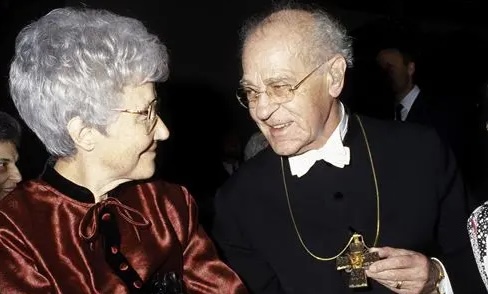
Chiara Lubich
“Nothing is more urgent in the world than a powerful current of love,” Chiara Lubich observed on November 29, 1998, at the Ecumenical Prayer in the historic Evangelical Church of St. Anne in Augsburg on the occasion of an ecumenical conference of bishops, and with 800 present. No one could have imagined that only one year later in this same place, the historic Joint Declaration on the Doctrine of Justification (October 31, 1999) between Lutherans and Catholics would be signed. Below is an excerpt from her 1998 talk.
If we Christians take a fresh look at our 2,000-year history, particularly the history of the second millennium, we cannot help but be saddened to see that it has often been a series of conflicts, quarrels and mutual incomprehension. Certainly, it was due to circumstances: historical, cultural, political, geographical, social circumstances. But it was also because among Christians there was a lack of what should be one of their specific unifying features: love.
And so today, as we seek to put right all that was so seriously wrong, we must focus our attention on the source of our common faith, on God who is love, and because he is love, calls us to love […]
In the light of God who is Love
In these times it seems to me that it is really him, God-Love, who, in a certain way, must return and reveal himself anew not only to the heart of each of us Christians, but also to the churches that we compose.
And he loves the churches for the times when throughout history they have acted according to the design that God had for them. But also—and here we see the wonder of God’s mercy—God loves them even when Christians became divided from one another, not corresponding to his design …
It is this very consoling conviction that made Pope John Paul II in 1994, trusting in the one who brings good from evil, give the following answer when he was asked, “Why would the Holy Spirit have permitted so many different divisions?”
While recognizing that it could have been because of our sins, he added: “Could it not be that these divisions have also been… a path continually leading the Church to discover the untold wealth contained in Christ’s Gospel and in the redemption accomplished by Christ? Perhaps all this wealth would not have come to light otherwise.”1.
We must therefore believe that God is Love for us and for the Churches.
Mutual love among Churches
But, if God loves us, we cannot remain inactive before such divine goodness. As true children we must return his love.
Over the centuries, each church has, to a degree, become set in its ways, because of the waves of indifference, lack of understanding and even of mutual hatred. What is needed in each church is a supplement of love.
So, we need love for the other churches, and mutual love between the churches. The love that leads each church to be a gift for the others, so that we can foresee in the Church of the future that there will be just one truth, but that it will be expressed in different ways, seen from different viewpoints, made more beautiful by the variety of interpretations.
Jesus Forsaken, Star of the Ecumenical Journey
Mutual love, however, is truly evangelical, and therefore valid, only if it is practiced in the measure wanted by Jesus: He said: “Love one another as I have loved you. Greater love has no one than this: to lay down one’s life for one’s friends” (Jn 15:13). And Jesus gave his life for us, in his passion and death, where he suffered during the agony in the garden, when he was scourged, and crowned with thorns, and when he was crucified, but he also suffered in that climax of suffering that he expressed in the cry: “My God, my God, why have you forsaken me?” (Mt 27:46) […]
But if this is so, it is not difficult to see in him, in Jesus forsaken, the brightest star which must throw light on our ecumenical journey. It seems that efforts in the field of ecumenism will be fruitful in so far as those who dedicate themselves to it see in Jesus crucified and forsaken, who re-abandons himself to the Father, the key to understanding every disunity and to re-establishing unity. To find in him the light and the strength, not to stop in the traumas and in the cracks of division, but always to go beyond and find a solution, all possible solutions.
Jesus among Christians of different Churches
Mutual love with this measure leads to the realization of unity. When unity is lived, it has an effect, and this too is a key point for a living ecumenism. It is the presence of Jesus among people, in the community, gathered in his name. He said, “For where two or three are gathered in my name, I am there among them” (Mt 18:20). Jesus in the midst between a Catholic and an Evangelical, who love one another, between Anglicans and Orthodox, between an Armenian and a member of the Reformed Church—how much peace it would bring even now, how much light it would shed on a productive ecumenical journey!
Jesus in our midst is a gift, among other things, that also lessens the pain of waiting for the day when we will all share together his presence in the Eucharist.
And it still requires a great love for the Holy Spirit, love personified, who binds in unity the persons of the blessed Trinity and is the bond between the members of the mystical body of Christ.
I know, too, from experience that if we all live in this way, there will be exceptional fruits, and there will be one effect above all others. By living together these different aspects of our Christianity, we will realize that we form, so to speak, one Christian people that can be leaven, helping to bring full communion among the Churches.
1 John Paul II, Crossing the Threshold of Hope, Mondadori, Milan 1994, p.167.

PDF version
Called to Hope – Key players of Dialogue
July to September 2025
No 28 – 2025/3
