
focus | experiences
Initiative for prisoners and their families
Always a Person
(Sempre Persona)
Giampietro Baldo
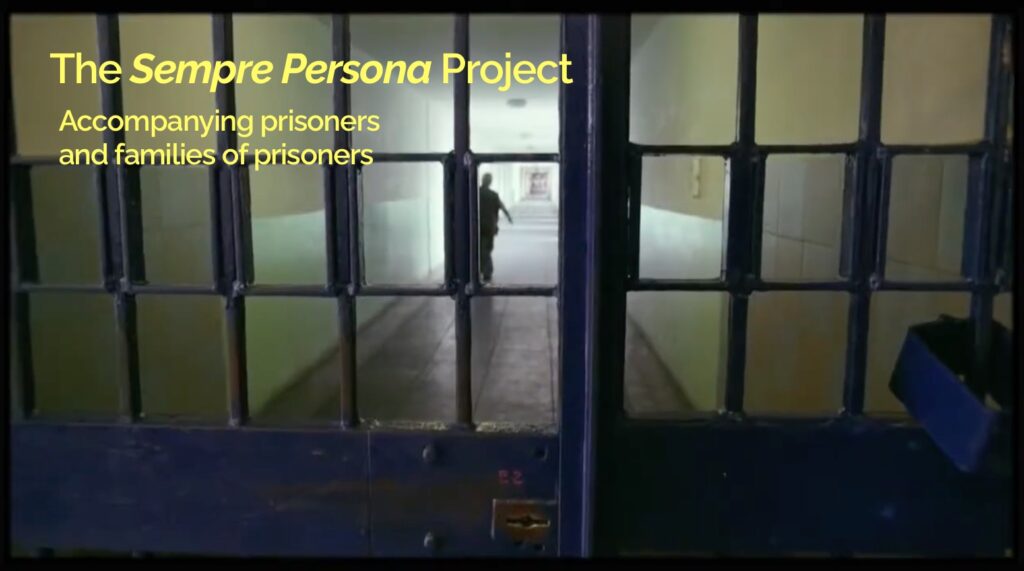
The Sempre Persona (Always a Person) project began 30 years ago, thanks to the commitment of Alfonso Di Nicola, a prison volunteer. It has since grown into an association bringing together young and old, in an extended volunteer network dedicated to visiting prisoners and accompanying them in societal reintegration after release. Two volunteers reflect on their personal experience.
As I biked to my weekly destination, I thought about the people that I would meet. I thought of their faces, and then Emanuele was there to greet me when I arrived. Leafing through his notebook, he gave me a brief update of recent events, and then we were ready to go and be with our friends.
They live in different places and we are unsure if we will be able to meet them all. It will depend on the dialogue established and on what we have to say to one another. Today we were promised pizza, even if it will just be our snack, since another full meal is also planned for 5:30 pm.
Alberto and Danilo come to meet us. Their work allows them to meet us every week for updates and mutual encouragement. Then there is Giulio at the coffee shop. We all set out to meet others. Along the way we encounter new friends, and there are brief greetings or a quick chat. You may not know others, but in this place it’s easy to become friends.
We head towards the location of the pizza, because we need to be there on time, if we want to be able to peacefully enjoy it.
As our departure time approaches, there is a small break from routine and we delay our exit by a few minutes. Once outside, Emanuele and I spontaneously exchange glances as we always do. It is a way of communicating our particular joy experienced after those two hours spent in Rebibbia prison.
The Importance of Relationships
For three years, through the Sempre Persona Association, a Focolare Movement project, we have had the opportunity to visit prison residents.
From its beginning, Sempre Persona, wanted to be an educational path that accompanies prisoners, ex-prisoners, and their families, irrespective of culture, nationality or religion. It is a demanding initiative, because it is not one based on welfarism, but rather it is rooted in the value and importance of relationships.
Youth, adults, families, and ex-prisoners all collaborate as builders of this community. Some are engaged in weaving and maintaining relationships with the families of prisoners. Others instead work for elements related to direct needs, such as food delivery to the families, with more than 30 volunteers involved in this aspect that benefits close to 60 families.
The Association is active in Rome and nearby suburbs, with relationships built with each family that goes beyond simple food delivery. These efforts become moments for sharing, listening, and even sipping coffee or having lunch together.
To ensure ongoing consistent relationships, families are entrusted to various volunteers. I accompany a family, or rather two families living together, with a total of ten children. The joy for these visits is indescribable. We play with the children, and sometimes bring gifts or clothing that has arrived, too, together with food. We might also give a hand for homework assignments where needed or help a parent with communications to a child’s teachers, etc.
Stories of friendship
There are many stories that are part of own stories now. I met up with Antimo, recently released after 37 years in prison, on the outskirts of Rome. He sleeps on a railway station bench. Together we go visit a friend of ours in the hospital. It’s raining, and getting out of the car I approach him with my umbrella. “It’s OK” he said, “because I want to feel the rain on my skin.”
When we meet Alberto in prison, he tells us about the open-air cinema that the warden organized. “What film did you see?” we ask him. “Who saw it?”, he said, “I was looking up, admiring the starry sky.” These words help us to understand more and more what life is like “beyond the wall.”
Marco is one of those faces not easily forgotten. We met during one prison interview and he immediately touched our hearts. Each meeting begins and ends with a strong, sincere embrace, the kind that speaks louder than words. And when we say goodbye, that fragrance of the cologne that always accompanies his presence hangs in the air. It’s like his signature, his way of saying “I’ve been here”. It is enough to cross a corridor to understand that Marco has just passed by. You can recognize him by the trail of cologne left behind, like a trace of presence and life.
After our first meeting, he wrote us an email: “I have no friends, neither inside nor outside [the prison]. But with you, I feel ready to build a friendship.” Simple words, but their truth strikes us deeply. Who are we to back away from such a great gift?
Every face we meet, every story entrusted to us by another, is an encounter with a person who suffers, silently asking us to stop, to listen, and to share a stretch of their life journey.
What more could we have done?
In every community, there are experiences that you would never want to happen, like when we learn that someone has taken his own life as we arrive at the entrance of Rebibbia. This happened, too, with a person with whom we had started to meet. He had shared a difficult moment that he was experiencing, but no one thought he would arrive at such a point as to commit this act.
So for us it was a matter of being close to his teammates, to those who knew him. And certainly, we all wondered if there was more that we could have done. These realities, along with others, do not leave us with a peaceful conscience in the face of problems like these that impact everyone. It is not always easy, from outside, to grasp the full weight of what it signifies to spend a part of your life in a cell.
Rope of Hope
The prison community can seem highly complex, both for those working there and for those living there. One afternoon, when I arrived in Rebibbia, I had the opportunity to meet with a group of adults. They talked about the situation they were experiencing, but the common thread from that meeting was about Pope Francis.
They remembered well his visit after Christmas, where someone had even been next to the Pope at the moment of greetings. And we all remembered his words: “Let us not forget two things we must do with our hands. First: Hold on tightly to the rope of hope, hold on to the anchor, to the rope. Never let go. Second: Open wide your hearts. Open hearts…”
They wanted to remember Pope Francis, too, by praying for him, for all prisoners, and for all those who are alone. It all becomes a moment in which a spirit of community can grow.

PDF version
In Today’s Times and Places
October to December 2025
No 29 – 2025/4