

focus | insights
Reflections on Jesus and the Kingdom
Jean-Pierre Rosa
Although the Final Document of the Synod on Synodality reaffirms the regional locales of Catholics, it also considers the unprecedented mobility taking place due to urbanization, globalization, migration and the digital world. It invites us to consider the Church not only as a “home” and a people, but as a sacrament of unity interwoven in the fabric of humanity, as it was envisioned during Vatican II. The author, a philosopher and biblical scholar, reflects on the question of Jesus’ “dwelling” as recounted in the Gospels.
“Where do you live?“
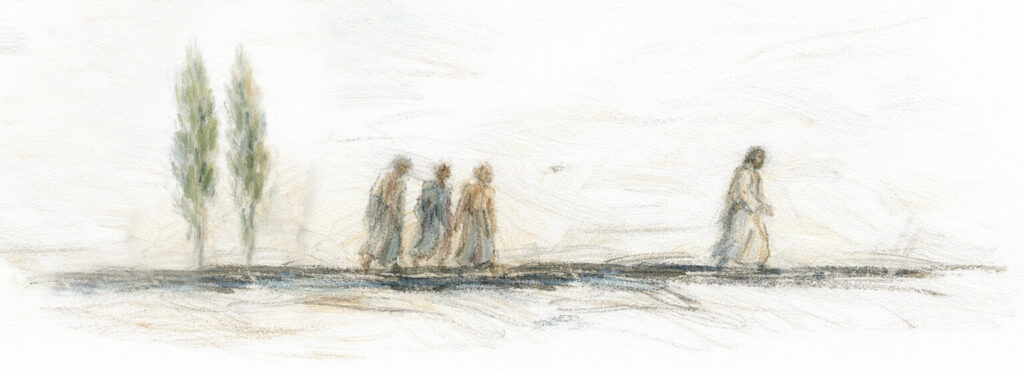
Jesus offers two opposing answers to this simple question. In Matthew’s gospel, Jesus replies sharply to the scribe who tries to follow him: “Foxes have dens and birds of the sky have nests, but the Son of Man has nowhere to rest his head.” (Mt 8:20). But then in John’s Gospel, speaking to the disciples of John the Baptist who follow Jesus and ask him where he lives, he instead replies with gentleness and transparency, saying: “Come and see” (Jn 1:39). Of course, the first response is aimed at emphasizing the demands required to be a follower of Christ, but it is nevertheless a question with seemingly contradictory answers when speaking of territoriality, faith, and belonging. To which “parish” did Jesus belong?
Jesus was constantly on the move, to the point of almost making us dizzy. In the passage from Matthew already quoted, he embarks on a wild race that starts at the mountain, crosses cities, villages and lakes, and ends with this commentary that provides the key to its interpretation: “Jesus went around to all the towns and villages, teaching in their synagogues, proclaiming the gospel of the kingdom, and curing every disease and illness.” (Mt 9, 35). Yet we still do not know “where he lives”…
From birth, Jesus is presented as in exile. Matthew, in fact, recalls Hosea’s words: “From Egypt I have called my son” (Mt 2:15) in a way that links him to the figure of Moses and to the theme of exodus, of liberation. But what is the parish of the exodus? One can easily imagine Galilee as his “diocese”, which he leaves to go up to Jerusalem where he will be judged. But then he is to be executed and buried outside the city, exiled even in death!
But if Jesus is all about movement, why does he respond to the disciple who approaches him by saying: “Come and see”? Is his home a special place? No, we know nothing about Jesus’ concrete house, but we do know his dwelling. John speaks of Jesus as coming “among his own”. His dwelling place is our humanity. And his home is divinity, life with the Father. And the place where the two meet, in addition to moments of intimate prayer, is in mutual love (Jn 15:9-17). It is a physical place, therefore, but a shared life: “Where two or three are gathered in my name, there am I in the midst of them” (Mt 18:20). It is perhaps this non-territorial perception of God’s life in us and among us that allows Paul to “enlarge the space of his heart” in the ways that are found in a suitable formulation of the Final Document of the Synod (n. 110), and constitute his address to the pagan nations.

PDF version
In Today’s Times and Places
October to December 2025
No 29 – 2025/4