

focus | experiences
The commitment to ecumenism of the Coptic Orthodox Church in Egypt
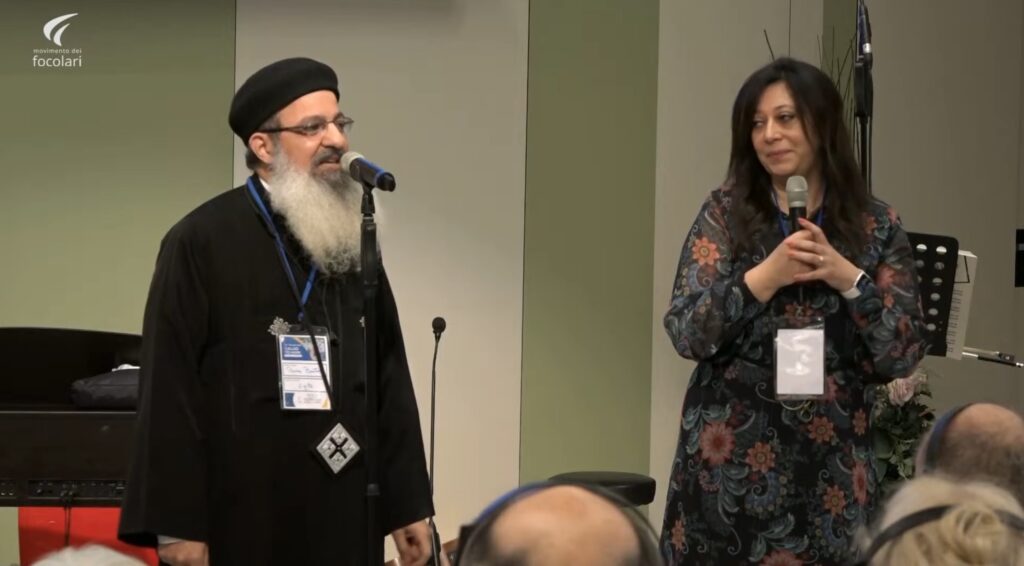
compiled by Mervat Kelli
Let’s imagine a large room with 151 ministers from five different Christian confessional families: Coptic Orthodox, Greek Orthodox, Catholics, Anglicans, and others. Each has their own history, traditions and theological language, but all are united by a desire to forge a common path. This is the focus of years of annual meetings for which the Coptic Orthodox Church, led by Pope Tawadros II, has been a protagonist. We share here the news of these meetings as recounted by Coptic Orthodox priest Boutros Fouad, member of the Priests’ Commission of the Council of Churches of Egypt and the Egyptian Family House, as well as a doctoral student in the history department of the Institute of Coptic Studies in Cairo.
“May all be one”
The starting point of the events recounted here is the prayer that Jesus addressed to the Father on the night of his Passion: “That they may all be one” (Jn 17:21). This request is not just a spiritual phrase, but a concrete invitation to overcome centuries of divisions, born of political, cultural and theological reasons.
For a long time, unity was a distant dream. The Christian Churches were divided, leaving deep wounds in their wake. But something has changed in the twentieth century. The desire for dialogue and reconciliation has begun to make its way. The Coptic Church desired to be at the forefront of this journey and has actively participated in ecumenical organizations such as the World Council of Churches, in addition to promoting theological dialogues with other Christian communities.
The approach of the Coptic Church
The Coptic Church’s ecumenical work is based on three pillars.
The first is the search for true unity. Through long and patient dialogues, an attempt is made to understand and clarify doctrinal differences, especially those related to the nature of Christ, which for centuries have divided the Churches.
The second pillar is the cultivation of charity and mutual respect. The late Pope Shenouda III said that “religion is love,” and now Pope Tawadros II, whom many call “the pope of love,” is a vivid witness to this. For Pope Tawadros II, true ecumenical dialogue is born of authentic love that is capable of overcoming every difference or conflict.
The third aspect is practical cooperation. In a world marked by crises, wars and growing secularization, Christian Churches cannot act in isolation. They must join forces to face today’s challenges together, from the defense of the faith to service for the neediest.
Travels, meetings, initiatives…
Pope Tawadros II embodied this vision through his travels and meetings. From the historic meeting with Pope Francis in 2013 to his visit to the World Council of Churches in Geneva in 2014, to the creation of commissions with the Russian Orthodox Church, every step is a tangible sign of openness and dialogue.
In 2017, together with Pope Francis and Patriarch Bartholomew I, Pope Tawadros II participated in a historic ecumenical prayer in Cairo with the presence of the heads of the Egyptian Churches, a moment that showed the whole world the strength of possible unity.
An invitation to build bridges
Pope Tawadros’ words are simple but profound: “God considers division a sin and calls us to preserve unity.” “Christ is present when we are united.” “Knowing the other is the path to unity.” “Love unites, selfishness divides.” “Like the fingers of the hand, different but collaborating, so the Churches must work together.” And his message becomes even stronger when speaking of the beauty of a person who embraces many cultures and knowledge, and how the lack of love is the root of all divisions.
The ecumenical history of the Coptic Church under the leadership of Pope Tawadros is therefore a history of hope, patience and faith. It is not just a theological dream, but a reality being built day after day, encounter after encounter, word after word, and guided by the conviction that the true Christian journey passes through love and mutual respect, despite our differences. It is an invitation for all of us to build bridges, to reach out, to truly become “one” in the body of Christ.

PDF version
Called to Hope – Key players of Dialogue
July to September 2025
No 28 – 2025/3
