
focus | insights
In dialogue with the Fraternal Delegates to the Synod on Synodality
Edited by Mervat Kelli and Hubertus Blaumeiser
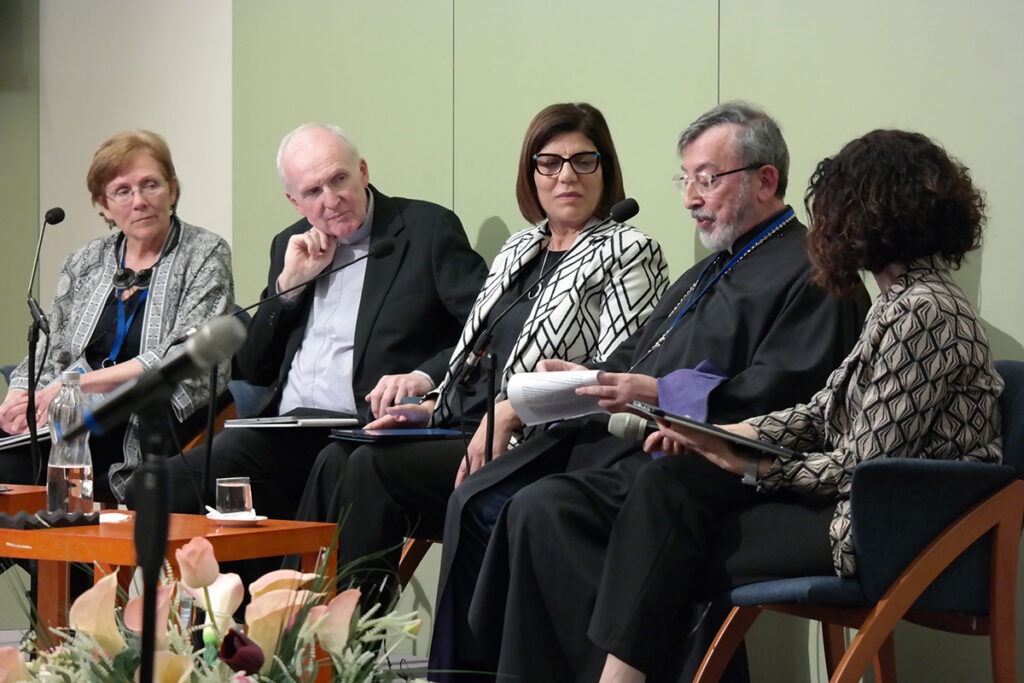
A central moment of the ecumenical conference Called to Hope was a round table discussion with representatives of various Churches who had participated in the two sessions of the Synod of the Catholic Church on synodality: Archbishop Khajag Barsamian, representative to the Holy See of the Armenian Apostolic Church; Prof. Elizabeth Newman, president of the Commission for Christian Doctrine and Unity of the World Baptist Alliance; Prof. Dirk Lange, Assistant Secretary General for Ecumenical Relations of the Lutheran World Federation; Catholic bishop Brendan Leahy of Limerick (Ireland), and Margaret Karram, president of the Focolare Movement. The round table was moderated by journalist Stefania Tanesini.
Stefania Tanesini invited each speaker to begin by sharing their lived experience of the Synod.
Professor Elizabeth Newman. For me, the Synod was truly transformational. I understood more deeply that synodality is a way of being in communion with God and with others, learning to trust, to “let go”, trusting in the presence and wisdom of God. One’s own point of view must not prevail. One does not have to “win”. The meaning of “losing” or “winning” changes radically when it is considered within the Christological mystery: God works in ways that cannot always be predicted or imagined. Although – understandably – we could not vote, we were given a full chance to speak, listen and discern together, and we were encouraged to do so.
Professor Dirk Lange. I confess that I was a little worried about participating in an ecclesial meeting that would last four weeks. But this concern soon faded. We were seated at round tables, without distinction of rank or call. And the method of Conversation in the Spirit involved us in a discipline of deep listening. Everything and everyone were rooted in prayer. It upended “business as usual” that happens at too many church conferences. The focus was on listening to all voices, including what Lutherans call the priesthood of all the faithful or the sensus fidei.
The Vigil of Repentance on 1 October was profoundly moving. We recognized our fragility on many levels, and so we began the Synod in the awareness of our need for forgiveness.
At the Ecumenical Vigil, ten days later, Pope Francis shared his unique vision of our ecumenical journey, telling us that we don’t have a ready-made model, but we discover it as we walk together.
Synodality is measured by relationships
Msgr. Brendan Leahy. Msgr. Brendan Leahy. The Vigil of Repentance was also very touching for me. We have heard testimonies of pain, failures, abuse, but also strong words of repentance. This has stayed with me as something to remember; unity cannot happen without a new beginning, and for this there is always a need for humility. It made me think of the experience of Chiara Lubich and her first companions. When they discovered that they were called to live for unity, they realized that there would never be unity without mercy. And they made what has been called a “pact of mercy.” We, at the Synod, did something similar: a pact of mercy.
I would also like to recall a simple but significant episode. At the end of one of the sessions, one of the Fraternal Delegates, an Orthodox, asked me: “Would you like to come and have lunch with me?” Surprised, I accepted. We experienced a moment of fraternal sharing in which I was able to understand his tradition much better. We became friends. I understood, on that occasion, that synodality is measured by relationships.
Dr. Margaret Karram. Without the Synod I would not have met Elizabeth, Archbishop Barsamian or Dirk. The simple fact of being here together today is already a gift of the Synod.
For me, the Synod was an experience of the universal Church, thanks to the presence of cardinals, bishops, priests, sisters, but also of lay men and women, and above all thanks to the presence of the fraternal delegates. Their participation has enriched the synodal journey and opened up new horizons for us in communion between the Churches. Together we have experienced that – as Pope Francis has said several times – there is no synodality without ecumenism. I would say that the door of communion was already open, but the Synod opened it wider, perhaps becoming a door through which we must all pass. Otherwise, we risk missing an appointment with history.
Respectful dialogue
Archbishop Khajag Barsamian. I felt truly embraced by a large family of sisters and brothers in Christ: a profound and enriching experience, which brought together people from all over the world, with different backgrounds and even with different perspectives, but all united by the same faith. What struck me most was the respectful dialogue. Even when different approaches or ideas emerged around the table, there was respect and love. This reminded us that our differences can coexist in an atmosphere of love and mutual understanding. The presence of the Holy Father Pope Francis at most of the sessions added an unparalleled significance. His personal greeting to each participant was not merely a formality, but one of genuine interest. The synodal process has encouraged an openness to learning from one another, thereby enhancing the spiritual and practical dimensions of ecumenism.
A second round of questions followed, with the moderator asking each speaker specific questions.
Listening and discerning, being silent, giving an echo, praying
Professor Lange: The Lutheran Church has a well-established tradition regarding assemblies, and “power”, we could say, that underlies synods. Was anything new for you in this recent synodal experience?
Yes, absolutely. One of the gifts of the Synod was the process itself. It was not a democratic Yes, absolutely. One of the gifts of the Synod was the process itself. It was not a “democratic” process, trying to get a majority on this or that issue, but a methodology that allowed for intense discussion and gave space to the action of the Spirit. It was wonderful to listen and discern together in the small group, to give feedback, to be silent, to pray. Through all this, a way forward was found, even in the midst of disagreements, and a text was written. The Synod, in this sense, was like a four-week spiritual exercise that had a profound influence on my self-understanding, on my ministry, and also on my Church.
The Lutheran World Federation is carrying out a similar process: we are questioning the doctrinal and communal authority and mutual responsibility of the member Churches, autonomous but committed to being a Communion of Churches. The Synod on synodality has given us a strong impetus and a clear direction.
Our Relationships: Where God Speaks and Acts
Bishop Leahy: you are constantly in contact with priests, religious, faithful and even people far from the Church. Did this relational method practiced at the Synod affect your daily life and ministry? And what do you foresee for the future?
After the Second Vatican Council we understood that we are called to communion, but we struggled to understand how. With the Synod we began to recognize important elements of discerning together.
I took away the method of “Conversation in the Spirit”, as a way to follow in the diocese. We are at the beginning, we have begun to train people, to prepare them for this style. And I too, of course, am called to live this dynamic: to recognize the positive in the other, to listen more – and this is always a great challenge, because it is easy to have the answer ready – to put judgments aside…
We have, in the Catholic Church, a long tradition of spiritual retreats that teach us to listen to God’s voice within us, but we have less experience in hearing God’s voice among us. The Synod emphasizes that we are saved not only individually, but our relationships are also redeemed. We must learn to value this: our relationships can become the place where God speaks and acts. It is no coincidence that the Synod placed the Risen Christ, who dwells in the body of the Church, at the centre. It is up to us to create the space for him to manifest his presence.
A Church that knows how to listen and walk together
Professor Newman: Has this synodal experience had an impact on your spiritual, ecclesial, personal, academic life? And what prospects does this experience open up in your opinion?
The Synod was a deeply spiritual experience for me. Back home, I cried for three days, not so much because of the fatigue – which there certainly was – but because of the spiritual depth of what we had experienced. For me, it was a moment of “Church in the making”, in which the presence of the Spirit was really tangible. Despite the fact that we were so different – bishops, laity, religious, men and women, from all over the world – we tried to listen to the Spirit together. There was a common desire to build something new, without destroying what is already there, but recognizing that the Spirit calls us to something deeper, more authentic.
In my academic life and in my service in the Church in the United States, all of this has had a tremendous impact. I am trying, with others, to promote moments of community listening, in this spirit. And I see that people are ready, eager to be heard, to speak heart to heart. This, in my opinion, is the core of what synodality can bring: a Church that knows how to listen, that knows how to walk all together and is not afraid of confrontation, because it knows that Christ is at the centre.
I am convinced that synodality, faithfully engaged, can also be a response to political polarization in the Church. In the United States, this polarization has deeply divided the Churches. Synodality is an alternative to this. When we are together, we can trust that God is with us, even in pain, even in division, and bear abundant fruit.
A style and a spirit to spread
Archbishop Khajag Barsamian: Your Eminence, what has remained with you from the and what do you think is important to carry forward in the future?
I lived the Synod as a time of grace, a spiritually profound experience. I felt the presence of the Holy Spirit among us.
The traditions of the Armenian Apostolic Church have taught us for centuries to live synodality. I was struck to see so many brothers and sisters of the Catholic Church walking together, listening to each other, seeking God’s will together.
The strongest moment for me was that of common prayer, every morning and every evening. It reminded us that we were not there for ourselves, but to serve Christ and the Church. It was possible to live synodality not only as a structure, but as a spiritual attitude, as a lifestyle. I really hope that this spirit will spread more and more, in communities, in parishes, among bishops, among young people. It is a new time, and we must welcome it with courage.
The Final Document of the Synod brings a deeper understanding of Christian unity. It emphasizes spiritual ecumenism, which goes beyond simple institutional collaboration to focus on shared prayer experiences. The ecumenism of blood, that is, mutual suffering and sacrifice among Christians, showcases a united front against injustice, reinforcing solidarity among Christians
The call for inclusive dialogue, rooted in mutual respect, opens up new possibilities for collaboration on issues such as social justice, interreligious dialogue and global challenges, and can lead to a more comprehensive understanding of Christian mission in today’s world. In all of this, it is crucial to embrace diversity, while recognizing the common faith that unites us as disciples of the Lord Jesus Christ.
Repercussions beyond the sphere of the Churches?
Margaret Karram: During these three years of the synodal journey, you were by the method of Conversation in the Spirit. What are your thoughts on it? Do you think this method can also be useful outside the strictly religious sphere?
The Conversation in the Spirit has made us live the experience of a relational Church, it has given us the opportunity to strengthen our relationships: laity, bishops, people of God, Christian Churches… We are called to continue this journey now at the local level. We need to learn to work together. Otherwise, we will not make any progress in unity. Cardinal Mario Grech, the Secretary General of the Synod, said recently that it is not a question of “adding work to work, but of helping the local Churches to work in synodal style”. He reminded us that this phase of implementation requires a real conversion, a change of mentality, and that needs time.
We too, in the Focolare Movement, are trying to put this method into practice. It strengthens the instruments of spirituality that Chiara Lubich left us: “making ourselves one”, that is, feeling what the other feels, listening deeply, bearing the burdens and concerns of the other and sharing his or her joys; dialogue, which means respecting the other’s way of thinking and enriching each other; listening to the Holy Spirit, to the voice of God within us.
We have a great responsibility to experience all this authentically. If we can do this, our relationships with others will have a greater impact. And if that becomes a way of life in society, also in politics, economics, etc., I think the world can change.
The moderator then asked: In the situation of our world today which almost all of you speak of, is hope still possible? What can offer hope?
Hope today
Margaret Karram: If we look at what is happening daily in many parts of the planet, we could despair. But we are Christians, and we know that hope is a virtue not to be lost. We must cultivate it and nourish it within us, in order to be able to transmit it to others.
We know that our hope is in God, and he does not disappoint. The more we have faith and the more we make small gestures of charity towards our neighbour – gestures of solidarity, communion, openness – the more hope we can have.
This encounter is already a sign, perhaps a small one, but it is like a flame that illuminates the great darkness of humanity. It is a sign of hope that we can spread and that allows us to build networks with those in the world who work for Christian unity, for peace, for the poor, for migrants, etc.
The synodal journey is teaching us that together we can do it. It is this “togetherness” that gives us the strength not to lose courage, not to feel powerless, but to sow seeds of hope wherever we are.
Professor Dirk Lange: I would like to add that I think that if we had had a Conversation in the Spirit in the sixteenth century, with this kind of listening and discernment, perhaps we would not have had the division between Catholics and Lutherans.
I believe that one of the most important aspects of the Synod was precisely to rethink the role of the Bishop of Rome as the one who offers a space for synodality. I have a very firm hope because of what happened on the last day of the Synod, and it still excites me: after the votes and the approval of the Final Document, Pope Francis made what for me, as a Lutheran, was a historic announcement: he welcomed and approved the Document and said that he would not publish a post-synodal apostolic exhortation. That is to say: the voice of the Synod – of lay people, ordained ministers, young people, women, men, ecumenical guests – has acquired an almost magisterial value. It was an incredibly moving moment, and the room was overflowing with joy.
Dr Margaret Karram, as convener, concluded the round table saying:
It is wonderful that fraternal delegates of other Churches could take an active part in this Synod, and we have been enriched by this. This shows how far the Catholic Church has come and it gives us hope. Certainly, much remains to be done, but unity between the Churches is not so far away.
It is important to make these steps known.
Otherwise, there is the risk that we will carry on with the idea that the Catholic Church thinks in a certain way and the Anglican Church in another, and that’s it. The Synod on synodality served to reflect together on a relational Church, in dialogue together and learning from one another. We must be grateful for this experience.
In dialogue with the
Fraternal Delegates to
the Synod on Synodality
Video copyright of Centro S. Chiara Media

PDF version
Called to Hope – Key players of Dialogue
July to September 2025
No 28 – 2025/3
