

focus | experiences
Grassroots ecumenism in the USA
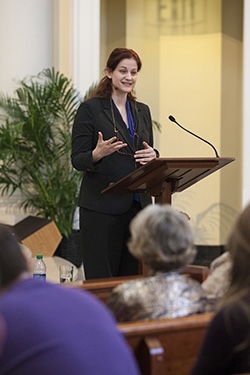
Image: Samford University
Karen Petersen Finch
The author, an ordained minister in the Presbyterian Church and ecumenical theologian, recounts here an experience of dialogue lived by her community and the Catholic community in Clarkston, Washington (USA). Fidelity to methodological presuppositions of dialogue brought numerous fruits of the Spirit, including unexpected insights from a doctrinal perspective, and serves to highlight the essential contribution of the laity in this ecumenical process.
In June 2018, believers in Clarkston, in the state of Washington (USA), made the unusual decision to merge the Holy Family Catholic Parish and First Presbyterian Church Family Evangelizing Bible Schools. In a nutshell, they decided to share the Good News with their neighbors, together. But the experience also brought doctrinal issues that members of both Churches wanted to address. That is, it was a question of specific teachings of the two respective Churches (Catholic and Reformed) and their judgment as to what is truest and most precious for their Christian identity. In practice, the question was whether these two different Churches could continue evangelizing together, despite the two communities obviously diverging around some doctrinal points.
Against this backdrop, from 2019 to 2021, I and 32 others planned and then conducted three rounds of dialogue. They focused on salvation, the papacy, and the Eucharist/Lord’s Supper. My book Grassroots Ecumenism: The Way of Local Christian Reunion tells the story of these Clarkston Dialogues, of how the faithful of the two communities learned their own theology and that of their neighbors. Skills in dialogue were acquired and differences were faced honestly. The faithful gathered with love and courage, to deepen their Christian commitment and mission to their neighborhood and became consciously ecumenical. And all of this during a global pandemic.
Assumptions and goals
Our goal was to be radically honest about the differences between the teachings of our Churches. Through a dialogue process, we could move closer to a common viewpoint. of dialogue, a viewpoint that reflected our best understanding of the Good News of Jesus Christ.
This meant that the viewpoint we sought was biblical, drawing deeply on our shared Scriptures. Secondly, this viewpoint was Trinitarian, rooted in the mission of the Father, the Son, and Spirit. And finally, that it is apostolic, grounded in the witness of the early Church. Thus, it signified a becoming more deeply Christian together.
To achieve all this, it was necessary to start from common assumptions that were at the basis of all our planning:
– Lay people can thoroughly understand the doctrine of their own Church and can dialogue skillfully with the beliefs of neighboring Churches.
– The work of national and international experts in church unity is not finished until lay persons are participating at the local level.
– Shared witness, service and justice are wonderful, but unity is not solid unless we are also working toward agreement in doctrine, no matter how difficult the conversation or how distant doctrinal unity might seem.
– Local dialogue is a work of the Holy Spirit that can deepen faith in Jesus Christ and commitment to his Gospel.
The last assumption highlights a recurring pattern in the dialogues: Local dialogue and pneumatology go together. Doing theology with the entire people of God taught us to depend, without excuses, on supernatural assistance. We prayed a lot, and I can bear witness to the fact that all of the Clarkston participants took special delight in praying together.
It was precisely thanks to the help of the Spirit that our goals were possible. We could learn dialogue skills that made room for the Holy Spirit, for openness, transparency and generativity. The Spirit also brought us to come together honestly and respectfully without softening our differences, and to proclaim the Gospel together there, through word and deed.
Two surprises
From what I have shared, you may have already noted what I call, The two surprises.
The first surprise was a recognition of the role of the laity in the local Church context as qualified agents of doctrinal dialogue. It takes the whole people of God to work out our doctrinal differences: clergy and laity. Ecumenical theologians know this, and they hope that their work will “trickle down” and be received in the Churches, even if this does not always happen because of the persistent assumption that only theological experts can participate in theological dialogue. Hence Surprise no. 1: Why not educate lay persons to serve as stewards of doctrine in their neighborhoods?
The second surprise was a rediscovery of the central role that doctrine occupies in this project. Most local ecumenism is focused on building positive experiences and relationships, often through shared worship or Bible study, and shared mission and service. But why leave doctrinal questions out of the local picture? If doctrine is part of the problem, then it needs to be part of the solution. Simple assimilation without doctrinal discussion, in which differences are never resolved, can crumble under pressure. So, why not engage boldly with our differences?
Together these two surprises add up to a proposal for local doctrinal dialogue by the whole people of God—clergy and lay people together — with a special emphasis on lay people, who may not have been included in the past. My desire is that other communities can experience the joy that we experienced from the living into the two surprises.
What Doctrine Can Do in Local Dialogue
Today, many people think that doctrine is divisive. We, on the other hand, have the great joy of witnessing how the dialogue of the laity at the local level, when it also pays attention to doctrine, produces precisely the opposite of division, in that we have seen an increase in reception, hope, emotional participation and legitimacy.
First, open discussion of doctrinal differences fosters what ecumenists call reception: making a tradition one’s own. This work enables all the People of God to better understand and to inhabit their own traditions more fully. In all our Churches there is a great desire to know more about their own doctrines and to respond personally to them; for this reason, dialogue must be accompanied by a process of education. Educated lay people feel deep joy in returning again and again to the central affirmation that Jesus Christ is Lord and that this reception of Christ can inspire both evangelization and ministries of justice, giving rise to a desire to serve our neighborhoods in concrete ways.
Second, open discussion of doctrinal differences brings with it a surprising amount of hope. Paradoxically, the level of exploration required to honestly probe the differences brings us closer to our common ground. This is what I write in my text: “The fact that the main differences are not arbitrary, but present themselves according to discernible patterns, is a source of hope because it makes us think of a unity under the rupture, or – to use another spatial metaphor – of an eschatological unity that is before us“١. This is true until we succumb to a false peace: “We noticed that our closest approach to that unity was always when we were uncompromisingly clear that we had not yet achieved it.” In the analysis of the differences, we have also experienced glimpses of new shared doctrinal positions that I call “seeds of collaboration” (see below).
– Doctrine is also not only intellectual but, having to do with values, stimulates our feelings. When my children were young, I read a book about sibling rivalry. The author said that, if we give space to negative emotions in the family, positive ones will follow. I can only say that this is my experience of secular dialogue. When members of divided churches feel that they can express their Christian convictions without necessarily having to agree, they suddenly discover a strong desire to get along. And so, love begins to flow: the honest difference, in the presence of love, is almost magical in its ability to move people towards each other.
Fourth, a doctrinal focus can help to give legitimacy to local efforts of the laity for Christian unity. Doctrinal formation allows them to take their place alongside Church leaders and professional theologians as decision-makers in the Church. In this sense, this experience accords very well with the efforts aimed at synodality. It is more likely that bishops, general assemblies and other authorities will recognize that local dialogue can and does change the ecumenical framework, as any progress at the local level helps to ensure a good chance of lasting and spreading.
Seeds of collaboration
To the question of whether the laity can act as guardians of doctrine, through a dialogue that generates new shared doctrinal approaches and new relationships, we can therefore answer positively.
We have experienced what I call “seeds of collaboration”, glimpses of a common point of view as I mentioned above. It is a germ or an idea that could be shared by both communities: an idea that points to our better understanding of the Gospel, a common insight or a glimpse of catholicity under our breakdowns.
An example is what Sharon of the Holy Family parish expressed to us, who one day told us: “Heaven is present among us when we live the experience of the Mass/Supper of the Lord.” I don’t remember what happened before and after you compared participating in the Eucharist to suddenly finding yourself in Heaven. As a Reformed Christian, I remember being struck by the similarity between Sharon’s words and Calvin’s vision of the Lord’s Supper as union with Christ “in heavenly places.” Yet, the words and images Sharon used to express her insight were all deeply Catholic, like her. I noticed a silence in the room after she had spoken, as if the members of both Churches were slowly digesting this new insight with increasing appreciation. Sharon understood something true. It was a seed of collaboration.
The laity and doctrine
This story illustrates both surprises: Laity as stewards of doctrine, and doctrine as the fuel for renewal. One could say that the affirmation that “Heaven is present among us as we experience the Lord’s Mass/Supper” is a very small seed of unity. But the Kingdom of God is also like a mustard seed, and, in a sense, the real “seed” is the local dialogue itself.
I pray that the seeds planted in Clarkston will grow and others will also experience the joy of unity in the Holy Spirit through dialogue in their neighborhoods. In this way, each will be strengthened in love and witness, through the crafting of a common viewpoint that is grounded in the person of Jesus.
___________________________
1 K.P. Finch, Grassroots Ecumenism. The Way of Local Christian Reunion, New City Press, New York 2022, p. 30.
2 Ibid.
Clarkston Dialogues
Rev Karen Petersen Finch
Video copyright of Centro S. Chiara Media

PDF version
Called to Hope – Key players of Dialogue
July to September 2025
No 28 – 2025/3
