

focus | insights
Two experts in ecumenism look at the historical importance and relevance today of the Council of Nicea
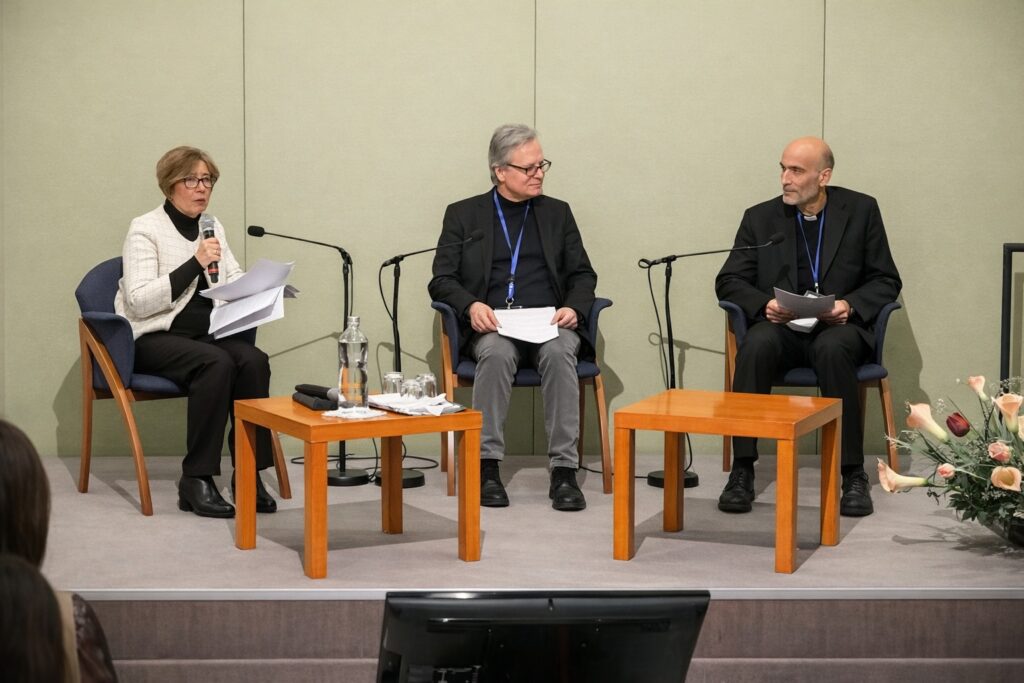
Interview with Mgr Andrea Palmieri and Professor Martin Illert
One of the purposes of the Called to Hope Conference was to mark the anniversaries of ecumenical importance which occurred in 2025: the 1700th anniversary of the Council of Nicaea, the common date of Easter and the 60th anniversary of the abrogation of the excommunications between the Church of Rome and the Ecumenical Patriarchate of Constantinople. Representatives of two leading ecumenical institutions were interviewed on the subject: Mons. Andrea Palmieri, under-secretary of the Vatican Dicastery for Promoting Christian Unity, and Prof. Martin Illert, Lutheran minister and member of the Faith and Order Commission of the World Council of Churches. Here are excerpts from these interviews.
Mons. Andrea Palmieri of the Dicastery for Promoting Christian Unity
What does the 1700th anniversary of the Council of Nicaea offer for ecumenism, for the Catholic Church and Pope Francis?
Pope Francis was always aware of the importance of this anniversary and jealously kept in his heart the invitation of the Ecumenical Patriarch Bartholomew to go to Nicaea. Moreover, the ecumenical significance of the 1700th anniversary of the first Council of Nicaea was also mentioned in the Bull of Indiction of the Jubilee 2025: “Nicaea also represents an invitation to all Churches and Ecclesial Communities to proceed on the path towards visible unity, not to tire of seeking suitable ways to correspond fully to Jesus’ prayer: “That they may all be one…” (Jn 17:21)” (Spes non confundit, n. 17).
The ecumenical significance of this commemoration is linked to three things: the common confession of faith, the question of the date of Easter, and the theory and practice of the Councils. It is not simply a matter of remembering what happened 1700 years ago in Nicaea, but of drawing inspiration from it to make important choices for ecumenism today.
First of all, the First Council of Nicaea represented a fundamental stage in the elaboration of what is now called the Nicene-Constantinopolitan Creed. This profession of faith has a very great ecumenical importance, because it is shared not only by the Orthodox and Eastern Orthodox Churches and the Catholic Church, but also by the Churches born from the Reformation. As we journey towards the re-establishment of full communion among all Christians, which has to be a unity in faith, the anniversary of the First Council of Nicaea tells us that Christians today, although divided, already share faith in the central mysteries of Christianity. The profession of faith is also called the Symbol of Faith. The word symbol, from the Greek syn-ballo, means to put together. The Creed not only brings together, as mentioned, the principal truths of the Christian faith, but also unites those who profess these truths.
The Creed unites us, yet we are still divided. One thing we see in the relations between Christians is that unfortunately not everyone feels the lack of reconciliation as a pain. Some influential figures of the last century experienced this pain, and took courageous and revolutionary steps.
When we recite the Creed, we should feel the pain caused by our divisions. This year also marks the 60th anniversary of the solemn act by which, on the eve of the conclusion of the Second Vatican Council, Pope Paul VI and the Ecumenical Patriarch Athenagoras erased from the memory of the Churches the mutual anathema exchanged in 1054. The coincidence of the two anniversaries should not be overlooked.
A second aspect of the 1700th anniversary of the First Council of Nicaea is the question of the date of Easter. That Council had indicated criteria for calculating the date of Easter valid for all the Churches. Today, even though the vast majority of Christendom is inspired by those criteria, Christians continue to celebrate Easter on different dates except in those cases when the calendars coincide. This division contradicts the commitment of all Christians to bear witness to their faith together. In addition, the date of Easter is a problem when members of mixed families are forced to celebrate the main feast of the liturgical year separately. Pope Francis, in continuity with the Second Vatican Council, restated that the Catholic Church is willing to accept any proposed date for which there is consensus. The current anniversary could be an opportunity to restart a dialogue between the Churches in search of such a consensus.
And does Nicaea also have something to say about the current process of synodality that the Catholic Church has begun to undertake together with the other Churches?
Yes, the first Council of Nicaea is also of particular importance because it documents the way in which the heated dispute over Christological faith and the pastoral-disciplinary question of the date of Easter were discussed and decided in synodal style. The 1700th anniversary of the Council of Nicaea should therefore also be seen as an invitation and a challenge to learn from Church history. Today’s revitalization of the synodal dimension in the Catholic Church is linked to the synodal traditions of the early Church. Pope Francis has repeatedly recalled the interdependence between synodality and the ecumenical journey, affirming that the synodal journey undertaken by the Catholic Church must be ecumenical, just as the ecumenical journey is synodal. However, it is not enough to repeat the word synodality as a mantra for the Church to be more synodal. It is necessary to experiment with practical ways of exercising synodality at all levels of the Church’s life. The experience lived in Bari in 2018 where the pope and the heads of the Churches of the Middle East, Orthodox and Catholic, met to discuss together the pastoral situation of that region, could be a model to imitate. If the pilgrimage of the pope and Ecumenical Patriarch Bartholomew to Nicaea takes place, the embrace between them and the common profession of faith could send a message of reconciliation for all Christians and represent an invitation to common witness.
Finally, the Catholic Church should be represented by a significant delegation to the International Congress promoted by the Faith and Order Commission of the World Council of Churches, scheduled to take place in Egypt in October[1]. These events are certainly important, but words must be followed by concrete, prophetic decisions. At the moment, it is unknown whether such decisions will be taken in the course of 2025, but I am convinced that the reflections begun this year will contribute to the formulation of decisions that can mark the future of the ecumenical journey.
Interview with Prof. Martin Illert of the World Council of Churches
What is the significance of the celebration of the 1700th anniversary of the Council of Nicaea in the journey of Christian unity?
The Council of Nicaea contributed to the formation of a confession of the common faith that unites the Christian Churches. The Creed represents this link both in synchronic terms [in space] and diachronically [in time]: synchronically, it unites the Churches today, so that we can recite together the text of the Nicaean-Constantinople profession of faith, which in turn derives from the Nicaea Creed. From the diachronic point of view, the profession of faith connects us to the first centuries of the Christian Church and, through the centuries, to many Christians of every age.
Both dimensions are equally important, and neither should be understood without the other: the spatial bond, which emphasizes the totality of our faith, and the bond in time, which reveals the dimension that unites us to those who have gone before us in faith. On the path towards Christian unity, both dimensions then lead to a third, the prophetic-eschatological one: the promise of a unity that will be given to us and to which today’s steps towards unity – which are still insufficient and imperfect – must be directed. This unity is already present in Christ, who at the end of time will be all in all.
Would you like to tell us one more word about this prophetic-eschatological dimension?
In my opinion, this eschatological promise also implies a prophetic mission: that unity in Christ may become the way we act and profess our faith, both individually and collectively. I think that a commemoration like that of Nicaea fits very well with the motto that has been the basis of the work of the World Council of Churches since the last General Assembly: A pilgrimage of justice, reconciliation and unity, and not only because the tradition of pilgrimage was born historically after the Council of Nicaea through the pilgrimage of Helen [mother of Emperor Constantine – ed.]. The synchronic and diachronic axes that I have described, as well as the eschatological and prophetic dimensions, which in their interaction are linked to their origins, are well matched, in my opinion, with the theology of Nicaea and at the same time with the idea of pilgrimage.
Can remembering and celebrating an event from 1700 years ago really be relevant for us today?
The Council reminds us and invites us to pursue common visions of unity through conciliarity and synodality. The basic idea of trying to gain everyone’s agreement is admirable, but it’s also important to point out clearly where this can go too far — where it begins to harm the profession of faith in Christ, by turning Him into something that people can treat as their own possession or manipulate. In this regard, I would like to cite an old example from my own culture and background, which is the evangelical tradition in Germany. It is very clear to me that the words of the theologians, who decided at the Synod of Barmen in 1934 not to mix the Christian faith at all with the terrible ideology of National Socialism, were oriented to the Nicene Creed, aware that at that moment it was necessary to make their profession of faith in Christ.
To this example could easily be added many other circumstances of the time of the Council of Nicaea: as today, a terrible war had pitted East and West against each other, and the desire for unity expressed in Constantine’s letters was always combined with the desire to overcome the divisions that opposed East and West. Looking at the canons of the Council, we can see that in this case and others – for example social questions – their efforts to seek what unites all Christians and the Churches was truly exemplary and decisive. This, too, in my opinion, is a further testimony of the fact that Nicaea is part of the common pilgrimage of Christians.
What impact can this commemoration have on Christian unity? What hope is there for the future?
I am convinced that prayer and common reflection – and the commemoration of Nicaea is basically this: coming together to pray and reflect together – are helping us on the journey towards unity, because we remember our common roots and our common mission. If I look at my Protestant confession, I realize that for long centuries we Protestants have represented our identity as a counter-identity to the Roman Catholic Church and we have also understood it in this way. Perhaps other denominations might recognize this as well, looking at their history.
A memory like that of Nicaea, on the other hand, emphasizes something completely different: it recalls the common basis of faith and draws from it a common task: to bear witness to our faith in the world. The Creed itself tells us that we, as believers, are included in this common confession, from which derives a common identity that is the basis for common action and prayer.
What is the significance of the 60th anniversary commemoration of the mutual abolition of the anathemas of 1054 between Catholics and Orthodox, which took place on December 7, 1965?
The reciprocal abrogation of anathemas represents an example of a turning point: one’s own identity is no longer seen as a counter-identity with respect to a confessional counterpart – staged in a polemical or apologetic way – but what we have in common in tradition and spirituality is placed at the center, so that we can participate in a mutual richness.
As a Church historian, I believe that accounts of Church history are still profoundly influenced by the apologetic and polemical aspects that the Churches themselves have already overcome in their daily community life. I remember that especially in the 1960s the idea of writing an ecumenical history of the Church without confessional boundaries was often brought up. In my opinion, there is still much to be done in this regard, and this could be a contribution to reconciliation, as it would prevent the formation of opposing identities and would allow us to let go of the polemical and apologetic perspectives of our own points of view.
What is the World Council of Churches organizing to celebrate and commemorate these two historical events?
The World Council of Churches has decided to celebrate 2025 as an “ecumenical year”. This is due to the fact that individual events, including the centenary of the Life and Work movement, which is being celebrated at this summer’s Stockholm Conference, have given significant impetus to the journey towards Christian unity.
For us, the central moment of the year will be the Sixth World Conference on Faith and Order of the Church, which will be held in the autumn in Alexandria at the invitation of the Coptic Church. The title of the conference is: Where now for visible unity? The conference, divided into three major thematic blocks, will focus on the unity of the Churches and Christians in relation to faith and mission. This conference should inspire our work in the Faith and Order Commission.
What is the World Council of Churches’ view on the importance of a common date for Easter and what is it doing to promote it?
The World Council of Churches is happy and grateful for the voices coming from the Christian Churches, such as those of Pope Francis, the Ecumenical Patriarch or the Coptic Pope, that are calling for a common date for Easter. We are well aware that this can be an important step towards visible unity. At the same time, we are aware that the Churches must proceed with special care and consideration, so that new divisions are not created – as we can see in the concern of some brothers and sisters, especially Orthodox – on our journey to this visible unity,
The World Council of Churches addressed this topic in a special webinar, also inspired by the initiative presented in Aleppo in 1997. We published the results on the occasion of Easter this year2 and will discuss them further at the autumn conference, in the hope of contributing to the common celebration of Easter.
edited by Sandra Ferreira Ribeiro
_______________________
[1] For information on this October 24- 28, 2025 event: “ Catholic Perspectives on Faith, Mission and Unity at the Faith and Order Conference in Wadi El Natrun”.

PDF version
Called to Hope – Key players of Dialogue
July to September 2025
No 28 – 2025/3
